

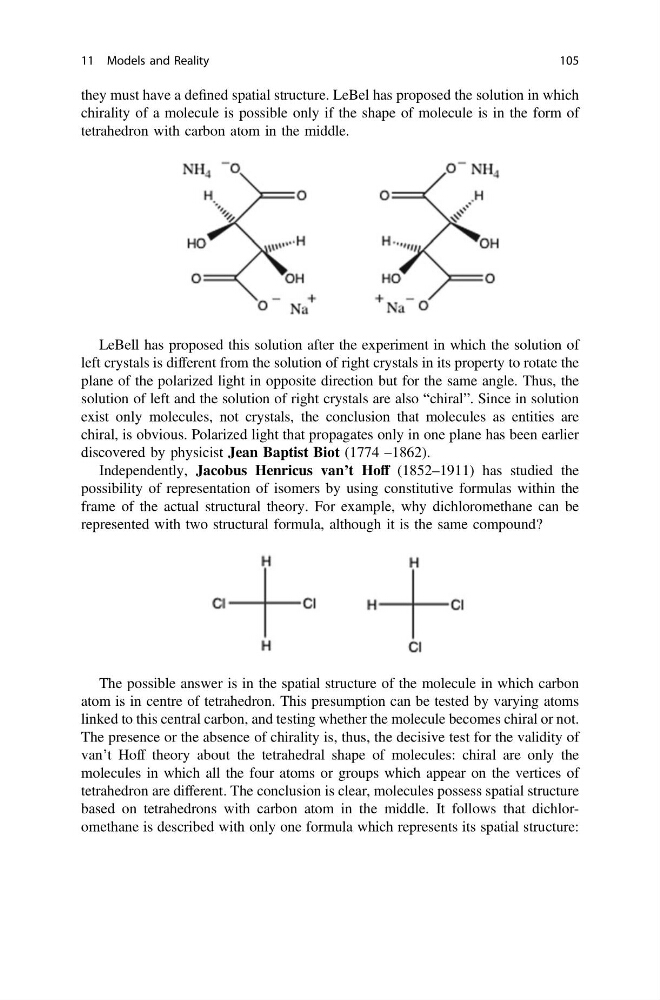
they must have a defined spatial structure. LeBel has proposed the solution in which
chirality of a molecule is possible only if the shape of molecule is in the form of
tetrahedron with carbon atom in the middle.
LeBell has proposed this solution after the experiment in which the solution of
left crystals is different from the solution of right crystals in its property to rotate the
plane of the polarized light in opposite direction but for the same angle. Thus, the
solution of left and the solution of right crystals are also “chiral”. Since in solution
exist only molecules, not crystals, the conclusion that molecules as entities are
chiral, is obvious. Polarized light that propagates only in one plane has been earlier
discovered by physicist Jean Baptist Biot (1774 –1862).
Independently, Jacobus Henricus van’t Hoff (1852–1911) has studied the
possibility of representation of isomers by using constitutive formulas within the
frame of the actual structural theory. For example, why dichloromethane can be
represented with two structural formula, although it is the same compound?
The possible answer is in the spatial structure of the molecule in which carbon
atom is in centre of tetrahedron. This presumption can be tested by varying atoms
linked to this central carbon, and testing whether the molecule becomes chiral or not.
The presence or the absence of chirality is, thus, the decisive test for the validity of
van’t Hoff theory about the tetrahedral shape of molecules: chiral are only the
molecules in which all the four atoms or groups which appear on the vertices of
tetrahedron are different. The conclusion is clear, molecules possess spatial structure
based on tetrahedrons with carbon atom in the middle. It follows that dichloromethane is described with only one formula which represents its spatial structure:
11 Models and Reality
105
chirality of a molecule is possible only if the shape of molecule is in the form of
tetrahedron with carbon atom in the middle.
LeBell has proposed this solution after the experiment in which the solution of
left crystals is different from the solution of right crystals in its property to rotate the
plane of the polarized light in opposite direction but for the same angle. Thus, the
solution of left and the solution of right crystals are also “chiral”. Since in solution
exist only molecules, not crystals, the conclusion that molecules as entities are
chiral, is obvious. Polarized light that propagates only in one plane has been earlier
discovered by physicist Jean Baptist Biot (1774 –1862).
Independently, Jacobus Henricus van’t Hoff (1852–1911) has studied the
possibility of representation of isomers by using constitutive formulas within the
frame of the actual structural theory. For example, why dichloromethane can be
represented with two structural formula, although it is the same compound?
The possible answer is in the spatial structure of the molecule in which carbon
atom is in centre of tetrahedron. This presumption can be tested by varying atoms
linked to this central carbon, and testing whether the molecule becomes chiral or not.
The presence or the absence of chirality is, thus, the decisive test for the validity of
van’t Hoff theory about the tetrahedral shape of molecules: chiral are only the
molecules in which all the four atoms or groups which appear on the vertices of
tetrahedron are different. The conclusion is clear, molecules possess spatial structure
based on tetrahedrons with carbon atom in the middle. It follows that dichloromethane is described with only one formula which represents its spatial structure:
11 Models and Reality
105