

5 The Incredible Quantum Mechanics
81
potential danger), but still the nature of electromagnetic waves, as predicted
by Maxwell’s equations, remains the same.
From the above discussion, it is clear that light is a form of wave propagation. No room is left for any doubt. As if these theoretical considerations are
not convincing enough, there exists a rich phenomenology to demonstrate
this particular characteristic: diffraction, interference, and polarization are all
examples of light’s wavy personality. These effects are discussed in more detail
later in this Chapter. They can produce flashy displays of natural splendour,
such as the rainbows that accompany a sun shower.
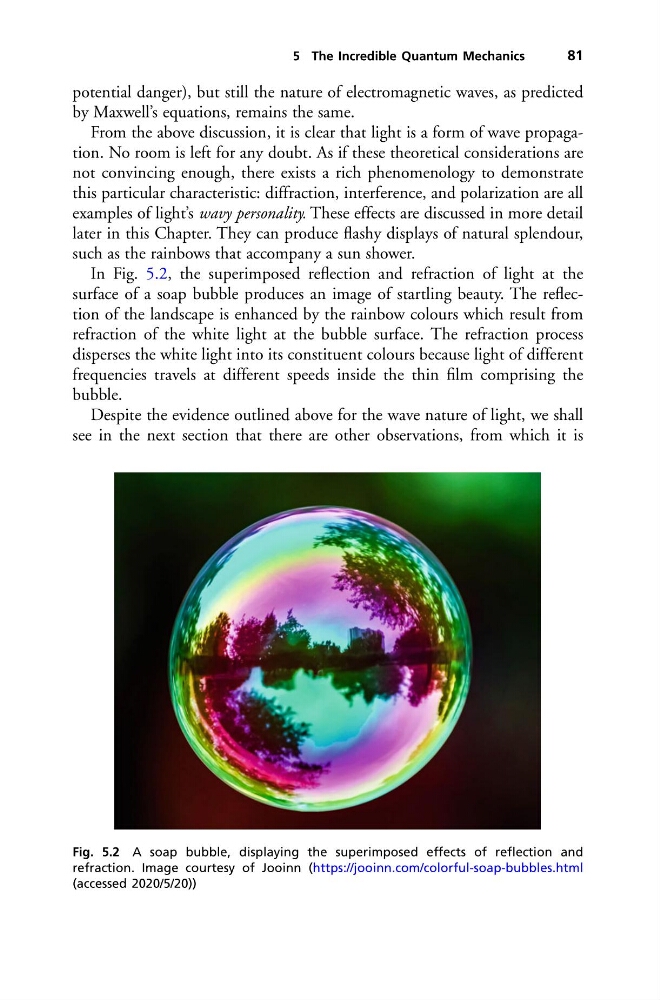
In Fig. 5.2, the superimposed reflection and refraction of light at the
surface of a soap bubble produces an image of startling beauty. The reflection of the landscape is enhanced by the rainbow colours which result from
refraction of the white light at the bubble surface. The refraction process
disperses the white light into its constituent colours because light of different
frequencies travels at different speeds inside the thin film comprising the
bubble.
Despite the evidence outlined above for the wave nature of light, we shall
see in the next section that there are other observations, from which it is
Fig. 5.2 A soap bubble, displaying the superimposed effects of reflection and
refraction. Image courtesy of Jooinn (https://jooinn.com/colorful-soap-bubbles.html
(accessed 2020/5/20))
81
potential danger), but still the nature of electromagnetic waves, as predicted
by Maxwell’s equations, remains the same.
From the above discussion, it is clear that light is a form of wave propagation. No room is left for any doubt. As if these theoretical considerations are
not convincing enough, there exists a rich phenomenology to demonstrate
this particular characteristic: diffraction, interference, and polarization are all
examples of light’s wavy personality. These effects are discussed in more detail
later in this Chapter. They can produce flashy displays of natural splendour,
such as the rainbows that accompany a sun shower.
In Fig. 5.2, the superimposed reflection and refraction of light at the
surface of a soap bubble produces an image of startling beauty. The reflection of the landscape is enhanced by the rainbow colours which result from
refraction of the white light at the bubble surface. The refraction process
disperses the white light into its constituent colours because light of different
frequencies travels at different speeds inside the thin film comprising the
bubble.
Despite the evidence outlined above for the wave nature of light, we shall
see in the next section that there are other observations, from which it is
Fig. 5.2 A soap bubble, displaying the superimposed effects of reflection and
refraction. Image courtesy of Jooinn (https://jooinn.com/colorful-soap-bubbles.html
(accessed 2020/5/20))