

80
R. Barrett and P. P. Delsanto
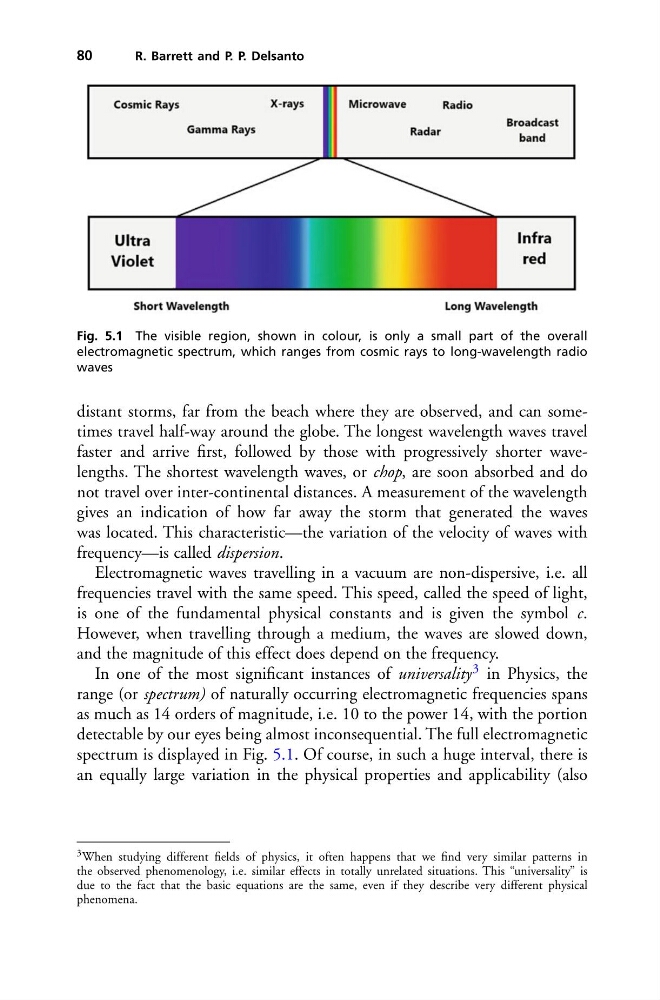
Fig. 5.1 The visible region, shown in colour, is only a small part of the overall
electromagnetic spectrum, which ranges from cosmic rays to long-wavelength radio
waves
distant storms, far from the beach where they are observed, and can sometimes travel half-way around the globe. The longest wavelength waves travel
faster and arrive first, followed by those with progressively shorter wavelengths. The shortest wavelength waves, or chop, are soon absorbed and do
not travel over inter-continental distances. A measurement of the wavelength
gives an indication of how far away the storm that generated the waves
was located. This characteristic—the variation of the velocity of waves with
frequency—is called dispersion.
Electromagnetic waves travelling in a vacuum are non-dispersive, i.e. all
frequencies travel with the same speed. This speed, called the speed of light,
is one of the fundamental physical constants and is given the symbol c.
However, when travelling through a medium, the waves are slowed down,
and the magnitude of this effect does depend on the frequency.
In one of the most significant instances of universality 3 in Physics, the
range (or spectrum) of naturally occurring electromagnetic frequencies spans
as much as 14 orders of magnitude, i.e. 10 to the power 14, with the portion
detectable by our eyes being almost inconsequential. The full electromagnetic
spectrum is displayed in Fig. 5.1. Of course, in such a huge interval, there is
an equally large variation in the physical properties and applicability (also
3 When studying different fields of physics, it often happens that we find very similar patterns in
the observed phenomenology, i.e. similar effects in totally unrelated situations. This “universality” is
due to the fact that the basic equations are the same, even if they describe very different physical
phenomena.
R. Barrett and P. P. Delsanto
Fig. 5.1 The visible region, shown in colour, is only a small part of the overall
electromagnetic spectrum, which ranges from cosmic rays to long-wavelength radio
waves
distant storms, far from the beach where they are observed, and can sometimes travel half-way around the globe. The longest wavelength waves travel
faster and arrive first, followed by those with progressively shorter wavelengths. The shortest wavelength waves, or chop, are soon absorbed and do
not travel over inter-continental distances. A measurement of the wavelength
gives an indication of how far away the storm that generated the waves
was located. This characteristic—the variation of the velocity of waves with
frequency—is called dispersion.
Electromagnetic waves travelling in a vacuum are non-dispersive, i.e. all
frequencies travel with the same speed. This speed, called the speed of light,
is one of the fundamental physical constants and is given the symbol c.
However, when travelling through a medium, the waves are slowed down,
and the magnitude of this effect does depend on the frequency.
In one of the most significant instances of universality 3 in Physics, the
range (or spectrum) of naturally occurring electromagnetic frequencies spans
as much as 14 orders of magnitude, i.e. 10 to the power 14, with the portion
detectable by our eyes being almost inconsequential. The full electromagnetic
spectrum is displayed in Fig. 5.1. Of course, in such a huge interval, there is
an equally large variation in the physical properties and applicability (also
3 When studying different fields of physics, it often happens that we find very similar patterns in
the observed phenomenology, i.e. similar effects in totally unrelated situations. This “universality” is
due to the fact that the basic equations are the same, even if they describe very different physical
phenomena.