

70
R. Barrett and P. P. Delsanto
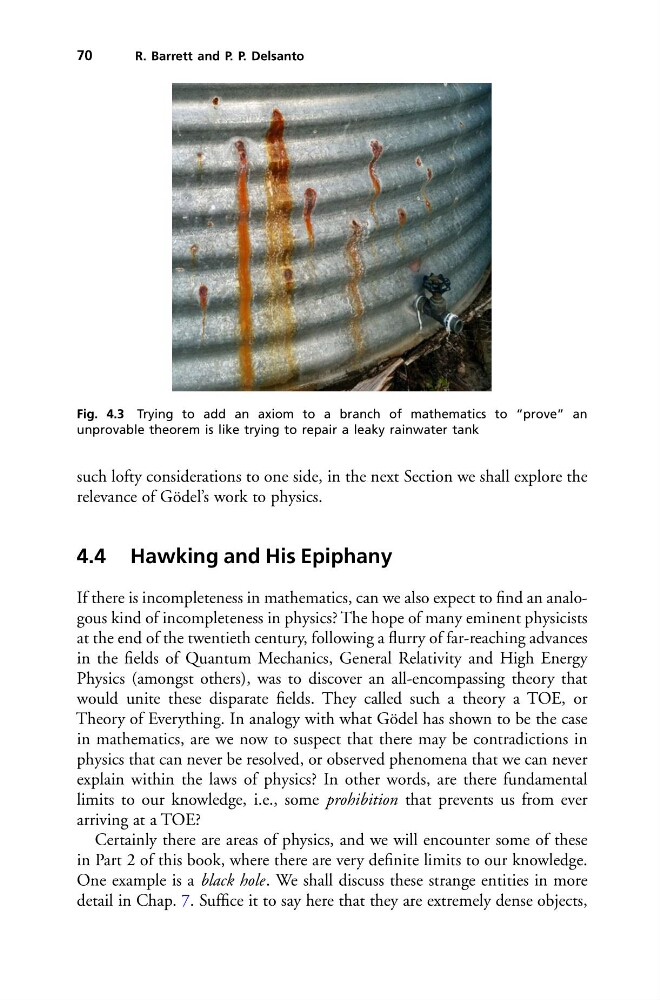
Fig. 4.3 Trying to add an axiom to a branch of mathematics to “prove” an
unprovable theorem is like trying to repair a leaky rainwater tank
such lofty considerations to one side, in the next Section we shall explore the
relevance of Gödel’s work to physics.
4.4 Hawking and His Epiphany
If there is incompleteness in mathematics, can we also expect to find an analogous kind of incompleteness in physics? The hope of many eminent physicists
at the end of the twentieth century, following a flurry of far-reaching advances
in the fields of Quantum Mechanics, General Relativity and High Energy
Physics (amongst others), was to discover an all-encompassing theory that
would unite these disparate fields. They called such a theory a TOE, or
Theory of Everything. In analogy with what Gödel has shown to be the case
in mathematics, are we now to suspect that there may be contradictions in
physics that can never be resolved, or observed phenomena that we can never
explain within the laws of physics? In other words, are there fundamental
limits to our knowledge, i.e., some prohibition that prevents us from ever
arriving at a TOE?
Certainly there are areas of physics, and we will encounter some of these
in Part 2 of this book, where there are very definite limits to our knowledge.
One example is a black hole. We shall discuss these strange entities in more
detail in Chap. 7. Suffice it to say here that they are extremely dense objects,
R. Barrett and P. P. Delsanto
Fig. 4.3 Trying to add an axiom to a branch of mathematics to “prove” an
unprovable theorem is like trying to repair a leaky rainwater tank
such lofty considerations to one side, in the next Section we shall explore the
relevance of Gödel’s work to physics.
4.4 Hawking and His Epiphany
If there is incompleteness in mathematics, can we also expect to find an analogous kind of incompleteness in physics? The hope of many eminent physicists
at the end of the twentieth century, following a flurry of far-reaching advances
in the fields of Quantum Mechanics, General Relativity and High Energy
Physics (amongst others), was to discover an all-encompassing theory that
would unite these disparate fields. They called such a theory a TOE, or
Theory of Everything. In analogy with what Gödel has shown to be the case
in mathematics, are we now to suspect that there may be contradictions in
physics that can never be resolved, or observed phenomena that we can never
explain within the laws of physics? In other words, are there fundamental
limits to our knowledge, i.e., some prohibition that prevents us from ever
arriving at a TOE?
Certainly there are areas of physics, and we will encounter some of these
in Part 2 of this book, where there are very definite limits to our knowledge.
One example is a black hole. We shall discuss these strange entities in more
detail in Chap. 7. Suffice it to say here that they are extremely dense objects,