

10 How the World Began
203
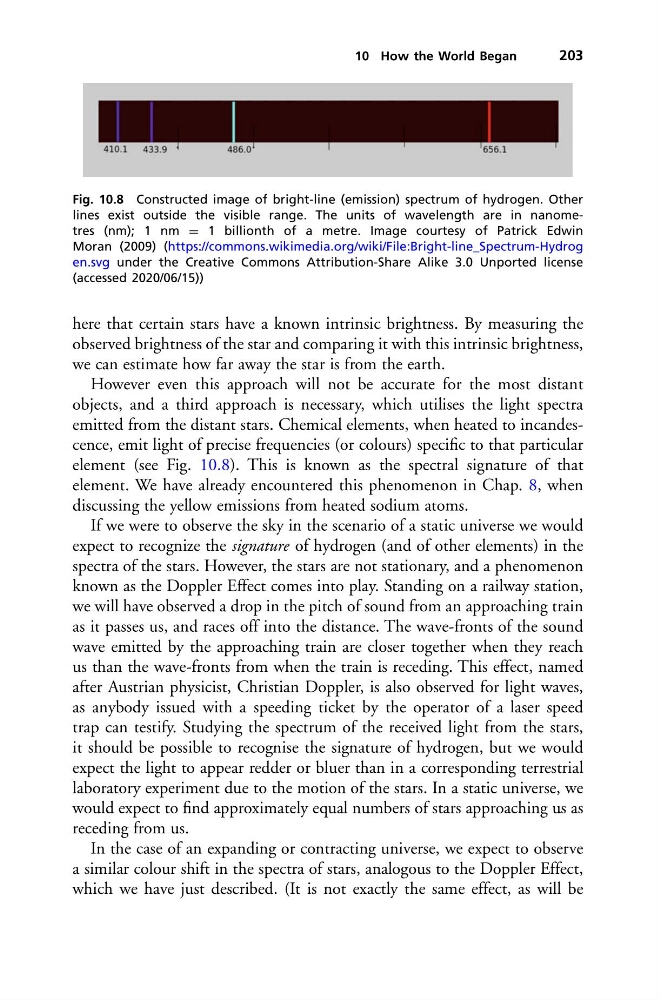
Fig. 10.8 Constructed image of bright-line (emission) spectrum of hydrogen. Other
lines exist outside the visible range. The units of wavelength are in nanometres (nm); 1 nm = 1 billionth of a metre. Image courtesy of Patrick Edwin
Moran (2009) (https://commons.wikimedia.org/wiki/File:Bright-line_Spectrum-Hydrog
en.svg under the Creative Commons Attribution-Share Alike 3.0 Unported license
(accessed 2020/06/15))
here that certain stars have a known intrinsic brightness. By measuring the
observed brightness of the star and comparing it with this intrinsic brightness,
we can estimate how far away the star is from the earth.
However even this approach will not be accurate for the most distant
objects, and a third approach is necessary, which utilises the light spectra
emitted from the distant stars. Chemical elements, when heated to incandescence, emit light of precise frequencies (or colours) specific to that particular
element (see Fig. 10.8). This is known as the spectral signature of that
element. We have already encountered this phenomenon in Chap. 8, when
discussing the yellow emissions from heated sodium atoms.
If we were to observe the sky in the scenario of a static universe we would
expect to recognize the signature of hydrogen (and of other elements) in the
spectra of the stars. However, the stars are not stationary, and a phenomenon
known as the Doppler Effect comes into play. Standing on a railway station,
we will have observed a drop in the pitch of sound from an approaching train
as it passes us, and races off into the distance. The wave-fronts of the sound
wave emitted by the approaching train are closer together when they reach
us than the wave-fronts from when the train is receding. This effect, named
after Austrian physicist, Christian Doppler, is also observed for light waves,
as anybody issued with a speeding ticket by the operator of a laser speed
trap can testify. Studying the spectrum of the received light from the stars,
it should be possible to recognise the signature of hydrogen, but we would
expect the light to appear redder or bluer than in a corresponding terrestrial
laboratory experiment due to the motion of the stars. In a static universe, we
would expect to find approximately equal numbers of stars approaching us as
receding from us.
In the case of an expanding or contracting universe, we expect to observe
a similar colour shift in the spectra of stars, analogous to the Doppler Effect,
which we have just described. (It is not exactly the same effect, as will be
203
Fig. 10.8 Constructed image of bright-line (emission) spectrum of hydrogen. Other
lines exist outside the visible range. The units of wavelength are in nanometres (nm); 1 nm = 1 billionth of a metre. Image courtesy of Patrick Edwin
Moran (2009) (https://commons.wikimedia.org/wiki/File:Bright-line_Spectrum-Hydrog
en.svg under the Creative Commons Attribution-Share Alike 3.0 Unported license
(accessed 2020/06/15))
here that certain stars have a known intrinsic brightness. By measuring the
observed brightness of the star and comparing it with this intrinsic brightness,
we can estimate how far away the star is from the earth.
However even this approach will not be accurate for the most distant
objects, and a third approach is necessary, which utilises the light spectra
emitted from the distant stars. Chemical elements, when heated to incandescence, emit light of precise frequencies (or colours) specific to that particular
element (see Fig. 10.8). This is known as the spectral signature of that
element. We have already encountered this phenomenon in Chap. 8, when
discussing the yellow emissions from heated sodium atoms.
If we were to observe the sky in the scenario of a static universe we would
expect to recognize the signature of hydrogen (and of other elements) in the
spectra of the stars. However, the stars are not stationary, and a phenomenon
known as the Doppler Effect comes into play. Standing on a railway station,
we will have observed a drop in the pitch of sound from an approaching train
as it passes us, and races off into the distance. The wave-fronts of the sound
wave emitted by the approaching train are closer together when they reach
us than the wave-fronts from when the train is receding. This effect, named
after Austrian physicist, Christian Doppler, is also observed for light waves,
as anybody issued with a speeding ticket by the operator of a laser speed
trap can testify. Studying the spectrum of the received light from the stars,
it should be possible to recognise the signature of hydrogen, but we would
expect the light to appear redder or bluer than in a corresponding terrestrial
laboratory experiment due to the motion of the stars. In a static universe, we
would expect to find approximately equal numbers of stars approaching us as
receding from us.
In the case of an expanding or contracting universe, we expect to observe
a similar colour shift in the spectra of stars, analogous to the Doppler Effect,
which we have just described. (It is not exactly the same effect, as will be