

194
R. Barrett and P. P. Delsanto
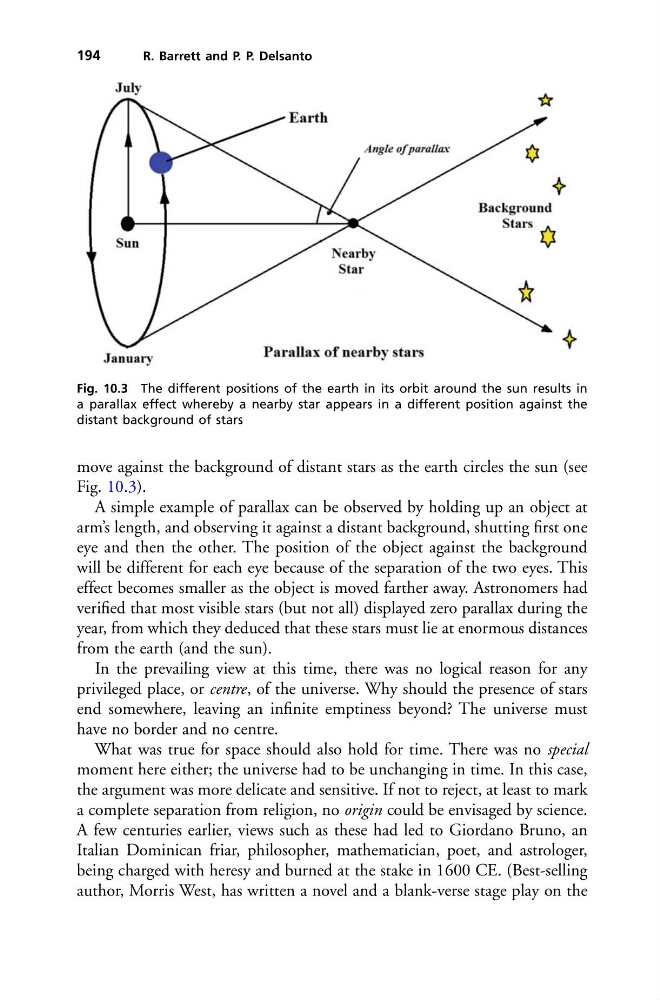
Fig. 10.3 The different positions of the earth in its orbit around the sun results in
a parallax effect whereby a nearby star appears in a different position against the
distant background of stars
move against the background of distant stars as the earth circles the sun (see
Fig. 10.3).
A simple example of parallax can be observed by holding up an object at
arm’s length, and observing it against a distant background, shutting first one
eye and then the other. The position of the object against the background
will be different for each eye because of the separation of the two eyes. This
effect becomes smaller as the object is moved farther away. Astronomers had
verified that most visible stars (but not all) displayed zero parallax during the
year, from which they deduced that these stars must lie at enormous distances
from the earth (and the sun).
In the prevailing view at this time, there was no logical reason for any
privileged place, or centre, of the universe. Why should the presence of stars
end somewhere, leaving an infinite emptiness beyond? The universe must
have no border and no centre.
What was true for space should also hold for time. There was no special
moment here either; the universe had to be unchanging in time. In this case,
the argument was more delicate and sensitive. If not to reject, at least to mark
a complete separation from religion, no origin could be envisaged by science.
A few centuries earlier, views such as these had led to Giordano Bruno, an
Italian Dominican friar, philosopher, mathematician, poet, and astrologer,
being charged with heresy and burned at the stake in 1600 CE. (Best-selling
author, Morris West, has written a novel and a blank-verse stage play on the
R. Barrett and P. P. Delsanto
Fig. 10.3 The different positions of the earth in its orbit around the sun results in
a parallax effect whereby a nearby star appears in a different position against the
distant background of stars
move against the background of distant stars as the earth circles the sun (see
Fig. 10.3).
A simple example of parallax can be observed by holding up an object at
arm’s length, and observing it against a distant background, shutting first one
eye and then the other. The position of the object against the background
will be different for each eye because of the separation of the two eyes. This
effect becomes smaller as the object is moved farther away. Astronomers had
verified that most visible stars (but not all) displayed zero parallax during the
year, from which they deduced that these stars must lie at enormous distances
from the earth (and the sun).
In the prevailing view at this time, there was no logical reason for any
privileged place, or centre, of the universe. Why should the presence of stars
end somewhere, leaving an infinite emptiness beyond? The universe must
have no border and no centre.
What was true for space should also hold for time. There was no special
moment here either; the universe had to be unchanging in time. In this case,
the argument was more delicate and sensitive. If not to reject, at least to mark
a complete separation from religion, no origin could be envisaged by science.
A few centuries earlier, views such as these had led to Giordano Bruno, an
Italian Dominican friar, philosopher, mathematician, poet, and astrologer,
being charged with heresy and burned at the stake in 1600 CE. (Best-selling
author, Morris West, has written a novel and a blank-verse stage play on the