

8 The Most Accurate Theory in Physics
159
are known as virtual particles. They differ from real particles in that, as a
consequence of the Heisenberg Uncertainty Principle that we encountered in
Chap. 5, they do not necessarily obey conservation laws. If a particle is shortlived, the time when it is in existence can be specified quite precisely. The
Uncertainty Principle tells us that in this case the particle’s energy cannot
be measured accurately (which is contrary to the Law of Conservation of
Energy), and QM tells us that all significant graphs must be considered when
taking the sum over all probabilities, not just those where energy is conserved.
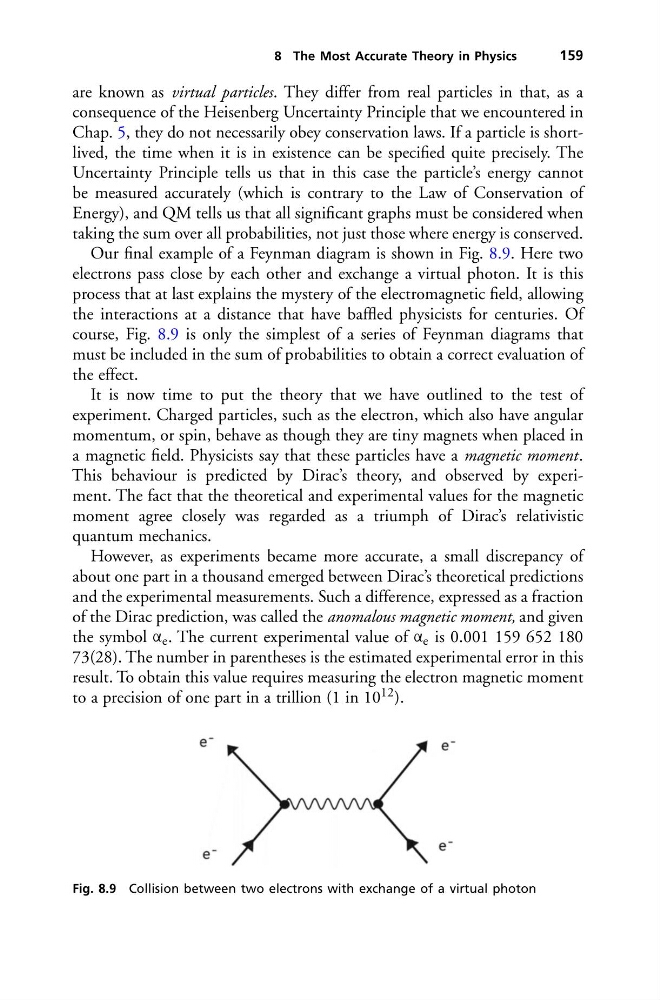
Our final example of a Feynman diagram is shown in Fig. 8.9. Here two
electrons pass close by each other and exchange a virtual photon. It is this
process that at last explains the mystery of the electromagnetic field, allowing
the interactions at a distance that have baffled physicists for centuries. Of
course, Fig. 8.9 is only the simplest of a series of Feynman diagrams that
must be included in the sum of probabilities to obtain a correct evaluation of
the effect.
It is now time to put the theory that we have outlined to the test of
experiment. Charged particles, such as the electron, which also have angular
momentum, or spin, behave as though they are tiny magnets when placed in
a magnetic field. Physicists say that these particles have a magnetic moment.
This behaviour is predicted by Dirac’s theory, and observed by experiment. The fact that the theoretical and experimental values for the magnetic
moment agree closely was regarded as a triumph of Dirac’s relativistic
quantum mechanics.
However, as experiments became more accurate, a small discrepancy of
about one part in a thousand emerged between Dirac’s theoretical predictions
and the experimental measurements. Such a difference, expressed as a fraction
of the Dirac prediction, was called the anomalous magnetic moment, and given
the symbol α e . The current experimental value of α e is 0.001 159 652 180
73(28). The number in parentheses is the estimated experimental error in this
result. To obtain this value requires measuring the electron magnetic moment
to a precision of one part in a trillion (1 in 10 12 ).
Fig. 8.9 Collision between two electrons with exchange of a virtual photon
159
are known as virtual particles. They differ from real particles in that, as a
consequence of the Heisenberg Uncertainty Principle that we encountered in
Chap. 5, they do not necessarily obey conservation laws. If a particle is shortlived, the time when it is in existence can be specified quite precisely. The
Uncertainty Principle tells us that in this case the particle’s energy cannot
be measured accurately (which is contrary to the Law of Conservation of
Energy), and QM tells us that all significant graphs must be considered when
taking the sum over all probabilities, not just those where energy is conserved.
Our final example of a Feynman diagram is shown in Fig. 8.9. Here two
electrons pass close by each other and exchange a virtual photon. It is this
process that at last explains the mystery of the electromagnetic field, allowing
the interactions at a distance that have baffled physicists for centuries. Of
course, Fig. 8.9 is only the simplest of a series of Feynman diagrams that
must be included in the sum of probabilities to obtain a correct evaluation of
the effect.
It is now time to put the theory that we have outlined to the test of
experiment. Charged particles, such as the electron, which also have angular
momentum, or spin, behave as though they are tiny magnets when placed in
a magnetic field. Physicists say that these particles have a magnetic moment.
This behaviour is predicted by Dirac’s theory, and observed by experiment. The fact that the theoretical and experimental values for the magnetic
moment agree closely was regarded as a triumph of Dirac’s relativistic
quantum mechanics.
However, as experiments became more accurate, a small discrepancy of
about one part in a thousand emerged between Dirac’s theoretical predictions
and the experimental measurements. Such a difference, expressed as a fraction
of the Dirac prediction, was called the anomalous magnetic moment, and given
the symbol α e . The current experimental value of α e is 0.001 159 652 180
73(28). The number in parentheses is the estimated experimental error in this
result. To obtain this value requires measuring the electron magnetic moment
to a precision of one part in a trillion (1 in 10 12 ).
Fig. 8.9 Collision between two electrons with exchange of a virtual photon