

158
R. Barrett and P. P. Delsanto
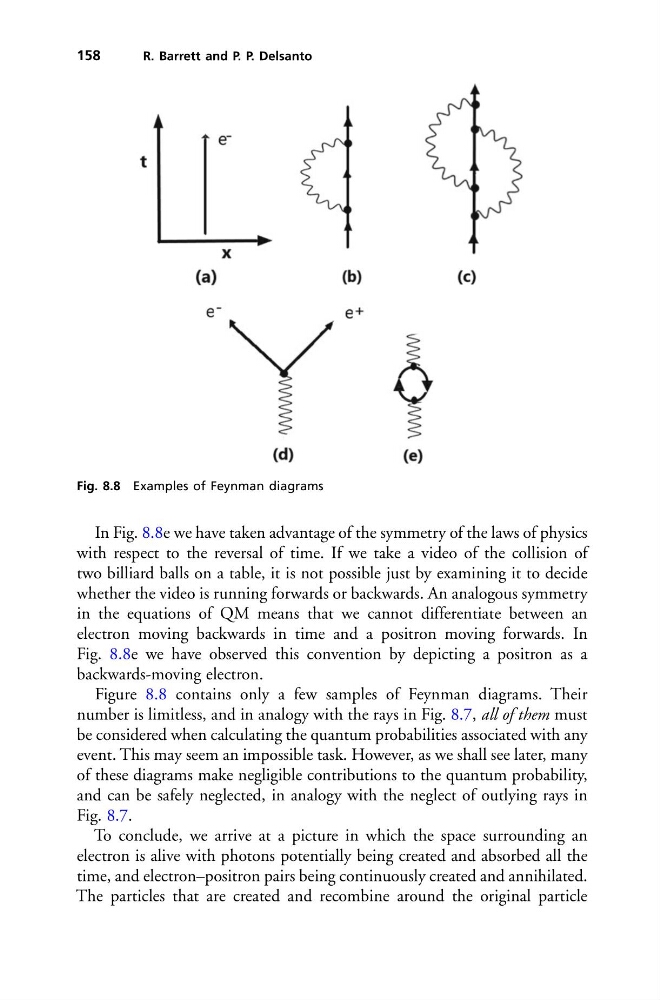
Fig. 8.8 Examples of Feynman diagrams
In Fig. 8.8e we have taken advantage of the symmetry of the laws of physics
with respect to the reversal of time. If we take a video of the collision of
two billiard balls on a table, it is not possible just by examining it to decide
whether the video is running forwards or backwards. An analogous symmetry
in the equations of QM means that we cannot differentiate between an
electron moving backwards in time and a positron moving forwards. In
Fig. 8.8e we have observed this convention by depicting a positron as a
backwards-moving electron.
Figure 8.8 contains only a few samples of Feynman diagrams. Their
number is limitless, and in analogy with the rays in Fig. 8.7, all of them must
be considered when calculating the quantum probabilities associated with any
event. This may seem an impossible task. However, as we shall see later, many
of these diagrams make negligible contributions to the quantum probability,
and can be safely neglected, in analogy with the neglect of outlying rays in
Fig. 8.7.
To conclude, we arrive at a picture in which the space surrounding an
electron is alive with photons potentially being created and absorbed all the
time, and electron–positron pairs being continuously created and annihilated.
The particles that are created and recombine around the original particle
R. Barrett and P. P. Delsanto
Fig. 8.8 Examples of Feynman diagrams
In Fig. 8.8e we have taken advantage of the symmetry of the laws of physics
with respect to the reversal of time. If we take a video of the collision of
two billiard balls on a table, it is not possible just by examining it to decide
whether the video is running forwards or backwards. An analogous symmetry
in the equations of QM means that we cannot differentiate between an
electron moving backwards in time and a positron moving forwards. In
Fig. 8.8e we have observed this convention by depicting a positron as a
backwards-moving electron.
Figure 8.8 contains only a few samples of Feynman diagrams. Their
number is limitless, and in analogy with the rays in Fig. 8.7, all of them must
be considered when calculating the quantum probabilities associated with any
event. This may seem an impossible task. However, as we shall see later, many
of these diagrams make negligible contributions to the quantum probability,
and can be safely neglected, in analogy with the neglect of outlying rays in
Fig. 8.7.
To conclude, we arrive at a picture in which the space surrounding an
electron is alive with photons potentially being created and absorbed all the
time, and electron–positron pairs being continuously created and annihilated.
The particles that are created and recombine around the original particle