

154
R. Barrett and P. P. Delsanto
theory allows negative energy solutions. But what does this mean: an electron
with negative energy? It must have been tempting at first to simply dismiss
these solutions as non-physical, and sweep them under the carpet. Dirac,
however, was of a different mind. He decided to assume that negative-energy
solutions were real and explore the implications of this assumption.
Firstly, he investigated what would be the effect of the energy carried by a
photon impinging on the electronic system described by his equation. Nonrelativistic QM allows an electron to be knocked from a lower to a higher
level, or even out of the atom altogether. The latter process, where atomic
electrons are completely stripped from atoms, is known as ionization. These
two phenomena are also possible in Dirac’s theory; it would not be a tenable
physical theory if this were not the case.
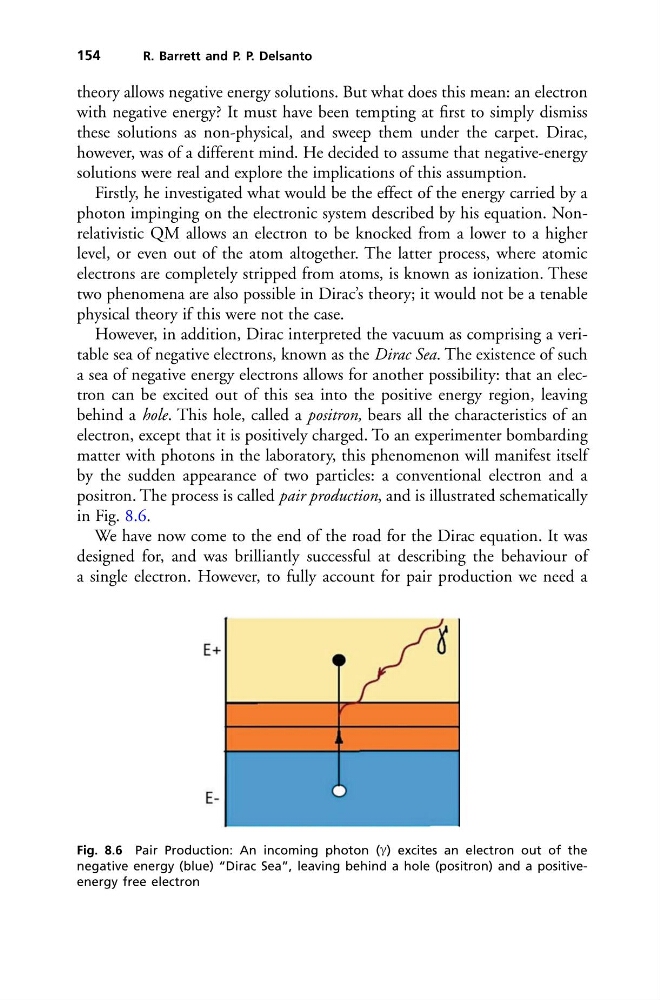
However, in addition, Dirac interpreted the vacuum as comprising a veritable sea of negative electrons, known as the Dirac Sea. The existence of such
a sea of negative energy electrons allows for another possibility: that an electron can be excited out of this sea into the positive energy region, leaving
behind a hole. This hole, called a positron, bears all the characteristics of an
electron, except that it is positively charged. To an experimenter bombarding
matter with photons in the laboratory, this phenomenon will manifest itself
by the sudden appearance of two particles: a conventional electron and a
positron. The process is called pair production, and is illustrated schematically
in Fig. 8.6.
We have now come to the end of the road for the Dirac equation. It was
designed for, and was brilliantly successful at describing the behaviour of
a single electron. However, to fully account for pair production we need a
Fig. 8.6 Pair Production: An incoming photon ( γ ) excites an electron out of the
negative energy (blue) “Dirac Sea”, leaving behind a hole (positron) and a positiveenergy free electron
R. Barrett and P. P. Delsanto
theory allows negative energy solutions. But what does this mean: an electron
with negative energy? It must have been tempting at first to simply dismiss
these solutions as non-physical, and sweep them under the carpet. Dirac,
however, was of a different mind. He decided to assume that negative-energy
solutions were real and explore the implications of this assumption.
Firstly, he investigated what would be the effect of the energy carried by a
photon impinging on the electronic system described by his equation. Nonrelativistic QM allows an electron to be knocked from a lower to a higher
level, or even out of the atom altogether. The latter process, where atomic
electrons are completely stripped from atoms, is known as ionization. These
two phenomena are also possible in Dirac’s theory; it would not be a tenable
physical theory if this were not the case.
However, in addition, Dirac interpreted the vacuum as comprising a veritable sea of negative electrons, known as the Dirac Sea. The existence of such
a sea of negative energy electrons allows for another possibility: that an electron can be excited out of this sea into the positive energy region, leaving
behind a hole. This hole, called a positron, bears all the characteristics of an
electron, except that it is positively charged. To an experimenter bombarding
matter with photons in the laboratory, this phenomenon will manifest itself
by the sudden appearance of two particles: a conventional electron and a
positron. The process is called pair production, and is illustrated schematically
in Fig. 8.6.
We have now come to the end of the road for the Dirac equation. It was
designed for, and was brilliantly successful at describing the behaviour of
a single electron. However, to fully account for pair production we need a
Fig. 8.6 Pair Production: An incoming photon ( γ ) excites an electron out of the
negative energy (blue) “Dirac Sea”, leaving behind a hole (positron) and a positiveenergy free electron