

7 General Relativity
135
in light emitted from the white dwarf star, 40 Eridani B. His result was
within experimental error of the value predicted by General Relativity. Since
this first ground breaking observation, numerous more recent experiments
have confirmed the existence of gravitational redshift (aka gravitational time
dilation) (See Appendix 7.2).
Gravitational Lensing
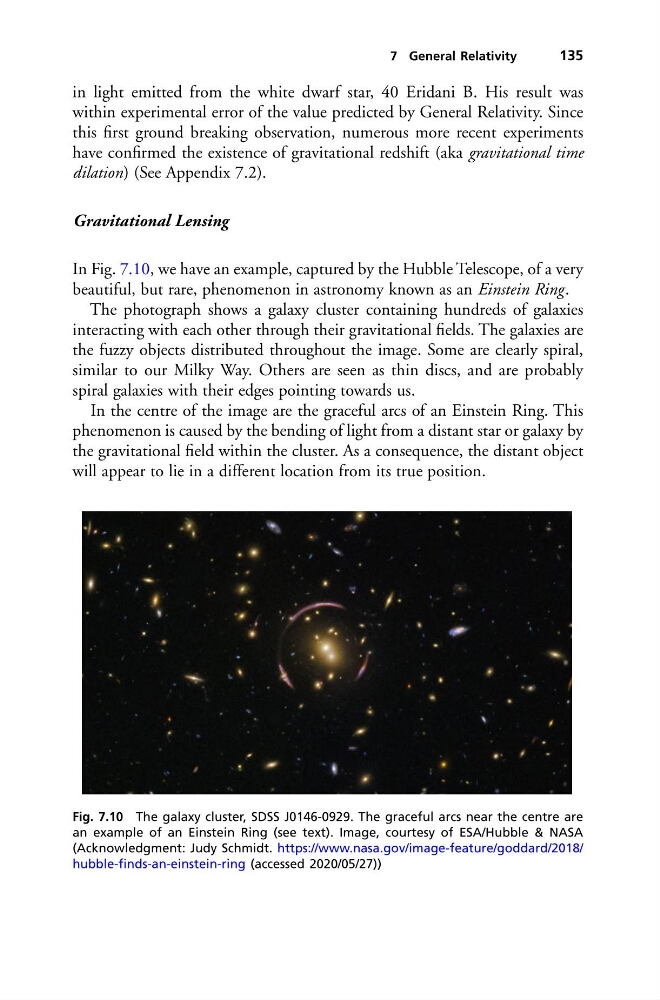
In Fig. 7.10, we have an example, captured by the Hubble Telescope, of a very
beautiful, but rare, phenomenon in astronomy known as an Einstein Ring.
The photograph shows a galaxy cluster containing hundreds of galaxies
interacting with each other through their gravitational fields. The galaxies are
the fuzzy objects distributed throughout the image. Some are clearly spiral,
similar to our Milky Way. Others are seen as thin discs, and are probably
spiral galaxies with their edges pointing towards us.
In the centre of the image are the graceful arcs of an Einstein Ring. This
phenomenon is caused by the bending of light from a distant star or galaxy by
the gravitational field within the cluster. As a consequence, the distant object
will appear to lie in a different location from its true position.
Fig. 7.10 The galaxy cluster, SDSS J0146-0929. The graceful arcs near the centre are
an example of an Einstein Ring (see text). Image, courtesy of ESA/Hubble & NASA
(Acknowledgment: Judy Schmidt. https://www.nasa.gov/image-feature/goddard/2018/
hubble-finds-an-einstein-ring (accessed 2020/05/27))
135
in light emitted from the white dwarf star, 40 Eridani B. His result was
within experimental error of the value predicted by General Relativity. Since
this first ground breaking observation, numerous more recent experiments
have confirmed the existence of gravitational redshift (aka gravitational time
dilation) (See Appendix 7.2).
Gravitational Lensing
In Fig. 7.10, we have an example, captured by the Hubble Telescope, of a very
beautiful, but rare, phenomenon in astronomy known as an Einstein Ring.
The photograph shows a galaxy cluster containing hundreds of galaxies
interacting with each other through their gravitational fields. The galaxies are
the fuzzy objects distributed throughout the image. Some are clearly spiral,
similar to our Milky Way. Others are seen as thin discs, and are probably
spiral galaxies with their edges pointing towards us.
In the centre of the image are the graceful arcs of an Einstein Ring. This
phenomenon is caused by the bending of light from a distant star or galaxy by
the gravitational field within the cluster. As a consequence, the distant object
will appear to lie in a different location from its true position.
Fig. 7.10 The galaxy cluster, SDSS J0146-0929. The graceful arcs near the centre are
an example of an Einstein Ring (see text). Image, courtesy of ESA/Hubble & NASA
(Acknowledgment: Judy Schmidt. https://www.nasa.gov/image-feature/goddard/2018/
hubble-finds-an-einstein-ring (accessed 2020/05/27))