

134
R. Barrett and P. P. Delsanto
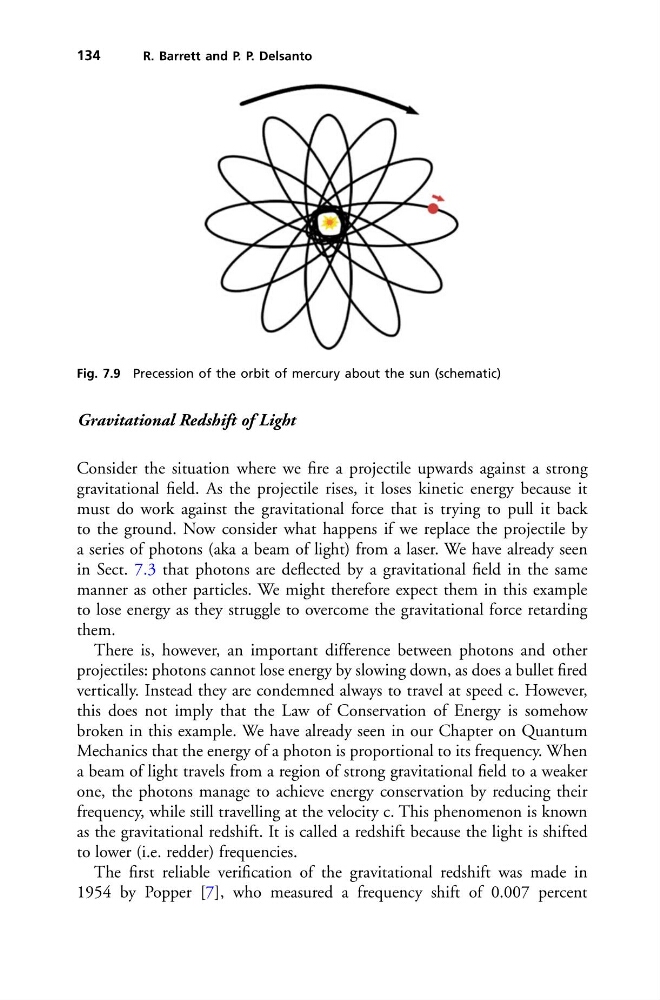
Fig. 7.9 Precession of the orbit of mercury about the sun (schematic)
Gravitational Redshift of Light
Consider the situation where we fire a projectile upwards against a strong
gravitational field. As the projectile rises, it loses kinetic energy because it
must do work against the gravitational force that is trying to pull it back
to the ground. Now consider what happens if we replace the projectile by
a series of photons (aka a beam of light) from a laser. We have already seen
in Sect. 7.3 that photons are deflected by a gravitational field in the same
manner as other particles. We might therefore expect them in this example
to lose energy as they struggle to overcome the gravitational force retarding
them.
There is, however, an important difference between photons and other
projectiles: photons cannot lose energy by slowing down, as does a bullet fired
vertically. Instead they are condemned always to travel at speed c. However,
this does not imply that the Law of Conservation of Energy is somehow
broken in this example. We have already seen in our Chapter on Quantum
Mechanics that the energy of a photon is proportional to its frequency. When
a beam of light travels from a region of strong gravitational field to a weaker
one, the photons manage to achieve energy conservation by reducing their
frequency, while still travelling at the velocity c. This phenomenon is known
as the gravitational redshift. It is called a redshift because the light is shifted
to lower (i.e. redder) frequencies.
The first reliable verification of the gravitational redshift was made in
1954 by Popper [7], who measured a frequency shift of 0.007 percent
R. Barrett and P. P. Delsanto
Fig. 7.9 Precession of the orbit of mercury about the sun (schematic)
Gravitational Redshift of Light
Consider the situation where we fire a projectile upwards against a strong
gravitational field. As the projectile rises, it loses kinetic energy because it
must do work against the gravitational force that is trying to pull it back
to the ground. Now consider what happens if we replace the projectile by
a series of photons (aka a beam of light) from a laser. We have already seen
in Sect. 7.3 that photons are deflected by a gravitational field in the same
manner as other particles. We might therefore expect them in this example
to lose energy as they struggle to overcome the gravitational force retarding
them.
There is, however, an important difference between photons and other
projectiles: photons cannot lose energy by slowing down, as does a bullet fired
vertically. Instead they are condemned always to travel at speed c. However,
this does not imply that the Law of Conservation of Energy is somehow
broken in this example. We have already seen in our Chapter on Quantum
Mechanics that the energy of a photon is proportional to its frequency. When
a beam of light travels from a region of strong gravitational field to a weaker
one, the photons manage to achieve energy conservation by reducing their
frequency, while still travelling at the velocity c. This phenomenon is known
as the gravitational redshift. It is called a redshift because the light is shifted
to lower (i.e. redder) frequencies.
The first reliable verification of the gravitational redshift was made in
1954 by Popper [7], who measured a frequency shift of 0.007 percent