

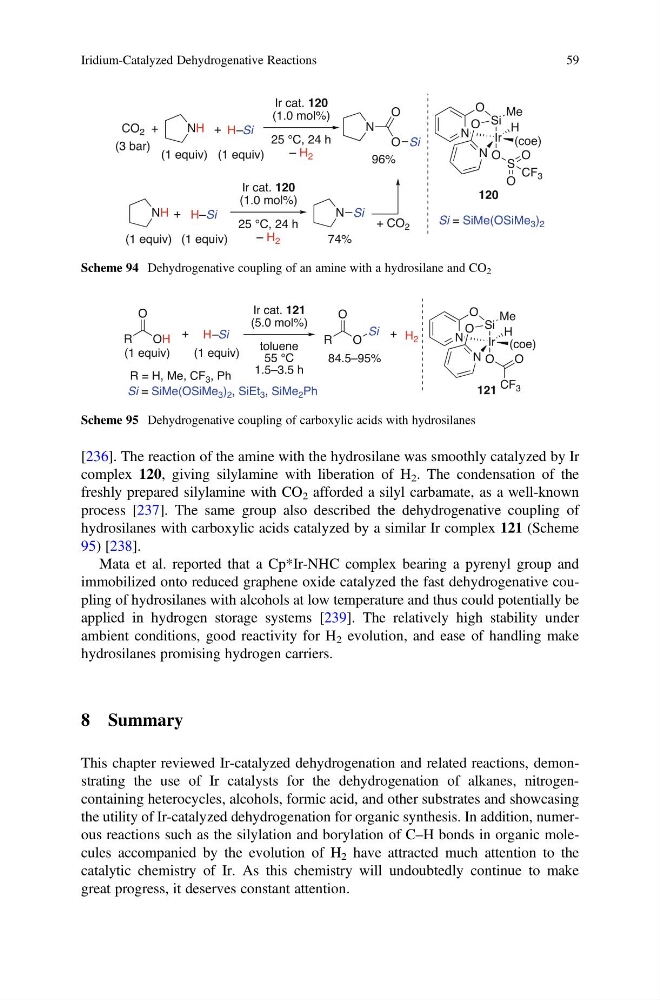
[236]. The reaction of the amine with the hydrosilane was smoothly catalyzed by Ir
complex 120, giving silylamine with liberation of H 2 . The condensation of the
freshly prepared silylamine with CO 2 afforded a silyl carbamate, as a well-known
process [237]. The same group also described the dehydrogenative coupling of
hydrosilanes with carboxylic acids catalyzed by a similar Ir complex 121 (Scheme
95) [238].
Mata et al. reported that a Cp*Ir-NHC complex bearing a pyrenyl group and
immobilized onto reduced graphene oxide catalyzed the fast dehydrogenative coupling of hydrosilanes with alcohols at low temperature and thus could potentially be
applied in hydrogen storage systems [239]. The relatively high stability under
ambient conditions, good reactivity for H 2 evolution, and ease of handling make
hydrosilanes promising hydrogen carriers.
8 Summary
This chapter reviewed Ir-catalyzed dehydrogenation and related reactions, demonstrating the use of Ir catalysts for the dehydrogenation of alkanes, nitrogencontaining heterocycles, alcohols, formic acid, and other substrates and showcasing
the utility of Ir-catalyzed dehydrogenation for organic synthesis. In addition, numerous reactions such as the silylation and borylation of C–H bonds in organic molecules accompanied by the evolution of H 2 have attracted much attention to the
catalytic chemistry of Ir. As this chemistry will undoubtedly continue to make
great progress, it deserves constant attention.
Scheme 94 Dehydrogenative coupling of an amine with a hydrosilane and CO 2
Scheme 95 Dehydrogenative coupling of carboxylic acids with hydrosilanes
Iridium-Catalyzed Dehydrogenative Reactions
59
complex 120, giving silylamine with liberation of H 2 . The condensation of the
freshly prepared silylamine with CO 2 afforded a silyl carbamate, as a well-known
process [237]. The same group also described the dehydrogenative coupling of
hydrosilanes with carboxylic acids catalyzed by a similar Ir complex 121 (Scheme
95) [238].
Mata et al. reported that a Cp*Ir-NHC complex bearing a pyrenyl group and
immobilized onto reduced graphene oxide catalyzed the fast dehydrogenative coupling of hydrosilanes with alcohols at low temperature and thus could potentially be
applied in hydrogen storage systems [239]. The relatively high stability under
ambient conditions, good reactivity for H 2 evolution, and ease of handling make
hydrosilanes promising hydrogen carriers.
8 Summary
This chapter reviewed Ir-catalyzed dehydrogenation and related reactions, demonstrating the use of Ir catalysts for the dehydrogenation of alkanes, nitrogencontaining heterocycles, alcohols, formic acid, and other substrates and showcasing
the utility of Ir-catalyzed dehydrogenation for organic synthesis. In addition, numerous reactions such as the silylation and borylation of C–H bonds in organic molecules accompanied by the evolution of H 2 have attracted much attention to the
catalytic chemistry of Ir. As this chemistry will undoubtedly continue to make
great progress, it deserves constant attention.
Scheme 94 Dehydrogenative coupling of an amine with a hydrosilane and CO 2
Scheme 95 Dehydrogenative coupling of carboxylic acids with hydrosilanes
Iridium-Catalyzed Dehydrogenative Reactions
59