

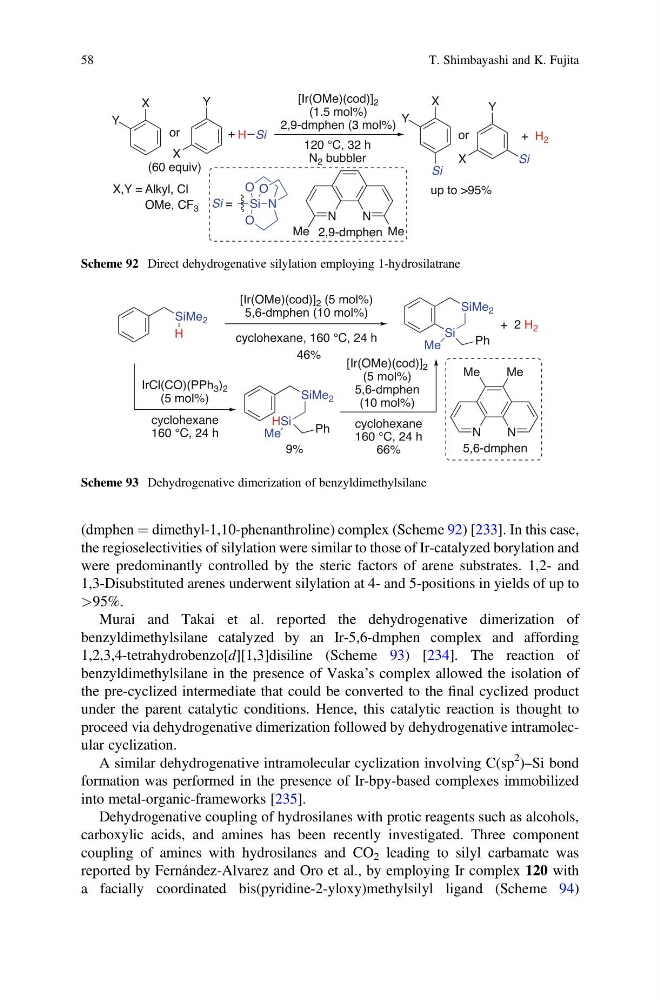
(dmphen ¼ dimethyl-1,10-phenanthroline) complex (Scheme 92) [233]. In this case,
the regioselectivities of silylation were similar to those of Ir-catalyzed borylation and
were predominantly controlled by the steric factors of arene substrates. 1,2- and
1,3-Disubstituted arenes underwent silylation at 4- and 5-positions in yields of up to
>95%.
Murai and Takai et al. reported the dehydrogenative dimerization of
benzyldimethylsilane catalyzed by an Ir-5,6-dmphen complex and affording
1,2,3,4-tetrahydrobenzo[d][1,3]disiline (Scheme 93) [234]. The reaction of
benzyldimethylsilane in the presence of Vaska’s complex allowed the isolation of
the pre-cyclized intermediate that could be converted to the final cyclized product
under the parent catalytic conditions. Hence, this catalytic reaction is thought to
proceed via dehydrogenative dimerization followed by dehydrogenative intramolecular cyclization.
A similar dehydrogenative intramolecular cyclization involving C(sp
2 )–Si bond
formation was performed in the presence of Ir-bpy-based complexes immobilized
into metal-organic-frameworks [235].
Dehydrogenative coupling of hydrosilanes with protic reagents such as alcohols,
carboxylic acids, and amines has been recently investigated. Three component
coupling of amines with hydrosilanes and CO 2 leading to silyl carbamate was
reported by Fernández-Alvarez and Oro et al., by employing Ir complex 120 with
a facially coordinated bis(pyridine-2-yloxy)methylsilyl ligand (Scheme 94)
Scheme 92 Direct dehydrogenative silylation employing 1-hydrosilatrane
Scheme 93 Dehydrogenative dimerization of benzyldimethylsilane
58
T. Shimbayashi and K. Fujita
the regioselectivities of silylation were similar to those of Ir-catalyzed borylation and
were predominantly controlled by the steric factors of arene substrates. 1,2- and
1,3-Disubstituted arenes underwent silylation at 4- and 5-positions in yields of up to
>95%.
Murai and Takai et al. reported the dehydrogenative dimerization of
benzyldimethylsilane catalyzed by an Ir-5,6-dmphen complex and affording
1,2,3,4-tetrahydrobenzo[d][1,3]disiline (Scheme 93) [234]. The reaction of
benzyldimethylsilane in the presence of Vaska’s complex allowed the isolation of
the pre-cyclized intermediate that could be converted to the final cyclized product
under the parent catalytic conditions. Hence, this catalytic reaction is thought to
proceed via dehydrogenative dimerization followed by dehydrogenative intramolecular cyclization.
A similar dehydrogenative intramolecular cyclization involving C(sp
2 )–Si bond
formation was performed in the presence of Ir-bpy-based complexes immobilized
into metal-organic-frameworks [235].
Dehydrogenative coupling of hydrosilanes with protic reagents such as alcohols,
carboxylic acids, and amines has been recently investigated. Three component
coupling of amines with hydrosilanes and CO 2 leading to silyl carbamate was
reported by Fernández-Alvarez and Oro et al., by employing Ir complex 120 with
a facially coordinated bis(pyridine-2-yloxy)methylsilyl ligand (Scheme 94)
Scheme 92 Direct dehydrogenative silylation employing 1-hydrosilatrane
Scheme 93 Dehydrogenative dimerization of benzyldimethylsilane
58
T. Shimbayashi and K. Fujita