

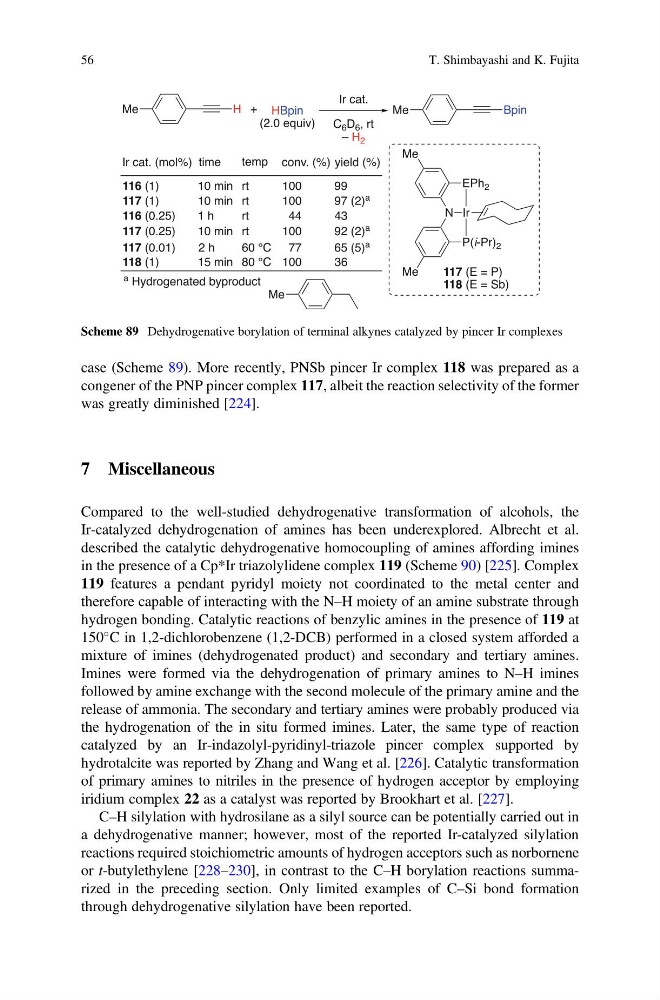
case (Scheme 89). More recently, PNSb pincer Ir complex 118 was prepared as a
congener of the PNP pincer complex 117, albeit the reaction selectivity of the former
was greatly diminished [224].
7 Miscellaneous
Compared to the well-studied dehydrogenative transformation of alcohols, the
Ir-catalyzed dehydrogenation of amines has been underexplored. Albrecht et al.
described the catalytic dehydrogenative homocoupling of amines affording imines
in the presence of a Cp*Ir triazolylidene complex 119 (Scheme 90) [225]. Complex
119 features a pendant pyridyl moiety not coordinated to the metal center and
therefore capable of interacting with the N–H moiety of an amine substrate through
hydrogen bonding. Catalytic reactions of benzylic amines in the presence of 119 at
150
C in 1,2-dichlorobenzene (1,2-DCB) performed in a closed system afforded a
mixture of imines (dehydrogenated product) and secondary and tertiary amines.
Imines were formed via the dehydrogenation of primary amines to N–H imines
followed by amine exchange with the second molecule of the primary amine and the
release of ammonia. The secondary and tertiary amines were probably produced via
the hydrogenation of the in situ formed imines. Later, the same type of reaction
catalyzed by an Ir-indazolyl-pyridinyl-triazole pincer complex supported by
hydrotalcite was reported by Zhang and Wang et al. [226]. Catalytic transformation
of primary amines to nitriles in the presence of hydrogen acceptor by employing
iridium complex 22 as a catalyst was reported by Brookhart et al. [227].
C–H silylation with hydrosilane as a silyl source can be potentially carried out in
a dehydrogenative manner; however, most of the reported Ir-catalyzed silylation
reactions required stoichiometric amounts of hydrogen acceptors such as norbornene
or t-butylethylene [228–230], in contrast to the C–H borylation reactions summarized in the preceding section. Only limited examples of C–Si bond formation
through dehydrogenative silylation have been reported.
Scheme 89 Dehydrogenative borylation of terminal alkynes catalyzed by pincer Ir complexes
56
T. Shimbayashi and K. Fujita
congener of the PNP pincer complex 117, albeit the reaction selectivity of the former
was greatly diminished [224].
7 Miscellaneous
Compared to the well-studied dehydrogenative transformation of alcohols, the
Ir-catalyzed dehydrogenation of amines has been underexplored. Albrecht et al.
described the catalytic dehydrogenative homocoupling of amines affording imines
in the presence of a Cp*Ir triazolylidene complex 119 (Scheme 90) [225]. Complex
119 features a pendant pyridyl moiety not coordinated to the metal center and
therefore capable of interacting with the N–H moiety of an amine substrate through
hydrogen bonding. Catalytic reactions of benzylic amines in the presence of 119 at
150
C in 1,2-dichlorobenzene (1,2-DCB) performed in a closed system afforded a
mixture of imines (dehydrogenated product) and secondary and tertiary amines.
Imines were formed via the dehydrogenation of primary amines to N–H imines
followed by amine exchange with the second molecule of the primary amine and the
release of ammonia. The secondary and tertiary amines were probably produced via
the hydrogenation of the in situ formed imines. Later, the same type of reaction
catalyzed by an Ir-indazolyl-pyridinyl-triazole pincer complex supported by
hydrotalcite was reported by Zhang and Wang et al. [226]. Catalytic transformation
of primary amines to nitriles in the presence of hydrogen acceptor by employing
iridium complex 22 as a catalyst was reported by Brookhart et al. [227].
C–H silylation with hydrosilane as a silyl source can be potentially carried out in
a dehydrogenative manner; however, most of the reported Ir-catalyzed silylation
reactions required stoichiometric amounts of hydrogen acceptors such as norbornene
or t-butylethylene [228–230], in contrast to the C–H borylation reactions summarized in the preceding section. Only limited examples of C–Si bond formation
through dehydrogenative silylation have been reported.
Scheme 89 Dehydrogenative borylation of terminal alkynes catalyzed by pincer Ir complexes
56
T. Shimbayashi and K. Fujita