

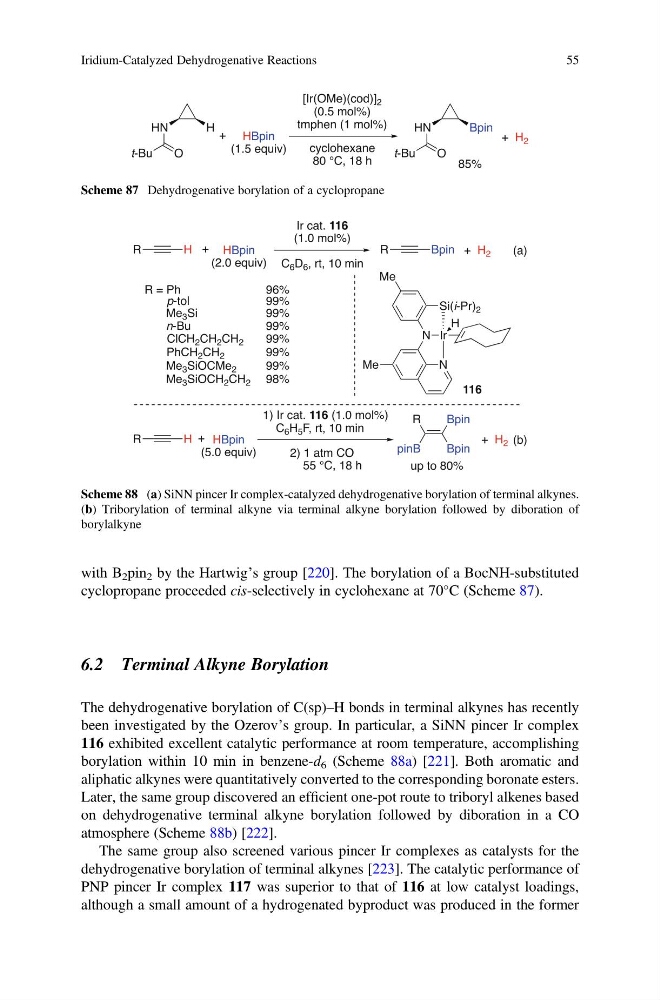
with B 2 pin 2 by the Hartwig’s group [220]. The borylation of a BocNH-substituted
cyclopropane proceeded cis-selectively in cyclohexane at 70
C (Scheme 87).
6.2 Terminal Alkyne Borylation
The dehydrogenative borylation of C(sp)–H bonds in terminal alkynes has recently
been investigated by the Ozerov’s group. In particular, a SiNN pincer Ir complex
116 exhibited excellent catalytic performance at room temperature, accomplishing
borylation within 10 min in benzene-d 6 (Scheme 88a) [221]. Both aromatic and
aliphatic alkynes were quantitatively converted to the corresponding boronate esters.
Later, the same group discovered an efficient one-pot route to triboryl alkenes based
on dehydrogenative terminal alkyne borylation followed by diboration in a CO
atmosphere (Scheme 88b) [222].
The same group also screened various pincer Ir complexes as catalysts for the
dehydrogenative borylation of terminal alkynes [223]. The catalytic performance of
PNP pincer Ir complex 117 was superior to that of 116 at low catalyst loadings,
although a small amount of a hydrogenated byproduct was produced in the former
Scheme 87 Dehydrogenative borylation of a cyclopropane
Scheme 88 (a) SiNN pincer Ir complex-catalyzed dehydrogenative borylation of terminal alkynes.
(b) Triborylation of terminal alkyne via terminal alkyne borylation followed by diboration of
borylalkyne
Iridium-Catalyzed Dehydrogenative Reactions
55
cyclopropane proceeded cis-selectively in cyclohexane at 70
C (Scheme 87).
6.2 Terminal Alkyne Borylation
The dehydrogenative borylation of C(sp)–H bonds in terminal alkynes has recently
been investigated by the Ozerov’s group. In particular, a SiNN pincer Ir complex
116 exhibited excellent catalytic performance at room temperature, accomplishing
borylation within 10 min in benzene-d 6 (Scheme 88a) [221]. Both aromatic and
aliphatic alkynes were quantitatively converted to the corresponding boronate esters.
Later, the same group discovered an efficient one-pot route to triboryl alkenes based
on dehydrogenative terminal alkyne borylation followed by diboration in a CO
atmosphere (Scheme 88b) [222].
The same group also screened various pincer Ir complexes as catalysts for the
dehydrogenative borylation of terminal alkynes [223]. The catalytic performance of
PNP pincer Ir complex 117 was superior to that of 116 at low catalyst loadings,
although a small amount of a hydrogenated byproduct was produced in the former
Scheme 87 Dehydrogenative borylation of a cyclopropane
Scheme 88 (a) SiNN pincer Ir complex-catalyzed dehydrogenative borylation of terminal alkynes.
(b) Triborylation of terminal alkyne via terminal alkyne borylation followed by diboration of
borylalkyne
Iridium-Catalyzed Dehydrogenative Reactions
55