

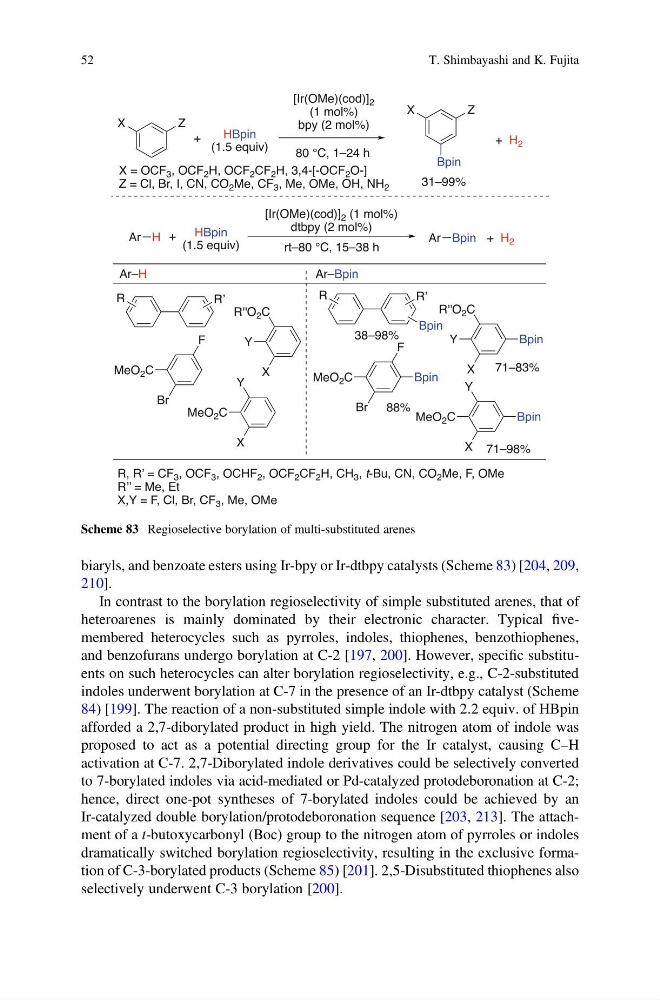
biaryls, and benzoate esters using Ir-bpy or Ir-dtbpy catalysts (Scheme 83) [204, 209,
210].
In contrast to the borylation regioselectivity of simple substituted arenes, that of
heteroarenes is mainly dominated by their electronic character. Typical fivemembered heterocycles such as pyrroles, indoles, thiophenes, benzothiophenes,
and benzofurans undergo borylation at C-2 [197, 200]. However, specific substituents on such heterocycles can alter borylation regioselectivity, e.g., C-2-substituted
indoles underwent borylation at C-7 in the presence of an Ir-dtbpy catalyst (Scheme
84) [199]. The reaction of a non-substituted simple indole with 2.2 equiv. of HBpin
afforded a 2,7-diborylated product in high yield. The nitrogen atom of indole was
proposed to act as a potential directing group for the Ir catalyst, causing C–H
activation at C-7. 2,7-Diborylated indole derivatives could be selectively converted
to 7-borylated indoles via acid-mediated or Pd-catalyzed protodeboronation at C-2;
hence, direct one-pot syntheses of 7-borylated indoles could be achieved by an
Ir-catalyzed double borylation/protodeboronation sequence [203, 213]. The attachment of a t-butoxycarbonyl (Boc) group to the nitrogen atom of pyrroles or indoles
dramatically switched borylation regioselectivity, resulting in the exclusive formation of C-3-borylated products (Scheme 85) [201]. 2,5-Disubstituted thiophenes also
selectively underwent C-3 borylation [200].
Scheme 83 Regioselective borylation of multi-substituted arenes
52
T. Shimbayashi and K. Fujita
210].
In contrast to the borylation regioselectivity of simple substituted arenes, that of
heteroarenes is mainly dominated by their electronic character. Typical fivemembered heterocycles such as pyrroles, indoles, thiophenes, benzothiophenes,
and benzofurans undergo borylation at C-2 [197, 200]. However, specific substituents on such heterocycles can alter borylation regioselectivity, e.g., C-2-substituted
indoles underwent borylation at C-7 in the presence of an Ir-dtbpy catalyst (Scheme
84) [199]. The reaction of a non-substituted simple indole with 2.2 equiv. of HBpin
afforded a 2,7-diborylated product in high yield. The nitrogen atom of indole was
proposed to act as a potential directing group for the Ir catalyst, causing C–H
activation at C-7. 2,7-Diborylated indole derivatives could be selectively converted
to 7-borylated indoles via acid-mediated or Pd-catalyzed protodeboronation at C-2;
hence, direct one-pot syntheses of 7-borylated indoles could be achieved by an
Ir-catalyzed double borylation/protodeboronation sequence [203, 213]. The attachment of a t-butoxycarbonyl (Boc) group to the nitrogen atom of pyrroles or indoles
dramatically switched borylation regioselectivity, resulting in the exclusive formation of C-3-borylated products (Scheme 85) [201]. 2,5-Disubstituted thiophenes also
selectively underwent C-3 borylation [200].
Scheme 83 Regioselective borylation of multi-substituted arenes
52
T. Shimbayashi and K. Fujita