

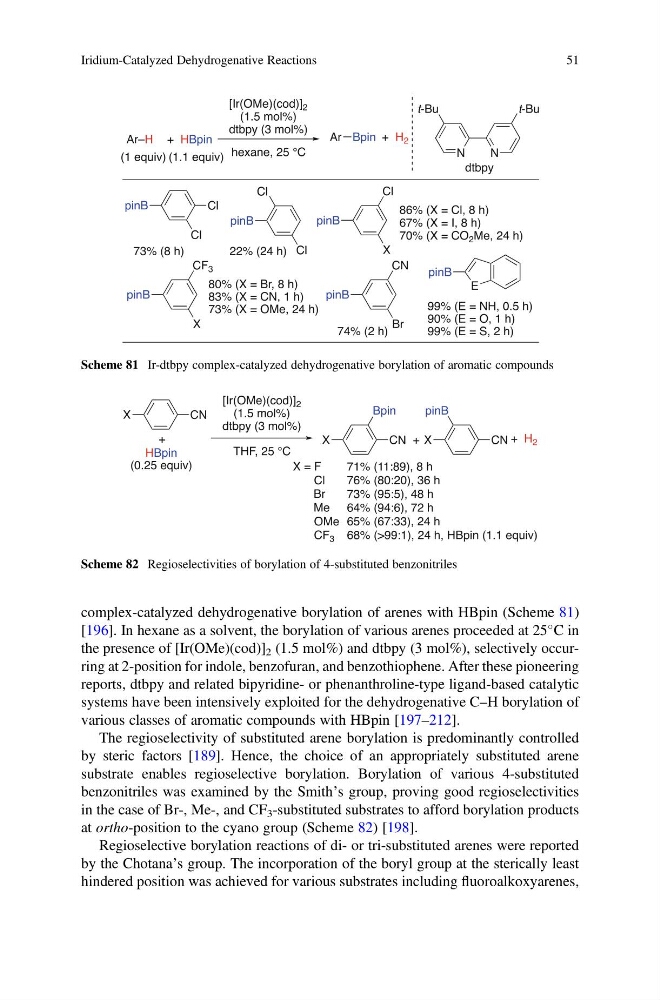
complex-catalyzed dehydrogenative borylation of arenes with HBpin (Scheme 81)
[196]. In hexane as a solvent, the borylation of various arenes proceeded at 25
C in
the presence of [Ir(OMe)(cod)] 2 (1.5 mol%) and dtbpy (3 mol%), selectively occurring at 2-position for indole, benzofuran, and benzothiophene. After these pioneering
reports, dtbpy and related bipyridine- or phenanthroline-type ligand-based catalytic
systems have been intensively exploited for the dehydrogenative C–H borylation of
various classes of aromatic compounds with HBpin [197–212].
The regioselectivity of substituted arene borylation is predominantly controlled
by steric factors [189]. Hence, the choice of an appropriately substituted arene
substrate enables regioselective borylation. Borylation of various 4-substituted
benzonitriles was examined by the Smith’s group, proving good regioselectivities
in the case of Br-, Me-, and CF 3 -substituted substrates to afford borylation products
at ortho-position to the cyano group (Scheme 82) [198].
Regioselective borylation reactions of di- or tri-substituted arenes were reported
by the Chotana’s group. The incorporation of the boryl group at the sterically least
hindered position was achieved for various substrates including fluoroalkoxyarenes,
Scheme 81 Ir-dtbpy complex-catalyzed dehydrogenative borylation of aromatic compounds
Scheme 82 Regioselectivities of borylation of 4-substituted benzonitriles
Iridium-Catalyzed Dehydrogenative Reactions
51
[196]. In hexane as a solvent, the borylation of various arenes proceeded at 25
C in
the presence of [Ir(OMe)(cod)] 2 (1.5 mol%) and dtbpy (3 mol%), selectively occurring at 2-position for indole, benzofuran, and benzothiophene. After these pioneering
reports, dtbpy and related bipyridine- or phenanthroline-type ligand-based catalytic
systems have been intensively exploited for the dehydrogenative C–H borylation of
various classes of aromatic compounds with HBpin [197–212].
The regioselectivity of substituted arene borylation is predominantly controlled
by steric factors [189]. Hence, the choice of an appropriately substituted arene
substrate enables regioselective borylation. Borylation of various 4-substituted
benzonitriles was examined by the Smith’s group, proving good regioselectivities
in the case of Br-, Me-, and CF 3 -substituted substrates to afford borylation products
at ortho-position to the cyano group (Scheme 82) [198].
Regioselective borylation reactions of di- or tri-substituted arenes were reported
by the Chotana’s group. The incorporation of the boryl group at the sterically least
hindered position was achieved for various substrates including fluoroalkoxyarenes,
Scheme 81 Ir-dtbpy complex-catalyzed dehydrogenative borylation of aromatic compounds
Scheme 82 Regioselectivities of borylation of 4-substituted benzonitriles
Iridium-Catalyzed Dehydrogenative Reactions
51