

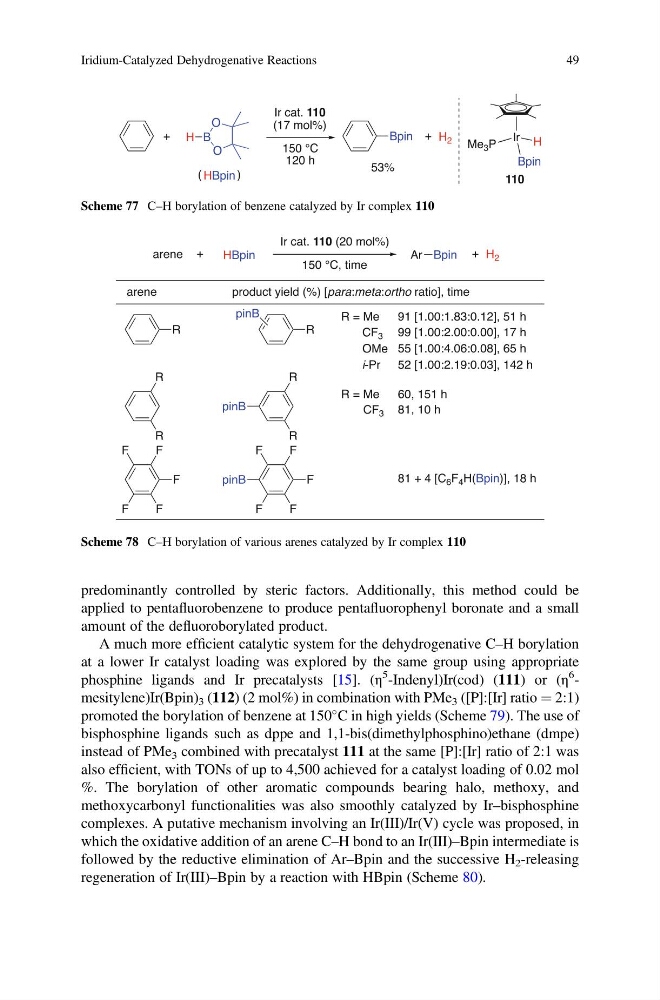
predominantly controlled by steric factors. Additionally, this method could be
applied to pentafluorobenzene to produce pentafluorophenyl boronate and a small
amount of the defluoroborylated product.
A much more efficient catalytic system for the dehydrogenative C–H borylation
at a lower Ir catalyst loading was explored by the same group using appropriate
phosphine ligands and Ir precatalysts [15]. (η
5 -Indenyl)Ir(cod) (111) or (η
6 -
mesitylene)Ir(Bpin) 3 (112) (2 mol%) in combination with PMe 3 ([P]:[Ir] ratio ¼ 2:1)
promoted the borylation of benzene at 150
C in high yields (Scheme 79). The use of
bisphosphine ligands such as dppe and 1,1-bis(dimethylphosphino)ethane (dmpe)
instead of PMe 3 combined with precatalyst 111 at the same [P]:[Ir] ratio of 2:1 was
also efficient, with TONs of up to 4,500 achieved for a catalyst loading of 0.02 mol
%. The borylation of other aromatic compounds bearing halo, methoxy, and
methoxycarbonyl functionalities was also smoothly catalyzed by Ir–bisphosphine
complexes. A putative mechanism involving an Ir(III)/Ir(V) cycle was proposed, in
which the oxidative addition of an arene C–H bond to an Ir(III)–Bpin intermediate is
followed by the reductive elimination of Ar–Bpin and the successive H 2 -releasing
regeneration of Ir(III)–Bpin by a reaction with HBpin (Scheme 80).
Scheme 77 C–H borylation of benzene catalyzed by Ir complex 110
Scheme 78 C–H borylation of various arenes catalyzed by Ir complex 110
Iridium-Catalyzed Dehydrogenative Reactions
49
applied to pentafluorobenzene to produce pentafluorophenyl boronate and a small
amount of the defluoroborylated product.
A much more efficient catalytic system for the dehydrogenative C–H borylation
at a lower Ir catalyst loading was explored by the same group using appropriate
phosphine ligands and Ir precatalysts [15]. (η
5 -Indenyl)Ir(cod) (111) or (η
6 -
mesitylene)Ir(Bpin) 3 (112) (2 mol%) in combination with PMe 3 ([P]:[Ir] ratio ¼ 2:1)
promoted the borylation of benzene at 150
C in high yields (Scheme 79). The use of
bisphosphine ligands such as dppe and 1,1-bis(dimethylphosphino)ethane (dmpe)
instead of PMe 3 combined with precatalyst 111 at the same [P]:[Ir] ratio of 2:1 was
also efficient, with TONs of up to 4,500 achieved for a catalyst loading of 0.02 mol
%. The borylation of other aromatic compounds bearing halo, methoxy, and
methoxycarbonyl functionalities was also smoothly catalyzed by Ir–bisphosphine
complexes. A putative mechanism involving an Ir(III)/Ir(V) cycle was proposed, in
which the oxidative addition of an arene C–H bond to an Ir(III)–Bpin intermediate is
followed by the reductive elimination of Ar–Bpin and the successive H 2 -releasing
regeneration of Ir(III)–Bpin by a reaction with HBpin (Scheme 80).
Scheme 77 C–H borylation of benzene catalyzed by Ir complex 110
Scheme 78 C–H borylation of various arenes catalyzed by Ir complex 110
Iridium-Catalyzed Dehydrogenative Reactions
49