

coupling reaction [185]. Therefore, rapid access to boronate compounds from readily
available hydrocarbons, e.g., through C–H bond borylation, has been intensively
investigated in the last few decades.
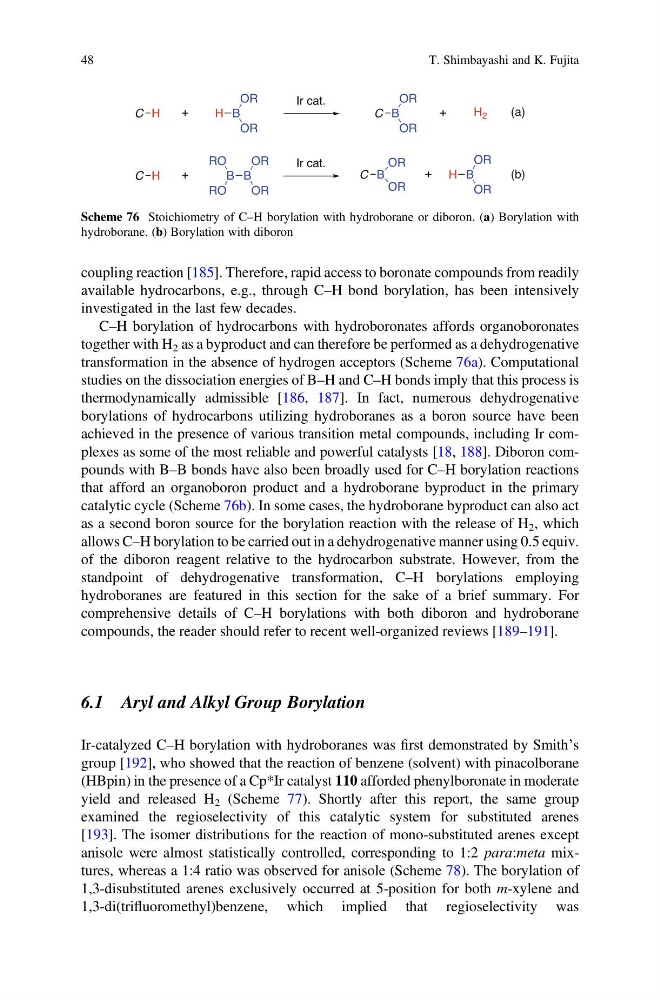
C–H borylation of hydrocarbons with hydroboronates affords organoboronates
together with H 2 as a byproduct and can therefore be performed as a dehydrogenative
transformation in the absence of hydrogen acceptors (Scheme 76a). Computational
studies on the dissociation energies of B–H and C–H bonds imply that this process is
thermodynamically admissible [186, 187]. In fact, numerous dehydrogenative
borylations of hydrocarbons utilizing hydroboranes as a boron source have been
achieved in the presence of various transition metal compounds, including Ir complexes as some of the most reliable and powerful catalysts [18, 188]. Diboron compounds with B–B bonds have also been broadly used for C–H borylation reactions
that afford an organoboron product and a hydroborane byproduct in the primary
catalytic cycle (Scheme 76b). In some cases, the hydroborane byproduct can also act
as a second boron source for the borylation reaction with the release of H 2 , which
allows C–H borylation to be carried out in a dehydrogenative manner using 0.5 equiv.
of the diboron reagent relative to the hydrocarbon substrate. However, from the
standpoint of dehydrogenative transformation, C–H borylations employing
hydroboranes are featured in this section for the sake of a brief summary. For
comprehensive details of C–H borylations with both diboron and hydroborane
compounds, the reader should refer to recent well-organized reviews [189–191].
6.1 Aryl and Alkyl Group Borylation
Ir-catalyzed C–H borylation with hydroboranes was first demonstrated by Smith’s
group [192], who showed that the reaction of benzene (solvent) with pinacolborane
(HBpin) in the presence of a Cp*Ir catalyst 110 afforded phenylboronate in moderate
yield and released H 2 (Scheme 77). Shortly after this report, the same group
examined the regioselectivity of this catalytic system for substituted arenes
[193]. The isomer distributions for the reaction of mono-substituted arenes except
anisole were almost statistically controlled, corresponding to 1:2 para:meta mixtures, whereas a 1:4 ratio was observed for anisole (Scheme 78). The borylation of
1,3-disubstituted arenes exclusively occurred at 5-position for both m-xylene and
1,3-di(trifluoromethyl)benzene, which implied that regioselectivity was
Scheme 76 Stoichiometry of C–H borylation with hydroborane or diboron. (a) Borylation with
hydroborane. (b) Borylation with diboron
48
T. Shimbayashi and K. Fujita
available hydrocarbons, e.g., through C–H bond borylation, has been intensively
investigated in the last few decades.
C–H borylation of hydrocarbons with hydroboronates affords organoboronates
together with H 2 as a byproduct and can therefore be performed as a dehydrogenative
transformation in the absence of hydrogen acceptors (Scheme 76a). Computational
studies on the dissociation energies of B–H and C–H bonds imply that this process is
thermodynamically admissible [186, 187]. In fact, numerous dehydrogenative
borylations of hydrocarbons utilizing hydroboranes as a boron source have been
achieved in the presence of various transition metal compounds, including Ir complexes as some of the most reliable and powerful catalysts [18, 188]. Diboron compounds with B–B bonds have also been broadly used for C–H borylation reactions
that afford an organoboron product and a hydroborane byproduct in the primary
catalytic cycle (Scheme 76b). In some cases, the hydroborane byproduct can also act
as a second boron source for the borylation reaction with the release of H 2 , which
allows C–H borylation to be carried out in a dehydrogenative manner using 0.5 equiv.
of the diboron reagent relative to the hydrocarbon substrate. However, from the
standpoint of dehydrogenative transformation, C–H borylations employing
hydroboranes are featured in this section for the sake of a brief summary. For
comprehensive details of C–H borylations with both diboron and hydroborane
compounds, the reader should refer to recent well-organized reviews [189–191].
6.1 Aryl and Alkyl Group Borylation
Ir-catalyzed C–H borylation with hydroboranes was first demonstrated by Smith’s
group [192], who showed that the reaction of benzene (solvent) with pinacolborane
(HBpin) in the presence of a Cp*Ir catalyst 110 afforded phenylboronate in moderate
yield and released H 2 (Scheme 77). Shortly after this report, the same group
examined the regioselectivity of this catalytic system for substituted arenes
[193]. The isomer distributions for the reaction of mono-substituted arenes except
anisole were almost statistically controlled, corresponding to 1:2 para:meta mixtures, whereas a 1:4 ratio was observed for anisole (Scheme 78). The borylation of
1,3-disubstituted arenes exclusively occurred at 5-position for both m-xylene and
1,3-di(trifluoromethyl)benzene, which implied that regioselectivity was
Scheme 76 Stoichiometry of C–H borylation with hydroborane or diboron. (a) Borylation with
hydroborane. (b) Borylation with diboron
48
T. Shimbayashi and K. Fujita