

7 Concluding Remarks
As can be seen by the numerous works mentioned in the present chapter, iridium
nanoparticles have attracted large interest as hydrogenation catalysts. NPs
immobilised on supports, ligand-stabilised NPs, confined NPs and NPs stabilised
by ionic liquids and polymers are examples of Ir NP-based catalytic systems
employed to carry out the hydrogenation process. Also remarkable is the use of Ir
NPs generated in situ that do not need stabilising agents. Although iridium is an
expensive transition metal, Ir NPs generally exhibit high activity as hydrogenation
catalysts. In addition, its low tendency to oxidation allows a good recyclability.
These features can make Ir NPs worthwhile from an industrial point of view.
However, Ir NPs have shown a limited efficiency in terms of selectivity, and thus
new approaches and strategies are required to make the reduction process sufficiently selective to be industrially relevant. Indeed, important advances have been
achieved in recent years in the development of highly chemoselective Ir NP-based
systems. These catalysts mainly consist of nanoparticles supported on oxides,
oxidised carbon materials or oxygenated surfaces, for which the catalytic reaction
sometimes proceeds through an interaction between metal and support. The use of Ir
NPs stabilised by ligands that additionally play a role in the process is also a very
promising strategy to carry out selective, partial hydrogenation of unsaturated substrates. Metal nanoparticles functionalised by organic ligands can be immobilised on
one of the many supports mentioned, which merges the two approaches creating a
plethora of interesting interactions between metals, support, ligands and substrates.
The new research area can be sure of a tremendous industrial interest [92], and thus it
can be expected that new and stimulating advances in this field will appear in the
near future.
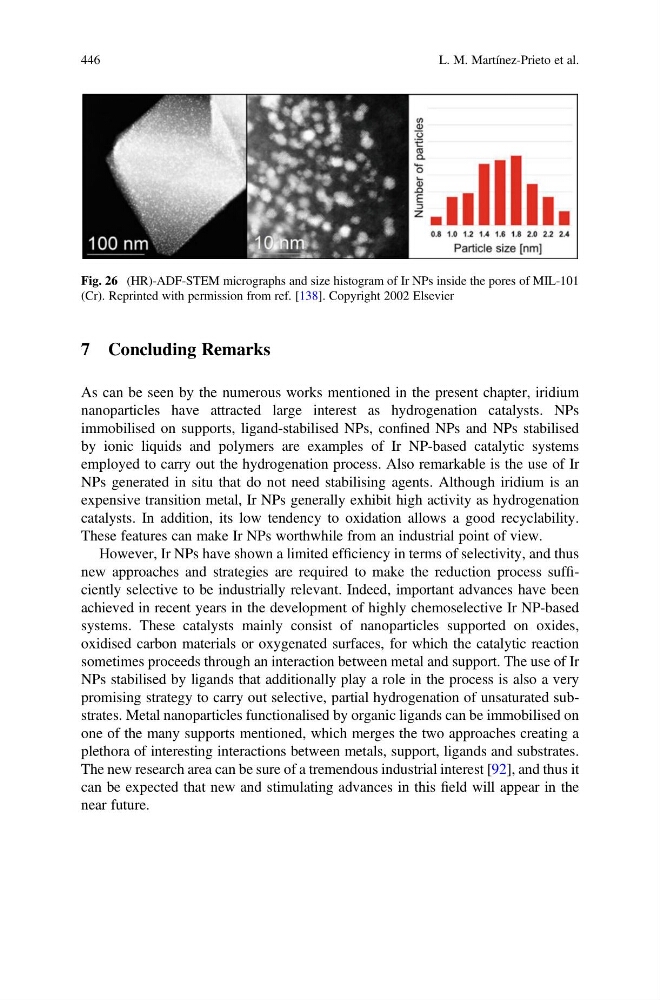
Fig. 26 (HR)-ADF-STEM micrographs and size histogram of Ir NPs inside the pores of MIL-101
(Cr). Reprinted with permission from ref. [138]. Copyright 2002 Elsevier
446
L. M. Martínez-Prieto et al.
As can be seen by the numerous works mentioned in the present chapter, iridium
nanoparticles have attracted large interest as hydrogenation catalysts. NPs
immobilised on supports, ligand-stabilised NPs, confined NPs and NPs stabilised
by ionic liquids and polymers are examples of Ir NP-based catalytic systems
employed to carry out the hydrogenation process. Also remarkable is the use of Ir
NPs generated in situ that do not need stabilising agents. Although iridium is an
expensive transition metal, Ir NPs generally exhibit high activity as hydrogenation
catalysts. In addition, its low tendency to oxidation allows a good recyclability.
These features can make Ir NPs worthwhile from an industrial point of view.
However, Ir NPs have shown a limited efficiency in terms of selectivity, and thus
new approaches and strategies are required to make the reduction process sufficiently selective to be industrially relevant. Indeed, important advances have been
achieved in recent years in the development of highly chemoselective Ir NP-based
systems. These catalysts mainly consist of nanoparticles supported on oxides,
oxidised carbon materials or oxygenated surfaces, for which the catalytic reaction
sometimes proceeds through an interaction between metal and support. The use of Ir
NPs stabilised by ligands that additionally play a role in the process is also a very
promising strategy to carry out selective, partial hydrogenation of unsaturated substrates. Metal nanoparticles functionalised by organic ligands can be immobilised on
one of the many supports mentioned, which merges the two approaches creating a
plethora of interesting interactions between metals, support, ligands and substrates.
The new research area can be sure of a tremendous industrial interest [92], and thus it
can be expected that new and stimulating advances in this field will appear in the
near future.
Fig. 26 (HR)-ADF-STEM micrographs and size histogram of Ir NPs inside the pores of MIL-101
(Cr). Reprinted with permission from ref. [138]. Copyright 2002 Elsevier
446
L. M. Martínez-Prieto et al.