

6.2.3 Ir NPs Supported on MoO x
Reducible metal oxides such as MoO x , with variable oxidation states that can be
easily reduced during catalysis (or catalyst preparation), have emerged as promising
supports for MNPs. They normally present numerous oxygen vacancies and strong
metal-support interactions, which results in efficient catalysis. For example, Gao
et al. reported Ir NPs supported on hydrogenated MoO x nanorods for the selective
hydrogenation of α, β,-unsaturated aldehydes [114]. Following a one-pot synthetic
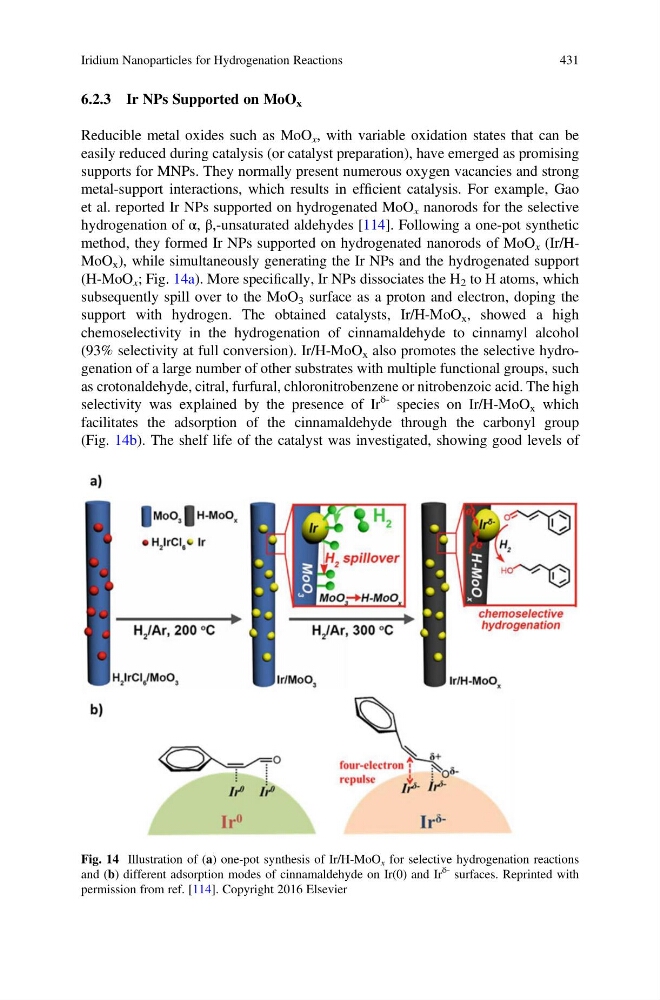
method, they formed Ir NPs supported on hydrogenated nanorods of MoO x (Ir/HMoO x ), while simultaneously generating the Ir NPs and the hydrogenated support
(H-MoO x ; Fig. 14a). More specifically, Ir NPs dissociates the H 2 to H atoms, which
subsequently spill over to the MoO 3 surface as a proton and electron, doping the
support with hydrogen. The obtained catalysts, Ir/H-MoO x , showed a high
chemoselectivity in the hydrogenation of cinnamaldehyde to cinnamyl alcohol
(93% selectivity at full conversion). Ir/H-MoO x also promotes the selective hydrogenation of a large number of other substrates with multiple functional groups, such
as crotonaldehyde, citral, furfural, chloronitrobenzene or nitrobenzoic acid. The high
selectivity was explained by the presence of Ir
δ- species on Ir/H-MoO x which
facilitates the adsorption of the cinnamaldehyde through the carbonyl group
(Fig. 14b). The shelf life of the catalyst was investigated, showing good levels of
Fig. 14 Illustration of (a) one-pot synthesis of Ir/H-MoO x for selective hydrogenation reactions
and (b) different adsorption modes of cinnamaldehyde on Ir(0) and Ir
δ- surfaces. Reprinted with
permission from ref. [114]. Copyright 2016 Elsevier
Iridium Nanoparticles for Hydrogenation Reactions
431
Reducible metal oxides such as MoO x , with variable oxidation states that can be
easily reduced during catalysis (or catalyst preparation), have emerged as promising
supports for MNPs. They normally present numerous oxygen vacancies and strong
metal-support interactions, which results in efficient catalysis. For example, Gao
et al. reported Ir NPs supported on hydrogenated MoO x nanorods for the selective
hydrogenation of α, β,-unsaturated aldehydes [114]. Following a one-pot synthetic
method, they formed Ir NPs supported on hydrogenated nanorods of MoO x (Ir/HMoO x ), while simultaneously generating the Ir NPs and the hydrogenated support
(H-MoO x ; Fig. 14a). More specifically, Ir NPs dissociates the H 2 to H atoms, which
subsequently spill over to the MoO 3 surface as a proton and electron, doping the
support with hydrogen. The obtained catalysts, Ir/H-MoO x , showed a high
chemoselectivity in the hydrogenation of cinnamaldehyde to cinnamyl alcohol
(93% selectivity at full conversion). Ir/H-MoO x also promotes the selective hydrogenation of a large number of other substrates with multiple functional groups, such
as crotonaldehyde, citral, furfural, chloronitrobenzene or nitrobenzoic acid. The high
selectivity was explained by the presence of Ir
δ- species on Ir/H-MoO x which
facilitates the adsorption of the cinnamaldehyde through the carbonyl group
(Fig. 14b). The shelf life of the catalyst was investigated, showing good levels of
Fig. 14 Illustration of (a) one-pot synthesis of Ir/H-MoO x for selective hydrogenation reactions
and (b) different adsorption modes of cinnamaldehyde on Ir(0) and Ir
δ- surfaces. Reprinted with
permission from ref. [114]. Copyright 2016 Elsevier
Iridium Nanoparticles for Hydrogenation Reactions
431