

corresponding amine by using as solvent a mixture of water and ethanol. The higher
activity and selectivity were attributed to the formation of hydrogen bonds between
the substrate and the hydroxyl groups of the hydrous support or water molecules,
which activates the nitro group. This catalyst also showed a remarkable stability as it
could be reused up to six times without any loss of activity/selectivity. Along the
same line, Reyes et al. employed Ir/ZrO 2 for the hydrogenation of meta-substituted
nitrobenzenes (-H, -CHO, -OCH3, -CH3, -Cl, -CN, -CH¼CH2 and -NO 2 )
[113]. After characterisation the Ir/ZrO 2 catalyst showed the presence of mainly
zero valent, partially oxidised, Ir NPs with a mean diameter of 1.8 nm. Ir/ZrO 2
exhibited a great activity and selectivity in the hydrogenation of a great number of
substituted nitrobenzenes to the corresponding amine, except for m-nitrostyrene and
m-nitrobenzaldehyde where there is a competition between two functional groups
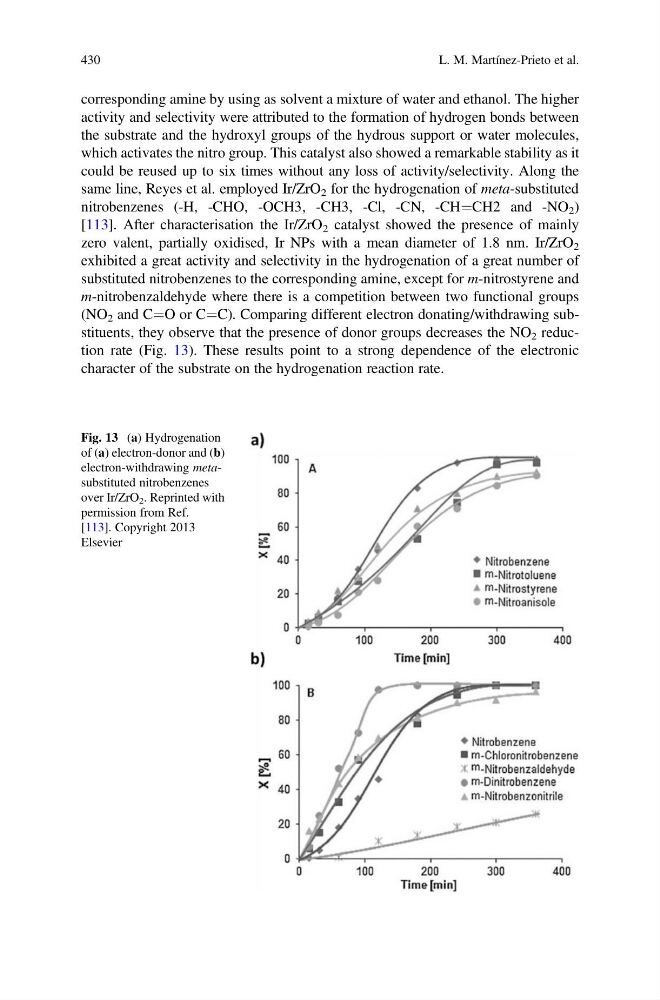
(NO 2 and C¼O or C¼C). Comparing different electron donating/withdrawing substituents, they observe that the presence of donor groups decreases the NO 2 reduction rate (Fig. 13). These results point to a strong dependence of the electronic
character of the substrate on the hydrogenation reaction rate.
Fig. 13 (a) Hydrogenation
of (a) electron-donor and (b)
electron-withdrawing metasubstituted nitrobenzenes
over Ir/ZrO 2 . Reprinted with
permission from Ref.
[113]. Copyright 2013
Elsevier
430
L. M. Martínez-Prieto et al.
activity and selectivity were attributed to the formation of hydrogen bonds between
the substrate and the hydroxyl groups of the hydrous support or water molecules,
which activates the nitro group. This catalyst also showed a remarkable stability as it
could be reused up to six times without any loss of activity/selectivity. Along the
same line, Reyes et al. employed Ir/ZrO 2 for the hydrogenation of meta-substituted
nitrobenzenes (-H, -CHO, -OCH3, -CH3, -Cl, -CN, -CH¼CH2 and -NO 2 )
[113]. After characterisation the Ir/ZrO 2 catalyst showed the presence of mainly
zero valent, partially oxidised, Ir NPs with a mean diameter of 1.8 nm. Ir/ZrO 2
exhibited a great activity and selectivity in the hydrogenation of a great number of
substituted nitrobenzenes to the corresponding amine, except for m-nitrostyrene and
m-nitrobenzaldehyde where there is a competition between two functional groups
(NO 2 and C¼O or C¼C). Comparing different electron donating/withdrawing substituents, they observe that the presence of donor groups decreases the NO 2 reduction rate (Fig. 13). These results point to a strong dependence of the electronic
character of the substrate on the hydrogenation reaction rate.
Fig. 13 (a) Hydrogenation
of (a) electron-donor and (b)
electron-withdrawing metasubstituted nitrobenzenes
over Ir/ZrO 2 . Reprinted with
permission from Ref.
[113]. Copyright 2013
Elsevier
430
L. M. Martínez-Prieto et al.