

6.2 Metal Oxide-Supported Ir NPs
6.2.1 Ir NPs Supported on TiO 2
During the last decade, catalysts based on MNPs supported on metal oxides have
awakened a great interest in heterogeneous catalysis. One of the most often
employed and studied metal oxide supports is titanium oxide or titania (TiO 2 ). The
great interest for TiO 2 -supported MNPs comes from their strong metal support
interaction, chemical stability and high surface area, which is reflected in an
improved catalytic activity and stability.
In 2012, Luo et al. reported a series of catalysts based on Ir NPs supported on
TiO 2 (Ir/TiO 2 ) for the vapour-phase selective hydrogenation of crotonaldehyde to
the corresponding unsaturated alcohol [105]. Ir/TiO 2 catalysts with an Ir content of
3 wt% were synthesised by the reduction of titania impregnated with H 2 IrCl 6 in H 2 at
different temperatures (100, 200, 300, 400 and 500
C). It was found that the
reduction temperature has a great influence in the activity and selectivity of the
resulting catalysts. While catalysts reduced at 100 and 500
C show poor activity and
selectivity after 500 min under flow conditions (~25% selectivity at ~3% conversion), Ir/TiO 2 reduced at 300
C present the highest activity/selectivity (75% selectivity at 27% conversion). Ir/TiO 2 reduced at 100
C (Ir/TiO 2À 100) contains a large
number of Lewis acid sites (Ir
δ+ ), which strongly interact with the reactant through
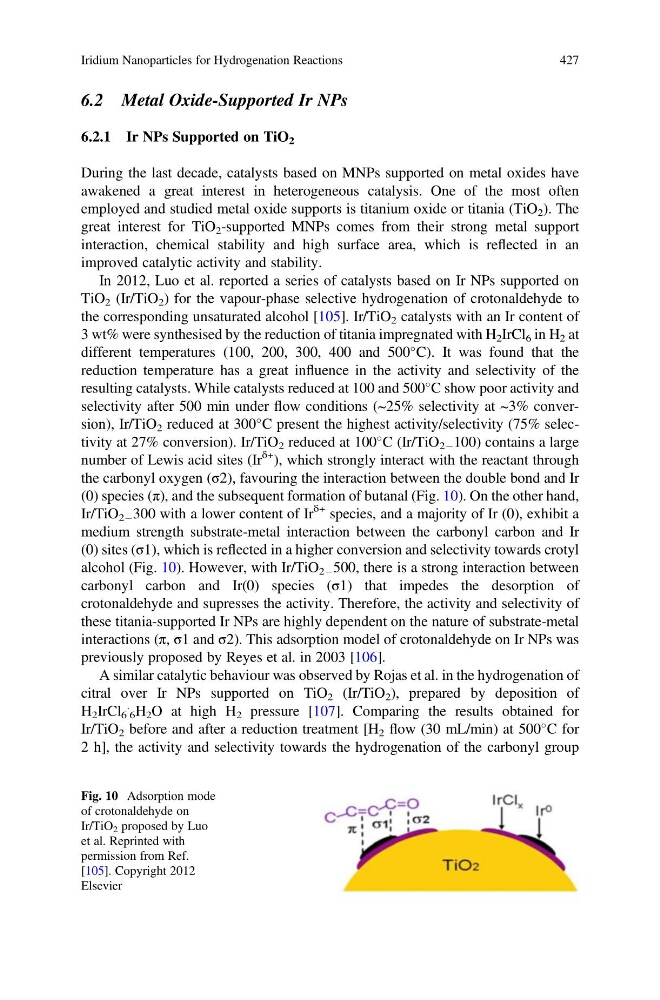
the carbonyl oxygen (σ2), favouring the interaction between the double bond and Ir
(0) species (π), and the subsequent formation of butanal (Fig. 10). On the other hand,
Ir/TiO 2À 300 with a lower content of Ir
δ+ species, and a majority of Ir (0), exhibit a
medium strength substrate-metal interaction between the carbonyl carbon and Ir
(0) sites (σ1), which is reflected in a higher conversion and selectivity towards crotyl
alcohol (Fig. 10). However, with Ir/TiO 2À 500, there is a strong interaction between
carbonyl carbon and Ir(0) species (σ1) that impedes the desorption of
crotonaldehyde and supresses the activity. Therefore, the activity and selectivity of
these titania-supported Ir NPs are highly dependent on the nature of substrate-metal
interactions (π, σ1 and σ2). This adsorption model of crotonaldehyde on Ir NPs was
previously proposed by Reyes et al. in 2003 [106].
A similar catalytic behaviour was observed by Rojas et al. in the hydrogenation of
citral over Ir NPs supported on TiO 2 (Ir/TiO 2 ), prepared by deposition of
H 2 IrCl 6
.
6 H 2 O at high H 2 pressure [107]. Comparing the results obtained for
Ir/TiO 2 before and after a reduction treatment [H 2 flow (30 mL/min) at 500
C for
2 h], the activity and selectivity towards the hydrogenation of the carbonyl group
Fig. 10 Adsorption mode
of crotonaldehyde on
Ir/TiO 2 proposed by Luo
et al. Reprinted with
permission from Ref.
[105]. Copyright 2012
Elsevier
Iridium Nanoparticles for Hydrogenation Reactions
427
6.2.1 Ir NPs Supported on TiO 2
During the last decade, catalysts based on MNPs supported on metal oxides have
awakened a great interest in heterogeneous catalysis. One of the most often
employed and studied metal oxide supports is titanium oxide or titania (TiO 2 ). The
great interest for TiO 2 -supported MNPs comes from their strong metal support
interaction, chemical stability and high surface area, which is reflected in an
improved catalytic activity and stability.
In 2012, Luo et al. reported a series of catalysts based on Ir NPs supported on
TiO 2 (Ir/TiO 2 ) for the vapour-phase selective hydrogenation of crotonaldehyde to
the corresponding unsaturated alcohol [105]. Ir/TiO 2 catalysts with an Ir content of
3 wt% were synthesised by the reduction of titania impregnated with H 2 IrCl 6 in H 2 at
different temperatures (100, 200, 300, 400 and 500
C). It was found that the
reduction temperature has a great influence in the activity and selectivity of the
resulting catalysts. While catalysts reduced at 100 and 500
C show poor activity and
selectivity after 500 min under flow conditions (~25% selectivity at ~3% conversion), Ir/TiO 2 reduced at 300
C present the highest activity/selectivity (75% selectivity at 27% conversion). Ir/TiO 2 reduced at 100
C (Ir/TiO 2À 100) contains a large
number of Lewis acid sites (Ir
δ+ ), which strongly interact with the reactant through
the carbonyl oxygen (σ2), favouring the interaction between the double bond and Ir
(0) species (π), and the subsequent formation of butanal (Fig. 10). On the other hand,
Ir/TiO 2À 300 with a lower content of Ir
δ+ species, and a majority of Ir (0), exhibit a
medium strength substrate-metal interaction between the carbonyl carbon and Ir
(0) sites (σ1), which is reflected in a higher conversion and selectivity towards crotyl
alcohol (Fig. 10). However, with Ir/TiO 2À 500, there is a strong interaction between
carbonyl carbon and Ir(0) species (σ1) that impedes the desorption of
crotonaldehyde and supresses the activity. Therefore, the activity and selectivity of
these titania-supported Ir NPs are highly dependent on the nature of substrate-metal
interactions (π, σ1 and σ2). This adsorption model of crotonaldehyde on Ir NPs was
previously proposed by Reyes et al. in 2003 [106].
A similar catalytic behaviour was observed by Rojas et al. in the hydrogenation of
citral over Ir NPs supported on TiO 2 (Ir/TiO 2 ), prepared by deposition of
H 2 IrCl 6
.
6 H 2 O at high H 2 pressure [107]. Comparing the results obtained for
Ir/TiO 2 before and after a reduction treatment [H 2 flow (30 mL/min) at 500
C for
2 h], the activity and selectivity towards the hydrogenation of the carbonyl group
Fig. 10 Adsorption mode
of crotonaldehyde on
Ir/TiO 2 proposed by Luo
et al. Reprinted with
permission from Ref.
[105]. Copyright 2012
Elsevier
Iridium Nanoparticles for Hydrogenation Reactions
427