

[103]. In particular, there are a couple of recent examples about catalysts based on Ir
NPs supported on graphene materials for hydrogenation reactions. In 2015, Janiak
and coworkers presented Ir NPs supported on thermally reduced graphite oxide, or
“graphene”, (Ir@TRGO) as a recyclable catalyst for the hydrogenation of benzene or
cyclohexene [72]. The Ir NPs were generated by thermal decomposition of Ir 4 (CO) 12
in the presence of the graphene material in an ionic liquid (1-butyl-3methylimidazolium tetrafluoroborate) by microwave or electron-beam irradiation,
as was already introduced in Sect. 2 on IL supported Ir NPs. Ir@TRGO showed a
high activity in the solvent-free hydrogenation of benzene to cyclohexane
(TOF ¼ 10,000 h
À1 ) under relatively mild conditions (100
C, 10 bar H 2 ). This
catalyst was reused more than ten times without any significant loss of activity.
Moreover, through size effect studies, they found that the optimum NP diameter for
benzene hydrogenation in these conditions and with this kind of catalysts is
3.6 Æ 1.0 nm. Reduced graphene-supported iridium NPs (Ir/rGO) were also
employed by Rong et al. for the hydrogenation of p-chloronitrobenzene ( p-CNB)
and cinnamaldehyde (CAL) [104]. Here, graphene-supported Ir NPs were prepared
following a one-pot hydrothermal method, in which H 2 IrCl 6
. 6H 2 O was reduced
together with graphene oxide under different H 2 pressures and temperatures. Interestingly, by adjusting the hydrothermal conditions, it was possible to modulate the
catalytic properties of the obtained catalysts. Ir/rGO obtained at higher H 2 pressure
displayed better activities in the hydrogenation reactions due to a higher reduction
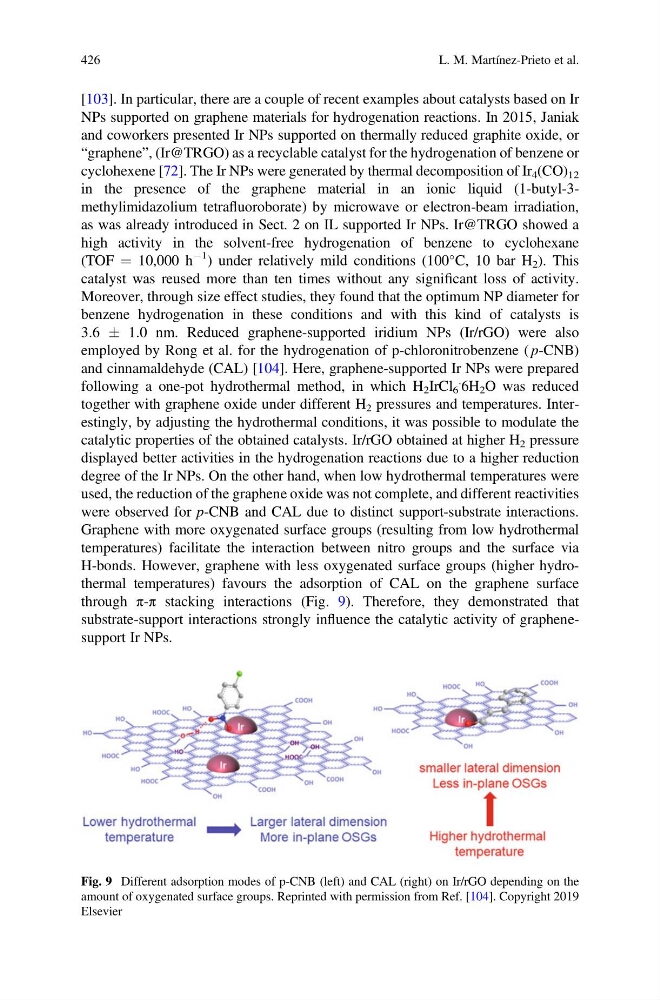
degree of the Ir NPs. On the other hand, when low hydrothermal temperatures were
used, the reduction of the graphene oxide was not complete, and different reactivities
were observed for p-CNB and CAL due to distinct support-substrate interactions.
Graphene with more oxygenated surface groups (resulting from low hydrothermal
temperatures) facilitate the interaction between nitro groups and the surface via
H-bonds. However, graphene with less oxygenated surface groups (higher hydrothermal temperatures) favours the adsorption of CAL on the graphene surface
through π-π stacking interactions (Fig. 9). Therefore, they demonstrated that
substrate-support interactions strongly influence the catalytic activity of graphenesupport Ir NPs.
Fig. 9 Different adsorption modes of p-CNB (left) and CAL (right) on Ir/rGO depending on the
amount of oxygenated surface groups. Reprinted with permission from Ref. [104]. Copyright 2019
Elsevier
426
L. M. Martínez-Prieto et al.
NPs supported on graphene materials for hydrogenation reactions. In 2015, Janiak
and coworkers presented Ir NPs supported on thermally reduced graphite oxide, or
“graphene”, (Ir@TRGO) as a recyclable catalyst for the hydrogenation of benzene or
cyclohexene [72]. The Ir NPs were generated by thermal decomposition of Ir 4 (CO) 12
in the presence of the graphene material in an ionic liquid (1-butyl-3methylimidazolium tetrafluoroborate) by microwave or electron-beam irradiation,
as was already introduced in Sect. 2 on IL supported Ir NPs. Ir@TRGO showed a
high activity in the solvent-free hydrogenation of benzene to cyclohexane
(TOF ¼ 10,000 h
À1 ) under relatively mild conditions (100
C, 10 bar H 2 ). This
catalyst was reused more than ten times without any significant loss of activity.
Moreover, through size effect studies, they found that the optimum NP diameter for
benzene hydrogenation in these conditions and with this kind of catalysts is
3.6 Æ 1.0 nm. Reduced graphene-supported iridium NPs (Ir/rGO) were also
employed by Rong et al. for the hydrogenation of p-chloronitrobenzene ( p-CNB)
and cinnamaldehyde (CAL) [104]. Here, graphene-supported Ir NPs were prepared
following a one-pot hydrothermal method, in which H 2 IrCl 6
. 6H 2 O was reduced
together with graphene oxide under different H 2 pressures and temperatures. Interestingly, by adjusting the hydrothermal conditions, it was possible to modulate the
catalytic properties of the obtained catalysts. Ir/rGO obtained at higher H 2 pressure
displayed better activities in the hydrogenation reactions due to a higher reduction
degree of the Ir NPs. On the other hand, when low hydrothermal temperatures were
used, the reduction of the graphene oxide was not complete, and different reactivities
were observed for p-CNB and CAL due to distinct support-substrate interactions.
Graphene with more oxygenated surface groups (resulting from low hydrothermal
temperatures) facilitate the interaction between nitro groups and the surface via
H-bonds. However, graphene with less oxygenated surface groups (higher hydrothermal temperatures) favours the adsorption of CAL on the graphene surface
through π-π stacking interactions (Fig. 9). Therefore, they demonstrated that
substrate-support interactions strongly influence the catalytic activity of graphenesupport Ir NPs.
Fig. 9 Different adsorption modes of p-CNB (left) and CAL (right) on Ir/rGO depending on the
amount of oxygenated surface groups. Reprinted with permission from Ref. [104]. Copyright 2019
Elsevier
426
L. M. Martínez-Prieto et al.