

carbonyl group with the intercalated Ir nanodisks of Ir-GIC. On the other hand,
cinnamaldehyde adsorbs arbitrarily on the supported Ir NPs of Ir/Gmix, showing a
low selectivity (44% at 90% of conversion).
The possibility to functionalise carbon materials by introducing heteroatoms,
such as N, can influence the catalytic activity of the supported Ir NPs. In line with
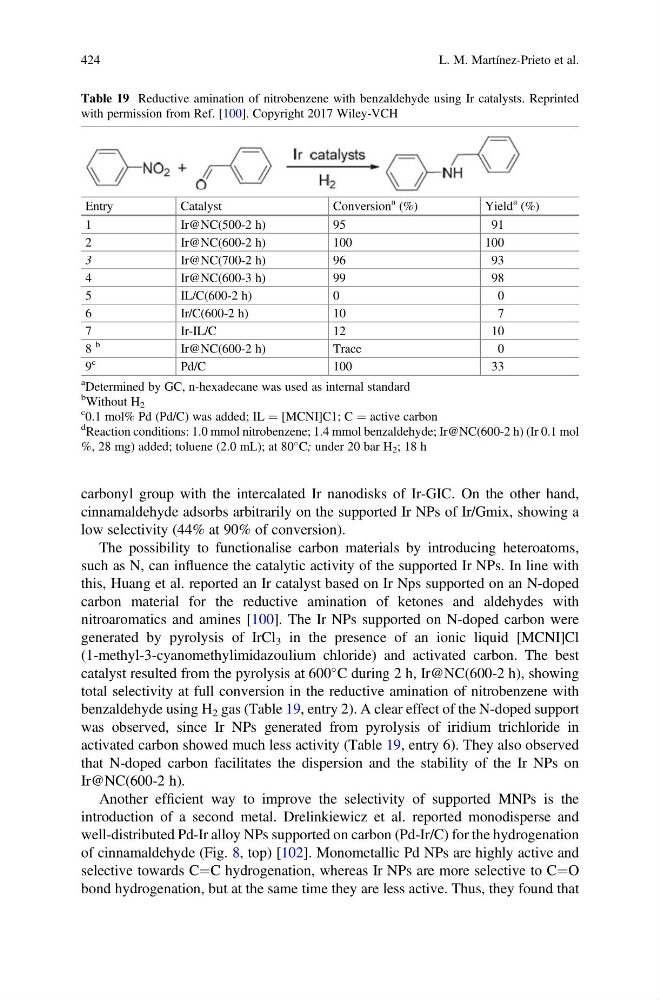
this, Huang et al. reported an Ir catalyst based on Ir Nps supported on an N-doped
carbon material for the reductive amination of ketones and aldehydes with
nitroaromatics and amines [100]. The Ir NPs supported on N-doped carbon were
generated by pyrolysis of IrCl 3 in the presence of an ionic liquid [MCNI]Cl
(1-methyl-3-cyanomethylimidazoulium chloride) and activated carbon. The best
catalyst resulted from the pyrolysis at 600
C during 2 h, Ir@NC(600-2 h), showing
total selectivity at full conversion in the reductive amination of nitrobenzene with
benzaldehyde using H 2 gas (Table 19, entry 2). A clear effect of the N-doped support
was observed, since Ir NPs generated from pyrolysis of iridium trichloride in
activated carbon showed much less activity (Table 19, entry 6). They also observed
that N-doped carbon facilitates the dispersion and the stability of the Ir NPs on
Ir@NC(600-2 h).
Another efficient way to improve the selectivity of supported MNPs is the
introduction of a second metal. Drelinkiewicz et al. reported monodisperse and
well-distributed Pd-Ir alloy NPs supported on carbon (Pd-Ir/C) for the hydrogenation
of cinnamaldehyde (Fig. 8, top) [102]. Monometallic Pd NPs are highly active and
selective towards C¼C hydrogenation, whereas Ir NPs are more selective to C¼O
bond hydrogenation, but at the same time they are less active. Thus, they found that
Table 19 Reductive amination of nitrobenzene with benzaldehyde using Ir catalysts. Reprinted
with permission from Ref. [100]. Copyright 2017 Wiley-VCH
Entry
Catalyst
Conversion
a (%)
Yield
a (%)
1
Ir@NC(500-2 h)
95
91
2
Ir@NC(600-2 h)
100
100
3
Ir@NC(700-2 h)
96
93
4
Ir@NC(600-3 h)
99
98
5
IL/C(600-2 h)
0
0
6
Ir/C(600-2 h)
10
7
7
Ir-IL/C
12
10
8
b
Ir@NC(600-2 h)
Trace
0
9
c
Pd/C
100
33
a Determined by GC, n-hexadecane was used as internal standard
b
Without H 2
c 0.1 mol% Pd (Pd/C) was added; IL ¼ [MCNI]C1; C ¼ active carbon
d
Reaction conditions: 1.0 mmol nitrobenzene; 1.4 mmol benzaldehyde; Ir@NC(600-2 h) (Ir 0.1 mol
%, 28 mg) added; toluene (2.0 mL); at 80
C; under 20 bar H 2 ; 18 h
424
L. M. Martínez-Prieto et al.
cinnamaldehyde adsorbs arbitrarily on the supported Ir NPs of Ir/Gmix, showing a
low selectivity (44% at 90% of conversion).
The possibility to functionalise carbon materials by introducing heteroatoms,
such as N, can influence the catalytic activity of the supported Ir NPs. In line with
this, Huang et al. reported an Ir catalyst based on Ir Nps supported on an N-doped
carbon material for the reductive amination of ketones and aldehydes with
nitroaromatics and amines [100]. The Ir NPs supported on N-doped carbon were
generated by pyrolysis of IrCl 3 in the presence of an ionic liquid [MCNI]Cl
(1-methyl-3-cyanomethylimidazoulium chloride) and activated carbon. The best
catalyst resulted from the pyrolysis at 600
C during 2 h, Ir@NC(600-2 h), showing
total selectivity at full conversion in the reductive amination of nitrobenzene with
benzaldehyde using H 2 gas (Table 19, entry 2). A clear effect of the N-doped support
was observed, since Ir NPs generated from pyrolysis of iridium trichloride in
activated carbon showed much less activity (Table 19, entry 6). They also observed
that N-doped carbon facilitates the dispersion and the stability of the Ir NPs on
Ir@NC(600-2 h).
Another efficient way to improve the selectivity of supported MNPs is the
introduction of a second metal. Drelinkiewicz et al. reported monodisperse and
well-distributed Pd-Ir alloy NPs supported on carbon (Pd-Ir/C) for the hydrogenation
of cinnamaldehyde (Fig. 8, top) [102]. Monometallic Pd NPs are highly active and
selective towards C¼C hydrogenation, whereas Ir NPs are more selective to C¼O
bond hydrogenation, but at the same time they are less active. Thus, they found that
Table 19 Reductive amination of nitrobenzene with benzaldehyde using Ir catalysts. Reprinted
with permission from Ref. [100]. Copyright 2017 Wiley-VCH
Entry
Catalyst
Conversion
a (%)
Yield
a (%)
1
Ir@NC(500-2 h)
95
91
2
Ir@NC(600-2 h)
100
100
3
Ir@NC(700-2 h)
96
93
4
Ir@NC(600-3 h)
99
98
5
IL/C(600-2 h)
0
0
6
Ir/C(600-2 h)
10
7
7
Ir-IL/C
12
10
8
b
Ir@NC(600-2 h)
Trace
0
9
c
Pd/C
100
33
a Determined by GC, n-hexadecane was used as internal standard
b
Without H 2
c 0.1 mol% Pd (Pd/C) was added; IL ¼ [MCNI]C1; C ¼ active carbon
d
Reaction conditions: 1.0 mmol nitrobenzene; 1.4 mmol benzaldehyde; Ir@NC(600-2 h) (Ir 0.1 mol
%, 28 mg) added; toluene (2.0 mL); at 80
C; under 20 bar H 2 ; 18 h
424
L. M. Martínez-Prieto et al.