

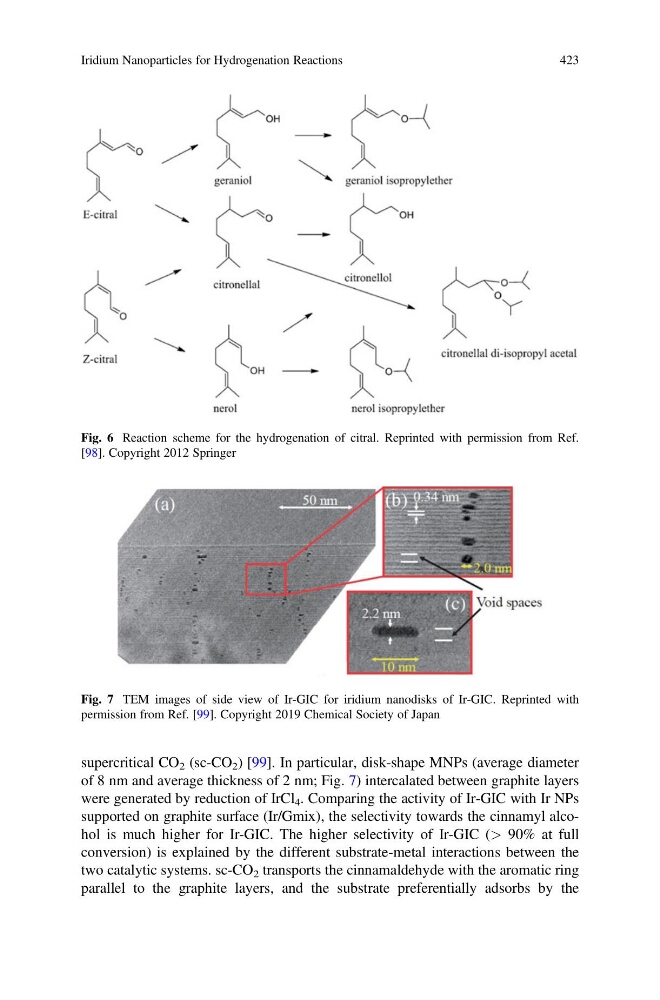
supercritical CO 2 (sc-CO 2 ) [99]. In particular, disk-shape MNPs (average diameter
of 8 nm and average thickness of 2 nm; Fig. 7) intercalated between graphite layers
were generated by reduction of IrCl 4 . Comparing the activity of Ir-GIC with Ir NPs
supported on graphite surface (Ir/Gmix), the selectivity towards the cinnamyl alcohol is much higher for Ir-GIC. The higher selectivity of Ir-GIC (> 90% at full
conversion) is explained by the different substrate-metal interactions between the
two catalytic systems. sc-CO 2 transports the cinnamaldehyde with the aromatic ring
parallel to the graphite layers, and the substrate preferentially adsorbs by the
Fig. 6 Reaction scheme for the hydrogenation of citral. Reprinted with permission from Ref.
[98]. Copyright 2012 Springer
Fig. 7 TEM images of side view of Ir-GIC for iridium nanodisks of Ir-GIC. Reprinted with
permission from Ref. [99]. Copyright 2019 Chemical Society of Japan
Iridium Nanoparticles for Hydrogenation Reactions
423
of 8 nm and average thickness of 2 nm; Fig. 7) intercalated between graphite layers
were generated by reduction of IrCl 4 . Comparing the activity of Ir-GIC with Ir NPs
supported on graphite surface (Ir/Gmix), the selectivity towards the cinnamyl alcohol is much higher for Ir-GIC. The higher selectivity of Ir-GIC (> 90% at full
conversion) is explained by the different substrate-metal interactions between the
two catalytic systems. sc-CO 2 transports the cinnamaldehyde with the aromatic ring
parallel to the graphite layers, and the substrate preferentially adsorbs by the
Fig. 6 Reaction scheme for the hydrogenation of citral. Reprinted with permission from Ref.
[98]. Copyright 2012 Springer
Fig. 7 TEM images of side view of Ir-GIC for iridium nanodisks of Ir-GIC. Reprinted with
permission from Ref. [99]. Copyright 2019 Chemical Society of Japan
Iridium Nanoparticles for Hydrogenation Reactions
423