

the solution by Z-contrast STEM, XAFS and MALDI MS showed a mixture of
monometallic Ir complexes and Ir 4–15 nanoclusters of 0.5–0.7 nm in size.
The use of this solution in cyclohexene hydrogenation led to the formation of
larger Ir(0) 40–150 nanoclusters with 1.0–1.6 nm in size. Interestingly, the population
of these nanoclusters increased during the hydrogenation process, for which a black
precipitate and a concomitant increase in activity were also observed. Consequently,
although activity by homogeneous iridium species was not discarded, the Ir(0) 40–150
nanoclusters are the most active catalyst in the system. Indeed, the precipitate
displays comparable catalytic activity as the maximum activity obtained at the end
of the hydrogenation process. This was further supported by mercury poisoning tests
[85]. The addition of Hg(0) when the process is in the maximum rate regime
completely inhibited the hydrogenation reaction, while some activity, attributed to
non-poisoned homogeneous catalysts as Ir complexes and subnanometer Ir 4–15
clusters, is observed if the addition of Hg(0) is carried out at initial stages of
hydrogenation process.
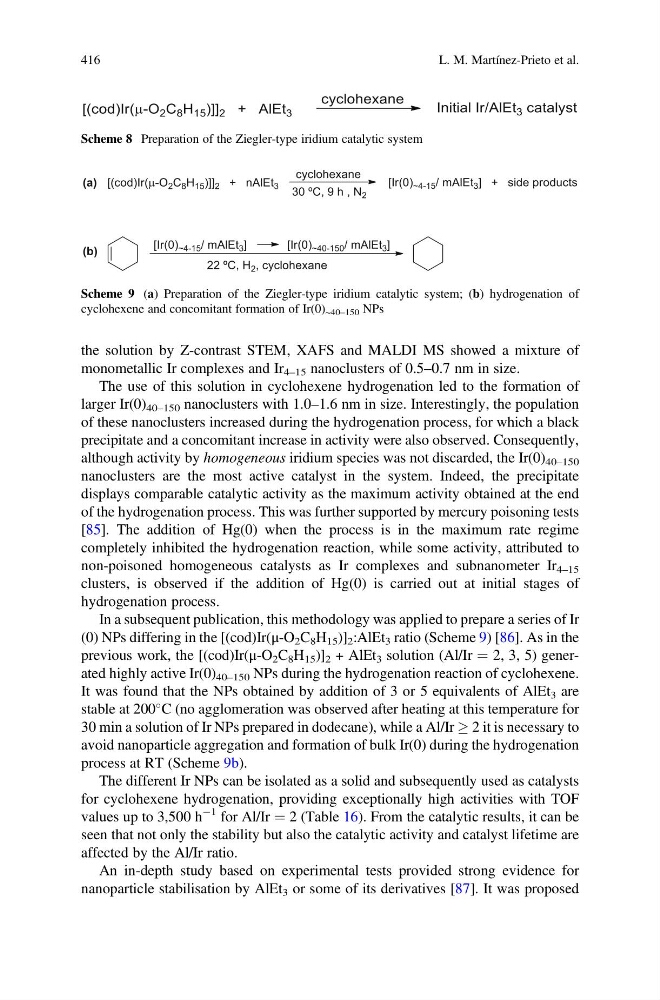
In a subsequent publication, this methodology was applied to prepare a series of Ir
(0) NPs differing in the [(cod)Ir(μ-O 2 C 8 H 15 )] 2 :AlEt 3 ratio (Scheme 9) [86]. As in the
previous work, the [(cod)Ir(μ-O 2 C 8 H 15 )] 2 + AlEt 3 solution (Al/Ir ¼ 2, 3, 5) generated highly active Ir(0) 40–150 NPs during the hydrogenation reaction of cyclohexene.
It was found that the NPs obtained by addition of 3 or 5 equivalents of AlEt 3 are
stable at 200
C (no agglomeration was observed after heating at this temperature for
30 min a solution of Ir NPs prepared in dodecane), while a Al/Ir ! 2 it is necessary to
avoid nanoparticle aggregation and formation of bulk Ir(0) during the hydrogenation
process at RT (Scheme 9b).
The different Ir NPs can be isolated as a solid and subsequently used as catalysts
for cyclohexene hydrogenation, providing exceptionally high activities with TOF
values up to 3,500 h
À1 for Al/Ir ¼ 2 (Table 16). From the catalytic results, it can be
seen that not only the stability but also the catalytic activity and catalyst lifetime are
affected by the Al/Ir ratio.
An in-depth study based on experimental tests provided strong evidence for
nanoparticle stabilisation by AlEt 3 or some of its derivatives [87]. It was proposed
Scheme 8 Preparation of the Ziegler-type iridium catalytic system
Scheme 9 (a) Preparation of the Ziegler-type iridium catalytic system; (b) hydrogenation of
cyclohexene and concomitant formation of Ir(0) ~40–150 NPs
416
L. M. Martínez-Prieto et al.
monometallic Ir complexes and Ir 4–15 nanoclusters of 0.5–0.7 nm in size.
The use of this solution in cyclohexene hydrogenation led to the formation of
larger Ir(0) 40–150 nanoclusters with 1.0–1.6 nm in size. Interestingly, the population
of these nanoclusters increased during the hydrogenation process, for which a black
precipitate and a concomitant increase in activity were also observed. Consequently,
although activity by homogeneous iridium species was not discarded, the Ir(0) 40–150
nanoclusters are the most active catalyst in the system. Indeed, the precipitate
displays comparable catalytic activity as the maximum activity obtained at the end
of the hydrogenation process. This was further supported by mercury poisoning tests
[85]. The addition of Hg(0) when the process is in the maximum rate regime
completely inhibited the hydrogenation reaction, while some activity, attributed to
non-poisoned homogeneous catalysts as Ir complexes and subnanometer Ir 4–15
clusters, is observed if the addition of Hg(0) is carried out at initial stages of
hydrogenation process.
In a subsequent publication, this methodology was applied to prepare a series of Ir
(0) NPs differing in the [(cod)Ir(μ-O 2 C 8 H 15 )] 2 :AlEt 3 ratio (Scheme 9) [86]. As in the
previous work, the [(cod)Ir(μ-O 2 C 8 H 15 )] 2 + AlEt 3 solution (Al/Ir ¼ 2, 3, 5) generated highly active Ir(0) 40–150 NPs during the hydrogenation reaction of cyclohexene.
It was found that the NPs obtained by addition of 3 or 5 equivalents of AlEt 3 are
stable at 200
C (no agglomeration was observed after heating at this temperature for
30 min a solution of Ir NPs prepared in dodecane), while a Al/Ir ! 2 it is necessary to
avoid nanoparticle aggregation and formation of bulk Ir(0) during the hydrogenation
process at RT (Scheme 9b).
The different Ir NPs can be isolated as a solid and subsequently used as catalysts
for cyclohexene hydrogenation, providing exceptionally high activities with TOF
values up to 3,500 h
À1 for Al/Ir ¼ 2 (Table 16). From the catalytic results, it can be
seen that not only the stability but also the catalytic activity and catalyst lifetime are
affected by the Al/Ir ratio.
An in-depth study based on experimental tests provided strong evidence for
nanoparticle stabilisation by AlEt 3 or some of its derivatives [87]. It was proposed
Scheme 8 Preparation of the Ziegler-type iridium catalytic system
Scheme 9 (a) Preparation of the Ziegler-type iridium catalytic system; (b) hydrogenation of
cyclohexene and concomitant formation of Ir(0) ~40–150 NPs
416
L. M. Martínez-Prieto et al.