

(TON ¼ 18,800), which points to an acid-assisted hydrogenation process. This was
demonstrated by the use of a strong and non-coordinating base named Proton
Sponge (1,8-bis-(dimethylamino)naphthalene) that scavenged the protons (H
+
)
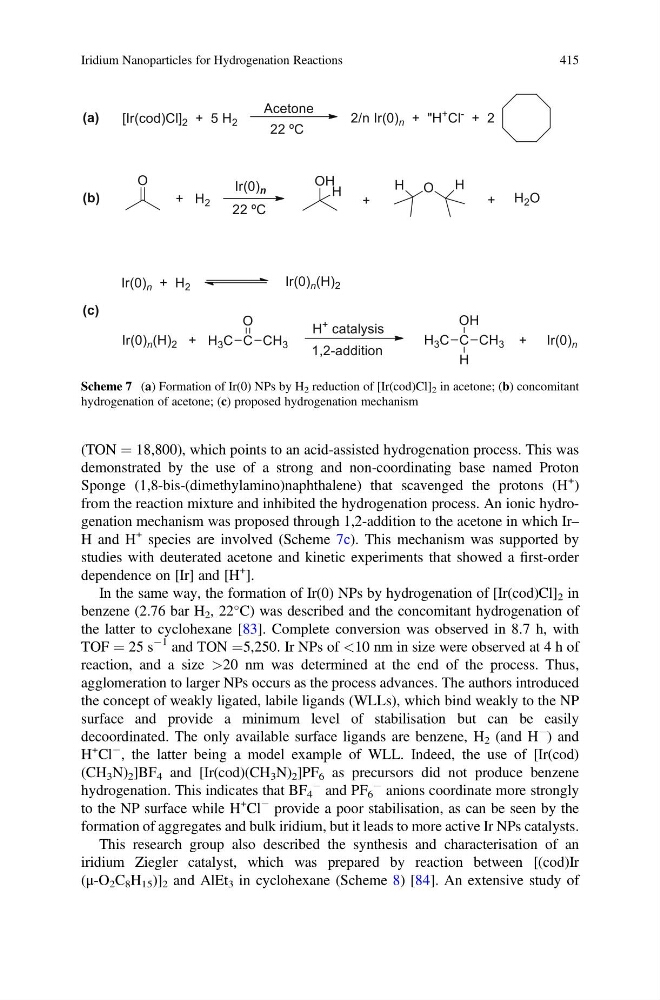
from the reaction mixture and inhibited the hydrogenation process. An ionic hydrogenation mechanism was proposed through 1,2-addition to the acetone in which Ir–
H and H
+ species are involved (Scheme 7c). This mechanism was supported by
studies with deuterated acetone and kinetic experiments that showed a first-order
dependence on [Ir] and [H
+
].
In the same way, the formation of Ir(0) NPs by hydrogenation of [Ir(cod)Cl] 2 in
benzene (2.76 bar H 2 , 22
C) was described and the concomitant hydrogenation of
the latter to cyclohexane [83]. Complete conversion was observed in 8.7 h, with
TOF ¼ 25 s
À1 and TON ¼5,250. Ir NPs of <10 nm in size were observed at 4 h of
reaction, and a size >20 nm was determined at the end of the process. Thus,
agglomeration to larger NPs occurs as the process advances. The authors introduced
the concept of weakly ligated, labile ligands (WLLs), which bind weakly to the NP
surface and provide a minimum level of stabilisation but can be easily
decoordinated. The only available surface ligands are benzene, H 2 (and H
À
) and
H
+
Cl
À , the latter being a model example of WLL. Indeed, the use of [Ir(cod)
(CH 3 N) 2 ]BF 4 and [Ir(cod)(CH 3 N) 2 ]PF 6 as precursors did not produce benzene
hydrogenation. This indicates that BF 4
À and PF 6
À anions coordinate more strongly
to the NP surface while H
+
Cl
À provide a poor stabilisation, as can be seen by the
formation of aggregates and bulk iridium, but it leads to more active Ir NPs catalysts.
This research group also described the synthesis and characterisation of an
iridium Ziegler catalyst, which was prepared by reaction between [(cod)Ir
(μ-O 2 C 8 H 15 )] 2 and AlEt 3 in cyclohexane (Scheme 8) [84]. An extensive study of
Scheme 7 (a) Formation of Ir(0) NPs by H 2 reduction of [Ir(cod)Cl] 2 in acetone; (b) concomitant
hydrogenation of acetone; (c) proposed hydrogenation mechanism
Iridium Nanoparticles for Hydrogenation Reactions
415
demonstrated by the use of a strong and non-coordinating base named Proton
Sponge (1,8-bis-(dimethylamino)naphthalene) that scavenged the protons (H
+
)
from the reaction mixture and inhibited the hydrogenation process. An ionic hydrogenation mechanism was proposed through 1,2-addition to the acetone in which Ir–
H and H
+ species are involved (Scheme 7c). This mechanism was supported by
studies with deuterated acetone and kinetic experiments that showed a first-order
dependence on [Ir] and [H
+
].
In the same way, the formation of Ir(0) NPs by hydrogenation of [Ir(cod)Cl] 2 in
benzene (2.76 bar H 2 , 22
C) was described and the concomitant hydrogenation of
the latter to cyclohexane [83]. Complete conversion was observed in 8.7 h, with
TOF ¼ 25 s
À1 and TON ¼5,250. Ir NPs of <10 nm in size were observed at 4 h of
reaction, and a size >20 nm was determined at the end of the process. Thus,
agglomeration to larger NPs occurs as the process advances. The authors introduced
the concept of weakly ligated, labile ligands (WLLs), which bind weakly to the NP
surface and provide a minimum level of stabilisation but can be easily
decoordinated. The only available surface ligands are benzene, H 2 (and H
À
) and
H
+
Cl
À , the latter being a model example of WLL. Indeed, the use of [Ir(cod)
(CH 3 N) 2 ]BF 4 and [Ir(cod)(CH 3 N) 2 ]PF 6 as precursors did not produce benzene
hydrogenation. This indicates that BF 4
À and PF 6
À anions coordinate more strongly
to the NP surface while H
+
Cl
À provide a poor stabilisation, as can be seen by the
formation of aggregates and bulk iridium, but it leads to more active Ir NPs catalysts.
This research group also described the synthesis and characterisation of an
iridium Ziegler catalyst, which was prepared by reaction between [(cod)Ir
(μ-O 2 C 8 H 15 )] 2 and AlEt 3 in cyclohexane (Scheme 8) [84]. An extensive study of
Scheme 7 (a) Formation of Ir(0) NPs by H 2 reduction of [Ir(cod)Cl] 2 in acetone; (b) concomitant
hydrogenation of acetone; (c) proposed hydrogenation mechanism
Iridium Nanoparticles for Hydrogenation Reactions
415