

may be used as building blocks for the production of catalytically active Ir NPs with
a controlled ligand composition.
The use of organic compounds that serve as solvent, as reducing agent and as
stabiliser is an interesting strategy to prepare ligand-stabilised MNPs. Following this
approach, highly crystalline NiIr 4 NPs (Ir/Ni ratio: 4) were synthesised by heating of
IrCl 3 in oleylamine at 300
C, which were subsequently isolated by centrifugation
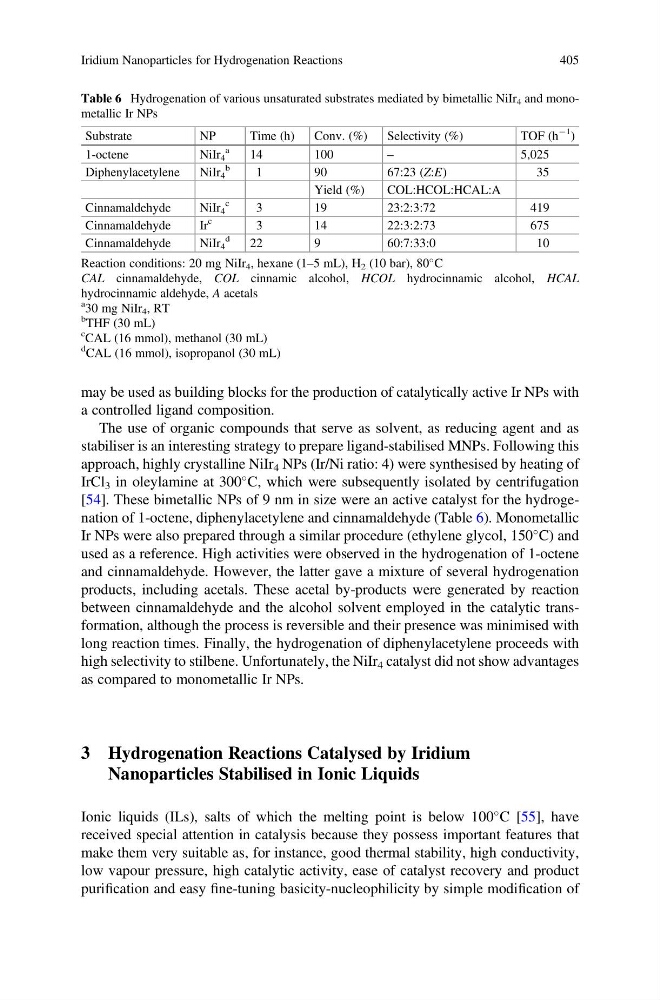
[54]. These bimetallic NPs of 9 nm in size were an active catalyst for the hydrogenation of 1-octene, diphenylacetylene and cinnamaldehyde (Table 6). Monometallic
Ir NPs were also prepared through a similar procedure (ethylene glycol, 150
C) and
used as a reference. High activities were observed in the hydrogenation of 1-octene
and cinnamaldehyde. However, the latter gave a mixture of several hydrogenation
products, including acetals. These acetal by-products were generated by reaction
between cinnamaldehyde and the alcohol solvent employed in the catalytic transformation, although the process is reversible and their presence was minimised with
long reaction times. Finally, the hydrogenation of diphenylacetylene proceeds with
high selectivity to stilbene. Unfortunately, the NiIr 4 catalyst did not show advantages
as compared to monometallic Ir NPs.
3 Hydrogenation Reactions Catalysed by Iridium
Nanoparticles Stabilised in Ionic Liquids
Ionic liquids (ILs), salts of which the melting point is below 100
C [55], have
received special attention in catalysis because they possess important features that
make them very suitable as, for instance, good thermal stability, high conductivity,
low vapour pressure, high catalytic activity, ease of catalyst recovery and product
purification and easy fine-tuning basicity-nucleophilicity by simple modification of
Table 6 Hydrogenation of various unsaturated substrates mediated by bimetallic NiIr 4 and monometallic Ir NPs
Substrate
NP
Time (h)
Conv. (%)
Selectivity (%)
TOF (h
À1
)
1-octene
NiIr 4
a
14
100
–
5,025
Diphenylacetylene
NiIr 4
b
1
90
67:23 (Z:E)
3 5
Yield (%)
COL:HCOL:HCAL:A
Cinnamaldehyde
NiIr 4
c
3
19
23:2:3:72
419
Cinnamaldehyde
Ir
c
3
14
22:3:2:73
675
Cinnamaldehyde
NiIr 4
d
22
9
60:7:33:0
10
Reaction conditions: 20 mg NiIr 4 , hexane (1–5 mL), H 2 (10 bar), 80
C
CAL cinnamaldehyde, COL cinnamic alcohol, HCOL hydrocinnamic alcohol, HCAL
hydrocinnamic aldehyde, A acetals
a 30 mg NiIr 4 , RT
b
THF (30 mL)
c CAL (16 mmol), methanol (30 mL)
d
CAL (16 mmol), isopropanol (30 mL)
Iridium Nanoparticles for Hydrogenation Reactions
405
a controlled ligand composition.
The use of organic compounds that serve as solvent, as reducing agent and as
stabiliser is an interesting strategy to prepare ligand-stabilised MNPs. Following this
approach, highly crystalline NiIr 4 NPs (Ir/Ni ratio: 4) were synthesised by heating of
IrCl 3 in oleylamine at 300
C, which were subsequently isolated by centrifugation
[54]. These bimetallic NPs of 9 nm in size were an active catalyst for the hydrogenation of 1-octene, diphenylacetylene and cinnamaldehyde (Table 6). Monometallic
Ir NPs were also prepared through a similar procedure (ethylene glycol, 150
C) and
used as a reference. High activities were observed in the hydrogenation of 1-octene
and cinnamaldehyde. However, the latter gave a mixture of several hydrogenation
products, including acetals. These acetal by-products were generated by reaction
between cinnamaldehyde and the alcohol solvent employed in the catalytic transformation, although the process is reversible and their presence was minimised with
long reaction times. Finally, the hydrogenation of diphenylacetylene proceeds with
high selectivity to stilbene. Unfortunately, the NiIr 4 catalyst did not show advantages
as compared to monometallic Ir NPs.
3 Hydrogenation Reactions Catalysed by Iridium
Nanoparticles Stabilised in Ionic Liquids
Ionic liquids (ILs), salts of which the melting point is below 100
C [55], have
received special attention in catalysis because they possess important features that
make them very suitable as, for instance, good thermal stability, high conductivity,
low vapour pressure, high catalytic activity, ease of catalyst recovery and product
purification and easy fine-tuning basicity-nucleophilicity by simple modification of
Table 6 Hydrogenation of various unsaturated substrates mediated by bimetallic NiIr 4 and monometallic Ir NPs
Substrate
NP
Time (h)
Conv. (%)
Selectivity (%)
TOF (h
À1
)
1-octene
NiIr 4
a
14
100
–
5,025
Diphenylacetylene
NiIr 4
b
1
90
67:23 (Z:E)
3 5
Yield (%)
COL:HCOL:HCAL:A
Cinnamaldehyde
NiIr 4
c
3
19
23:2:3:72
419
Cinnamaldehyde
Ir
c
3
14
22:3:2:73
675
Cinnamaldehyde
NiIr 4
d
22
9
60:7:33:0
10
Reaction conditions: 20 mg NiIr 4 , hexane (1–5 mL), H 2 (10 bar), 80
C
CAL cinnamaldehyde, COL cinnamic alcohol, HCOL hydrocinnamic alcohol, HCAL
hydrocinnamic aldehyde, A acetals
a 30 mg NiIr 4 , RT
b
THF (30 mL)
c CAL (16 mmol), methanol (30 mL)
d
CAL (16 mmol), isopropanol (30 mL)
Iridium Nanoparticles for Hydrogenation Reactions
405