

Roucoux, Chaudret and coworkers employed an aqueous solution of Ir(0) NPs
stabilised by N,N-dimethyl-N-cetyl-N-(2-hydroxyethyl)ammonium chloride for
arene hydrogenation [51]. The Ir NPs of 1.9 (0.7) nm in size were synthesised by
NaBH 4 reduction of IrCl 3 in the presence of this surfactant under microwaveassisted conditions. These NPs were stored in solution and subsequently used for
the hydrogenation of several aromatic compounds in biphasic media (substrate/
Ir ¼ 100, water, 40 bar H 2 , 20
C), showing good recycling behaviour and TOF
values up to 400 h
À1 for the hydrogenation of anisole.
In 2005, Korgel and coworkers described the use of oleic acid and oleylamine,
tetraoctylammonium bromide (TOAB), trioctylphosphine (TOP) and
tetraoctylphosphonium bromide (TOPB) to stabilise Ir NPs, which were subsequently employed as catalysts for 1-decene hydrogenation [52]. The NP size
decreases in the order TOP (10–100 nm) > TOPB (~4 nm) > oleic–oleylamine
(~2 and ~ 4 nm by selective precipitation) > TOAB (1.5–3 nm). Interestingly,
TOPB-ligated Ir NPs showed higher activity than those stabilised by TOAB, while
the use of TOP and oleic acid and oleylamine led to catalytically inactive NPs. It was
proposed that the ligand desorption allows the access of 1-decene to metal surface
sites. The smallest NPs (TOAB) would show stronger ligand binding and thus are
less active (4 s
À1 at 75
C, 0.21 bar H 2 and 1,000:1-decene/Ir mass ratio) than the
bigger NPs stabilised by the presumably labile TOPB ligand (270 s
À1 ). Similarly,
oleic acid and oleylamine would bind very strongly to the surface, and therefore the
corresponding NPs are not active. Indeed, before decreasing in the fifth cycle, an
increase in TOF values was observed for the first four cycles in the recycling
experiments with TOAB-ligated Ir NPs (4 ! 13 ! 50 ! 124 s
À1 ), which was
attributed to this ligand desorption. Although the ligand desorption is key for the
observed activity, this example does not describe a real role of the ligand in the
catalytic process.
In this vein, Finke and coworkers described the use of Ir NPs stabilised only by
H
+
Cl
À , Ir(0) n Á(H
+
Cl
À ) a , as structural unit to prepare new Ir NPs by exchange with
more strongly binding ligands such as tributylamine (Bu 3 N), tridodecylamine
(Dodec 3 N) and trioctylphosphine (P(Oct) 3 ) [53]. The Ir(0) n Á(H
+
Cl
À ) a NPs are generated by H 2 reduction of [Ir(cod)Cl] 2 in acetone, and H
+
Cl
À can be easily replaced
in situ by other ligands of interest that coordinate more strongly. Indeed, the
analogous H 2 reduction of [Ir(cod)Cl] 2 in the presence of these ligands allows one
to obtain new nanoparticles, which were employed as catalysts for cyclohexene
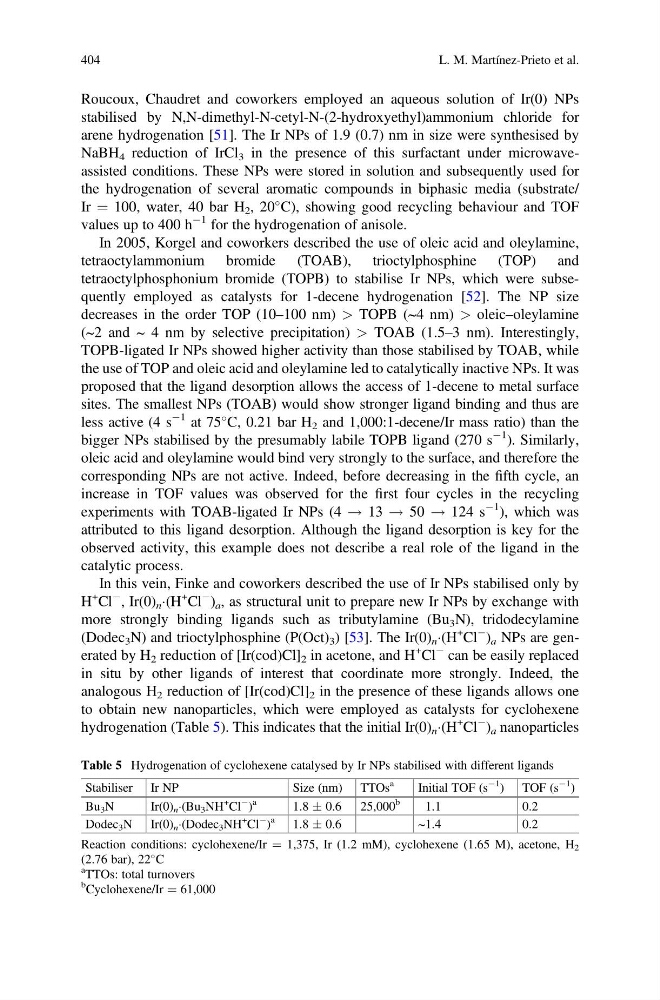
hydrogenation (Table 5). This indicates that the initial Ir(0) n Á(H
+
Cl
À ) a nanoparticles
Table 5 Hydrogenation of cyclohexene catalysed by Ir NPs stabilised with different ligands
Stabiliser Ir NP
Size (nm) TTOs
a
Initial TOF (s
À1
) TOF (s
À1
)
Bu 3 N
Ir(0) n Á(Bu 3 NH
+ Cl
À
)
a
1.8 Æ 0.6 25,000
b
1.1
0.2
Dodec 3 N Ir(0) n Á(Dodec 3 NH
+ Cl
À )
a
1.8 Æ 0.6
~1.4
0.2
Reaction conditions: cyclohexene/Ir ¼ 1,375, Ir (1.2 mM), cyclohexene (1.65 M), acetone, H 2
(2.76 bar), 22
C
a TTOs: total turnovers
b
Cyclohexene/Ir ¼ 61,000
404
L. M. Martínez-Prieto et al.
stabilised by N,N-dimethyl-N-cetyl-N-(2-hydroxyethyl)ammonium chloride for
arene hydrogenation [51]. The Ir NPs of 1.9 (0.7) nm in size were synthesised by
NaBH 4 reduction of IrCl 3 in the presence of this surfactant under microwaveassisted conditions. These NPs were stored in solution and subsequently used for
the hydrogenation of several aromatic compounds in biphasic media (substrate/
Ir ¼ 100, water, 40 bar H 2 , 20
C), showing good recycling behaviour and TOF
values up to 400 h
À1 for the hydrogenation of anisole.
In 2005, Korgel and coworkers described the use of oleic acid and oleylamine,
tetraoctylammonium bromide (TOAB), trioctylphosphine (TOP) and
tetraoctylphosphonium bromide (TOPB) to stabilise Ir NPs, which were subsequently employed as catalysts for 1-decene hydrogenation [52]. The NP size
decreases in the order TOP (10–100 nm) > TOPB (~4 nm) > oleic–oleylamine
(~2 and ~ 4 nm by selective precipitation) > TOAB (1.5–3 nm). Interestingly,
TOPB-ligated Ir NPs showed higher activity than those stabilised by TOAB, while
the use of TOP and oleic acid and oleylamine led to catalytically inactive NPs. It was
proposed that the ligand desorption allows the access of 1-decene to metal surface
sites. The smallest NPs (TOAB) would show stronger ligand binding and thus are
less active (4 s
À1 at 75
C, 0.21 bar H 2 and 1,000:1-decene/Ir mass ratio) than the
bigger NPs stabilised by the presumably labile TOPB ligand (270 s
À1 ). Similarly,
oleic acid and oleylamine would bind very strongly to the surface, and therefore the
corresponding NPs are not active. Indeed, before decreasing in the fifth cycle, an
increase in TOF values was observed for the first four cycles in the recycling
experiments with TOAB-ligated Ir NPs (4 ! 13 ! 50 ! 124 s
À1 ), which was
attributed to this ligand desorption. Although the ligand desorption is key for the
observed activity, this example does not describe a real role of the ligand in the
catalytic process.
In this vein, Finke and coworkers described the use of Ir NPs stabilised only by
H
+
Cl
À , Ir(0) n Á(H
+
Cl
À ) a , as structural unit to prepare new Ir NPs by exchange with
more strongly binding ligands such as tributylamine (Bu 3 N), tridodecylamine
(Dodec 3 N) and trioctylphosphine (P(Oct) 3 ) [53]. The Ir(0) n Á(H
+
Cl
À ) a NPs are generated by H 2 reduction of [Ir(cod)Cl] 2 in acetone, and H
+
Cl
À can be easily replaced
in situ by other ligands of interest that coordinate more strongly. Indeed, the
analogous H 2 reduction of [Ir(cod)Cl] 2 in the presence of these ligands allows one
to obtain new nanoparticles, which were employed as catalysts for cyclohexene
hydrogenation (Table 5). This indicates that the initial Ir(0) n Á(H
+
Cl
À ) a nanoparticles
Table 5 Hydrogenation of cyclohexene catalysed by Ir NPs stabilised with different ligands
Stabiliser Ir NP
Size (nm) TTOs
a
Initial TOF (s
À1
) TOF (s
À1
)
Bu 3 N
Ir(0) n Á(Bu 3 NH
+ Cl
À
)
a
1.8 Æ 0.6 25,000
b
1.1
0.2
Dodec 3 N Ir(0) n Á(Dodec 3 NH
+ Cl
À )
a
1.8 Æ 0.6
~1.4
0.2
Reaction conditions: cyclohexene/Ir ¼ 1,375, Ir (1.2 mM), cyclohexene (1.65 M), acetone, H 2
(2.76 bar), 22
C
a TTOs: total turnovers
b
Cyclohexene/Ir ¼ 61,000
404
L. M. Martínez-Prieto et al.