

synthesised through NaBH 4 reduction of IrCl 3 , which were subsequently
immobilised in SiO 2 by impregnation (1 wt% Ir). These Ir NPs gave 90% conversion
and 23% ee in the asymmetric hydrogenation of ethyl pyruvate (substrate/Ir ¼ 100,
40 bar H 2 , RT, 460 min), which shows a chiral induction from the ligand.
In the same way, Cano, van Leeuwen and coworkers described the synthesis of Ir
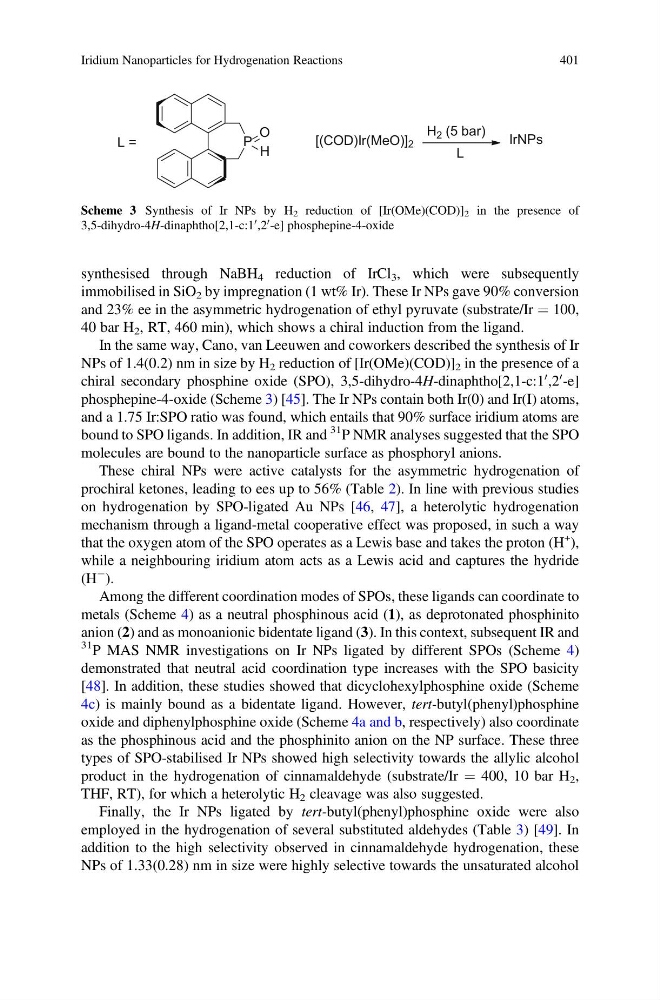
NPs of 1.4(0.2) nm in size by H 2 reduction of [Ir(OMe)(COD)] 2 in the presence of a
chiral secondary phosphine oxide (SPO), 3,5-dihydro-4H-dinaphtho[2,1-c:1
0 ,2
0 -e]
phosphepine-4-oxide (Scheme 3) [45]. The Ir NPs contain both Ir(0) and Ir(I) atoms,
and a 1.75 Ir:SPO ratio was found, which entails that 90% surface iridium atoms are
bound to SPO ligands. In addition, IR and
31 P NMR analyses suggested that the SPO
molecules are bound to the nanoparticle surface as phosphoryl anions.
These chiral NPs were active catalysts for the asymmetric hydrogenation of
prochiral ketones, leading to ees up to 56% (Table 2). In line with previous studies
on hydrogenation by SPO-ligated Au NPs [46, 47], a heterolytic hydrogenation
mechanism through a ligand-metal cooperative effect was proposed, in such a way
that the oxygen atom of the SPO operates as a Lewis base and takes the proton (H
+
),
while a neighbouring iridium atom acts as a Lewis acid and captures the hydride
(H
À ).
Among the different coordination modes of SPOs, these ligands can coordinate to
metals (Scheme 4) as a neutral phosphinous acid (1), as deprotonated phosphinito
anion (2) and as monoanionic bidentate ligand (3). In this context, subsequent IR and
31 P MAS NMR investigations on Ir NPs ligated by different SPOs (Scheme 4)
demonstrated that neutral acid coordination type increases with the SPO basicity
[48]. In addition, these studies showed that dicyclohexylphosphine oxide (Scheme
4c) is mainly bound as a bidentate ligand. However, tert-butyl(phenyl)phosphine
oxide and diphenylphosphine oxide (Scheme 4a and b, respectively) also coordinate
as the phosphinous acid and the phosphinito anion on the NP surface. These three
types of SPO-stabilised Ir NPs showed high selectivity towards the allylic alcohol
product in the hydrogenation of cinnamaldehyde (substrate/Ir ¼ 400, 10 bar H 2 ,
THF, RT), for which a heterolytic H 2 cleavage was also suggested.
Finally, the Ir NPs ligated by tert-butyl(phenyl)phosphine oxide were also
employed in the hydrogenation of several substituted aldehydes (Table 3) [49]. In
addition to the high selectivity observed in cinnamaldehyde hydrogenation, these
NPs of 1.33(0.28) nm in size were highly selective towards the unsaturated alcohol
P
O
H
H 2 (5 bar)
IrNPs
[(COD)Ir(MeO)] 2
L =
L
Scheme 3 Synthesis of Ir NPs by H 2 reduction of [Ir(OMe)(COD)] 2 in the presence of
3,5-dihydro-4H-dinaphtho[2,1-c:1
0 ,2
0 -e] phosphepine-4-oxide
Iridium Nanoparticles for Hydrogenation Reactions
401
immobilised in SiO 2 by impregnation (1 wt% Ir). These Ir NPs gave 90% conversion
and 23% ee in the asymmetric hydrogenation of ethyl pyruvate (substrate/Ir ¼ 100,
40 bar H 2 , RT, 460 min), which shows a chiral induction from the ligand.
In the same way, Cano, van Leeuwen and coworkers described the synthesis of Ir
NPs of 1.4(0.2) nm in size by H 2 reduction of [Ir(OMe)(COD)] 2 in the presence of a
chiral secondary phosphine oxide (SPO), 3,5-dihydro-4H-dinaphtho[2,1-c:1
0 ,2
0 -e]
phosphepine-4-oxide (Scheme 3) [45]. The Ir NPs contain both Ir(0) and Ir(I) atoms,
and a 1.75 Ir:SPO ratio was found, which entails that 90% surface iridium atoms are
bound to SPO ligands. In addition, IR and
31 P NMR analyses suggested that the SPO
molecules are bound to the nanoparticle surface as phosphoryl anions.
These chiral NPs were active catalysts for the asymmetric hydrogenation of
prochiral ketones, leading to ees up to 56% (Table 2). In line with previous studies
on hydrogenation by SPO-ligated Au NPs [46, 47], a heterolytic hydrogenation
mechanism through a ligand-metal cooperative effect was proposed, in such a way
that the oxygen atom of the SPO operates as a Lewis base and takes the proton (H
+
),
while a neighbouring iridium atom acts as a Lewis acid and captures the hydride
(H
À ).
Among the different coordination modes of SPOs, these ligands can coordinate to
metals (Scheme 4) as a neutral phosphinous acid (1), as deprotonated phosphinito
anion (2) and as monoanionic bidentate ligand (3). In this context, subsequent IR and
31 P MAS NMR investigations on Ir NPs ligated by different SPOs (Scheme 4)
demonstrated that neutral acid coordination type increases with the SPO basicity
[48]. In addition, these studies showed that dicyclohexylphosphine oxide (Scheme
4c) is mainly bound as a bidentate ligand. However, tert-butyl(phenyl)phosphine
oxide and diphenylphosphine oxide (Scheme 4a and b, respectively) also coordinate
as the phosphinous acid and the phosphinito anion on the NP surface. These three
types of SPO-stabilised Ir NPs showed high selectivity towards the allylic alcohol
product in the hydrogenation of cinnamaldehyde (substrate/Ir ¼ 400, 10 bar H 2 ,
THF, RT), for which a heterolytic H 2 cleavage was also suggested.
Finally, the Ir NPs ligated by tert-butyl(phenyl)phosphine oxide were also
employed in the hydrogenation of several substituted aldehydes (Table 3) [49]. In
addition to the high selectivity observed in cinnamaldehyde hydrogenation, these
NPs of 1.33(0.28) nm in size were highly selective towards the unsaturated alcohol
P
O
H
H 2 (5 bar)
IrNPs
[(COD)Ir(MeO)] 2
L =
L
Scheme 3 Synthesis of Ir NPs by H 2 reduction of [Ir(OMe)(COD)] 2 in the presence of
3,5-dihydro-4H-dinaphtho[2,1-c:1
0 ,2
0 -e] phosphepine-4-oxide
Iridium Nanoparticles for Hydrogenation Reactions
401