

was also used to scale up the reaction in an experiment where 25 g of 5-HMF was
used and where HHD was obtained in a good isolated yield of 71% after 1 h [53].
In conclusion, it has been demonstrated that Cp* iridium complexes bearing
additional bidentate ligands show a high activity and a good selectivity in the
conversion of 5-HMF into HHD (see Table 1). However, the scalability of the
HHD production from 5-HMF through homogenous iridium-catalyzed hydrogenations is still strongly limited by the formation of humins which may be reduced by
using high dilutions, and by the poor reusability of the catalysts [61].
3.2 Conversion of Furfural Compounds to Ketones
Due to the promising results obtained in the synthesis of HHD from 5-HMF, an
increasing interest in the further applications of HHD has emerged. Interestingly,
several iridium-catalyzed reactions using 5-HMF as the starting material were
reported where HHD was formed in situ and then it further cyclized to two different
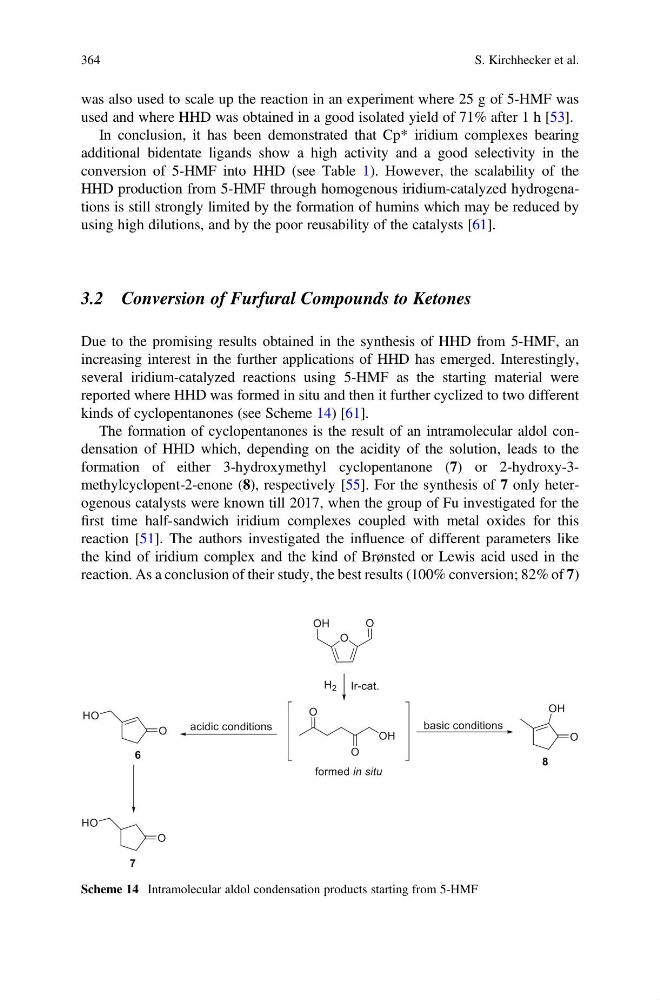
kinds of cyclopentanones (see Scheme 14) [61].
The formation of cyclopentanones is the result of an intramolecular aldol condensation of HHD which, depending on the acidity of the solution, leads to the
formation of either 3-hydroxymethyl cyclopentanone (7) or 2-hydroxy-3methylcyclopent-2-enone (8), respectively [55]. For the synthesis of 7 only heterogenous catalysts were known till 2017, when the group of Fu investigated for the
first time half-sandwich iridium complexes coupled with metal oxides for this
reaction [51]. The authors investigated the influence of different parameters like
the kind of iridium complex and the kind of Brønsted or Lewis acid used in the
reaction. As a conclusion of their study, the best results (100% conversion; 82% of 7)
Scheme 14 Intramolecular aldol condensation products starting from 5-HMF
364
S. Kirchhecker et al.
used and where HHD was obtained in a good isolated yield of 71% after 1 h [53].
In conclusion, it has been demonstrated that Cp* iridium complexes bearing
additional bidentate ligands show a high activity and a good selectivity in the
conversion of 5-HMF into HHD (see Table 1). However, the scalability of the
HHD production from 5-HMF through homogenous iridium-catalyzed hydrogenations is still strongly limited by the formation of humins which may be reduced by
using high dilutions, and by the poor reusability of the catalysts [61].
3.2 Conversion of Furfural Compounds to Ketones
Due to the promising results obtained in the synthesis of HHD from 5-HMF, an
increasing interest in the further applications of HHD has emerged. Interestingly,
several iridium-catalyzed reactions using 5-HMF as the starting material were
reported where HHD was formed in situ and then it further cyclized to two different
kinds of cyclopentanones (see Scheme 14) [61].
The formation of cyclopentanones is the result of an intramolecular aldol condensation of HHD which, depending on the acidity of the solution, leads to the
formation of either 3-hydroxymethyl cyclopentanone (7) or 2-hydroxy-3methylcyclopent-2-enone (8), respectively [55]. For the synthesis of 7 only heterogenous catalysts were known till 2017, when the group of Fu investigated for the
first time half-sandwich iridium complexes coupled with metal oxides for this
reaction [51]. The authors investigated the influence of different parameters like
the kind of iridium complex and the kind of Brønsted or Lewis acid used in the
reaction. As a conclusion of their study, the best results (100% conversion; 82% of 7)
Scheme 14 Intramolecular aldol condensation products starting from 5-HMF
364
S. Kirchhecker et al.