

them to synthesize HHD via hydrolytic hydrogenation (30 bar) with a selectivity of
77% in the presence of 5 wt% of Al 2 (SO 4 ) 3 (Table 1, Entry 3) [51]. Zhang and
coworkers tested a new series of Cp*-iridium(III) complexes bearing different
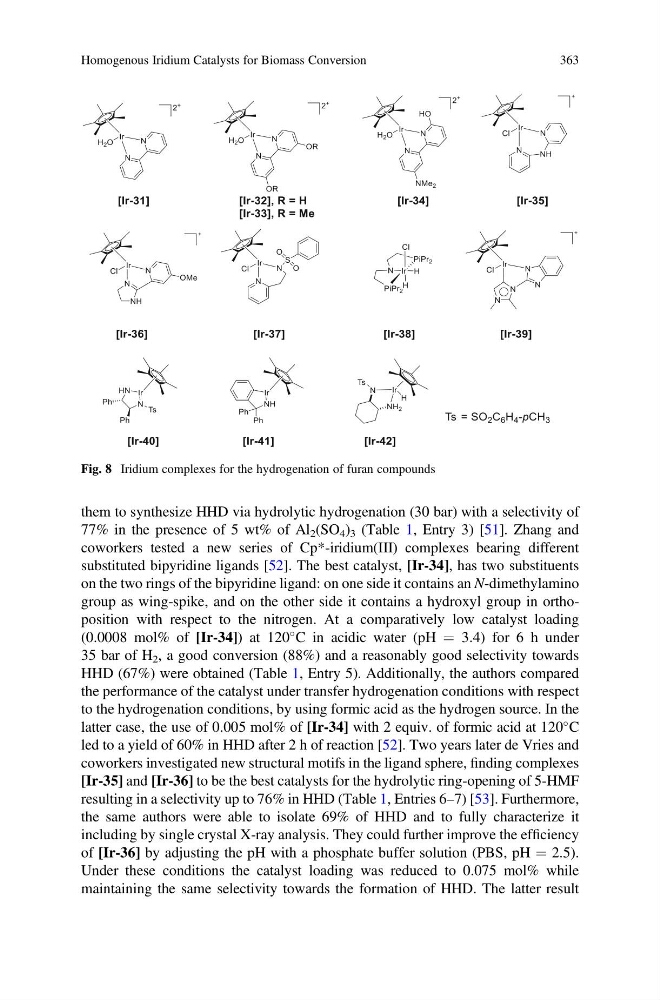
substituted bipyridine ligands [52]. The best catalyst, [Ir-34], has two substituents
on the two rings of the bipyridine ligand: on one side it contains an N-dimethylamino
group as wing-spike, and on the other side it contains a hydroxyl group in orthoposition with respect to the nitrogen. At a comparatively low catalyst loading
(0.0008 mol% of [Ir-34]) at 120
C in acidic water (pH ¼ 3.4) for 6 h under
35 bar of H 2 , a good conversion (88%) and a reasonably good selectivity towards
HHD (67%) were obtained (Table 1, Entry 5). Additionally, the authors compared
the performance of the catalyst under transfer hydrogenation conditions with respect
to the hydrogenation conditions, by using formic acid as the hydrogen source. In the
latter case, the use of 0.005 mol% of [Ir-34] with 2 equiv. of formic acid at 120
C
led to a yield of 60% in HHD after 2 h of reaction [52]. Two years later de Vries and
coworkers investigated new structural motifs in the ligand sphere, finding complexes
[Ir-35] and [Ir-36] to be the best catalysts for the hydrolytic ring-opening of 5-HMF
resulting in a selectivity up to 76% in HHD (Table 1, Entries 6–7) [53]. Furthermore,
the same authors were able to isolate 69% of HHD and to fully characterize it
including by single crystal X-ray analysis. They could further improve the efficiency
of [Ir-36] by adjusting the pH with a phosphate buffer solution (PBS, pH ¼ 2.5).
Under these conditions the catalyst loading was reduced to 0.075 mol% while
maintaining the same selectivity towards the formation of HHD. The latter result
Fig. 8 Iridium complexes for the hydrogenation of furan compounds
Homogenous Iridium Catalysts for Biomass Conversion
363
77% in the presence of 5 wt% of Al 2 (SO 4 ) 3 (Table 1, Entry 3) [51]. Zhang and
coworkers tested a new series of Cp*-iridium(III) complexes bearing different
substituted bipyridine ligands [52]. The best catalyst, [Ir-34], has two substituents
on the two rings of the bipyridine ligand: on one side it contains an N-dimethylamino
group as wing-spike, and on the other side it contains a hydroxyl group in orthoposition with respect to the nitrogen. At a comparatively low catalyst loading
(0.0008 mol% of [Ir-34]) at 120
C in acidic water (pH ¼ 3.4) for 6 h under
35 bar of H 2 , a good conversion (88%) and a reasonably good selectivity towards
HHD (67%) were obtained (Table 1, Entry 5). Additionally, the authors compared
the performance of the catalyst under transfer hydrogenation conditions with respect
to the hydrogenation conditions, by using formic acid as the hydrogen source. In the
latter case, the use of 0.005 mol% of [Ir-34] with 2 equiv. of formic acid at 120
C
led to a yield of 60% in HHD after 2 h of reaction [52]. Two years later de Vries and
coworkers investigated new structural motifs in the ligand sphere, finding complexes
[Ir-35] and [Ir-36] to be the best catalysts for the hydrolytic ring-opening of 5-HMF
resulting in a selectivity up to 76% in HHD (Table 1, Entries 6–7) [53]. Furthermore,
the same authors were able to isolate 69% of HHD and to fully characterize it
including by single crystal X-ray analysis. They could further improve the efficiency
of [Ir-36] by adjusting the pH with a phosphate buffer solution (PBS, pH ¼ 2.5).
Under these conditions the catalyst loading was reduced to 0.075 mol% while
maintaining the same selectivity towards the formation of HHD. The latter result
Fig. 8 Iridium complexes for the hydrogenation of furan compounds
Homogenous Iridium Catalysts for Biomass Conversion
363