

reaction, ethylene glycol is dehydrogenated to glycolaldehyde and methanol is
dehydrogenated to formaldehyde. These two products are joined in a base-catalyzed
aldol condensation reaction to give glyceraldehyde which is in equilibrium with
1,3-dihydroxyacetone. Further dehydration results in pyruvaldehyde, which
undergoes an internal Cannizzaro reaction to form lactic acid (Scheme 1). Interestingly, when EG was replaced by either glycerol or sorbitol, the yield of the reaction
remained high and LA was produced with 85% and 99% selectivity, respectively.
Finally, strong σ-donating and weak π-acceptor ligands in combination with Ir
(I) seemed generally beneficial for the conversion of bio-polyols towards LA.
2.1.2 Iridium-Catalyzed Oxidation of Ethylene Glycol Towards
Glycolic Acid
Glycolic acid (GA) is a simple α-hydroxy acid which finds applications in the fields
of fine chemicals and pharmaceutical chemistry [11]. Additionally, GA is of interest
for the synthesis of polyglycolic acid (PGA), a material which could be a sustainable
replacement for traditional plastics, due to its excellent biodegradability and biocompatibility. However, at present, GA is predominantly synthesized via the poorly
sustainable process based on the hydrolysis of chloroacetic acid in alkaline solution
[11]. In contrast, the synthesis of GA from biomass can be achieved through two
different mechanisms both using EG as the starting material. In one method, GA can
be synthesized from EG through an oxidation pathway which proceeds via the
intermediates glycolaldehyde and glyoxal. However, the synthesis of GA through
this process has been so far achieved only by using high temperatures and in the
presence of an oxygen enriched atmosphere and metallic oxides [12]. The second
strategy, alternative to the oxidation pathway for the conversion of EG into GA, is
the use of a dehydrogenation reaction, which is superior to the oxidation pathway,
because it avoids overoxidation. Tang and coworkers have used this strategy and
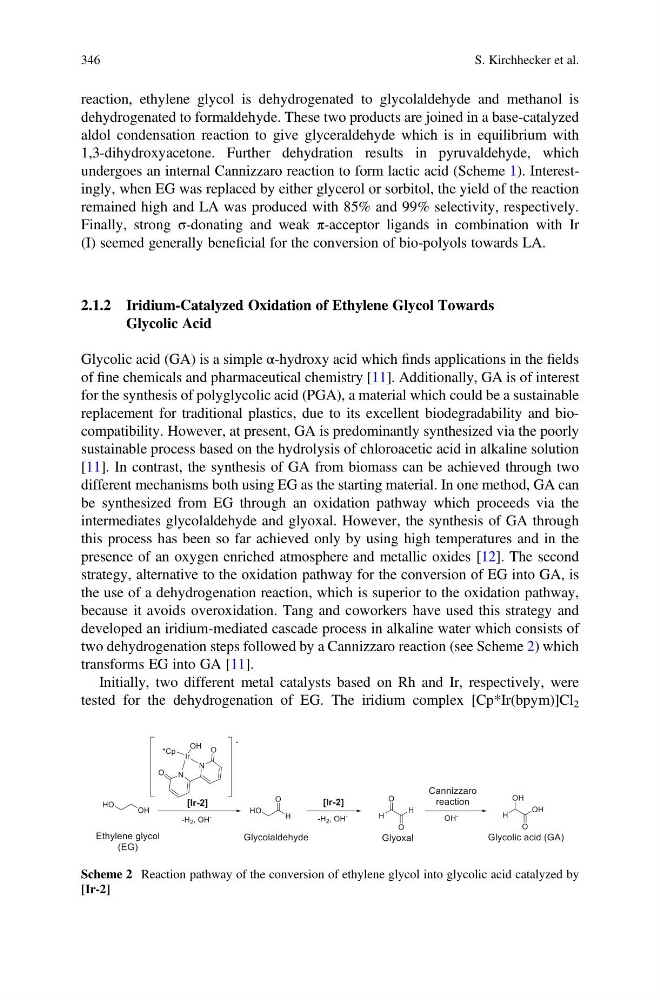
developed an iridium-mediated cascade process in alkaline water which consists of
two dehydrogenation steps followed by a Cannizzaro reaction (see Scheme 2) which
transforms EG into GA [11].
Initially, two different metal catalysts based on Rh and Ir, respectively, were
tested for the dehydrogenation of EG. The iridium complex [Cp*Ir(bpym)]Cl 2
Scheme 2 Reaction pathway of the conversion of ethylene glycol into glycolic acid catalyzed by
[Ir-2]
346
S. Kirchhecker et al.
dehydrogenated to formaldehyde. These two products are joined in a base-catalyzed
aldol condensation reaction to give glyceraldehyde which is in equilibrium with
1,3-dihydroxyacetone. Further dehydration results in pyruvaldehyde, which
undergoes an internal Cannizzaro reaction to form lactic acid (Scheme 1). Interestingly, when EG was replaced by either glycerol or sorbitol, the yield of the reaction
remained high and LA was produced with 85% and 99% selectivity, respectively.
Finally, strong σ-donating and weak π-acceptor ligands in combination with Ir
(I) seemed generally beneficial for the conversion of bio-polyols towards LA.
2.1.2 Iridium-Catalyzed Oxidation of Ethylene Glycol Towards
Glycolic Acid
Glycolic acid (GA) is a simple α-hydroxy acid which finds applications in the fields
of fine chemicals and pharmaceutical chemistry [11]. Additionally, GA is of interest
for the synthesis of polyglycolic acid (PGA), a material which could be a sustainable
replacement for traditional plastics, due to its excellent biodegradability and biocompatibility. However, at present, GA is predominantly synthesized via the poorly
sustainable process based on the hydrolysis of chloroacetic acid in alkaline solution
[11]. In contrast, the synthesis of GA from biomass can be achieved through two
different mechanisms both using EG as the starting material. In one method, GA can
be synthesized from EG through an oxidation pathway which proceeds via the
intermediates glycolaldehyde and glyoxal. However, the synthesis of GA through
this process has been so far achieved only by using high temperatures and in the
presence of an oxygen enriched atmosphere and metallic oxides [12]. The second
strategy, alternative to the oxidation pathway for the conversion of EG into GA, is
the use of a dehydrogenation reaction, which is superior to the oxidation pathway,
because it avoids overoxidation. Tang and coworkers have used this strategy and
developed an iridium-mediated cascade process in alkaline water which consists of
two dehydrogenation steps followed by a Cannizzaro reaction (see Scheme 2) which
transforms EG into GA [11].
Initially, two different metal catalysts based on Rh and Ir, respectively, were
tested for the dehydrogenation of EG. The iridium complex [Cp*Ir(bpym)]Cl 2
Scheme 2 Reaction pathway of the conversion of ethylene glycol into glycolic acid catalyzed by
[Ir-2]
346
S. Kirchhecker et al.