

mostly known for its use as anti-freeze ingredient in liquid mixtures [5]. However,
extremely relevant is its use as a building block for the synthesis of polyesters.
Particularly, polyethylene terephthalate (PET) and, more recently, its green analogue
polyethylene 2,5-furandicarboxylate (PEF) are the polyester materials in which EG
finds its main use [6]. Additionally, other important derivates and platform
chemicals can be obtained from EG. One of them is lactic acid (LA) which has
attracted extensive attention over the last years due to its versatility and the useful
properties of its derived polymer, polylactide [10]. Besides the existing conventional
processes, based on the fermentation of carbohydrates, several new routes based on
renewables have been developed for the production of LA. Tu and coworkers
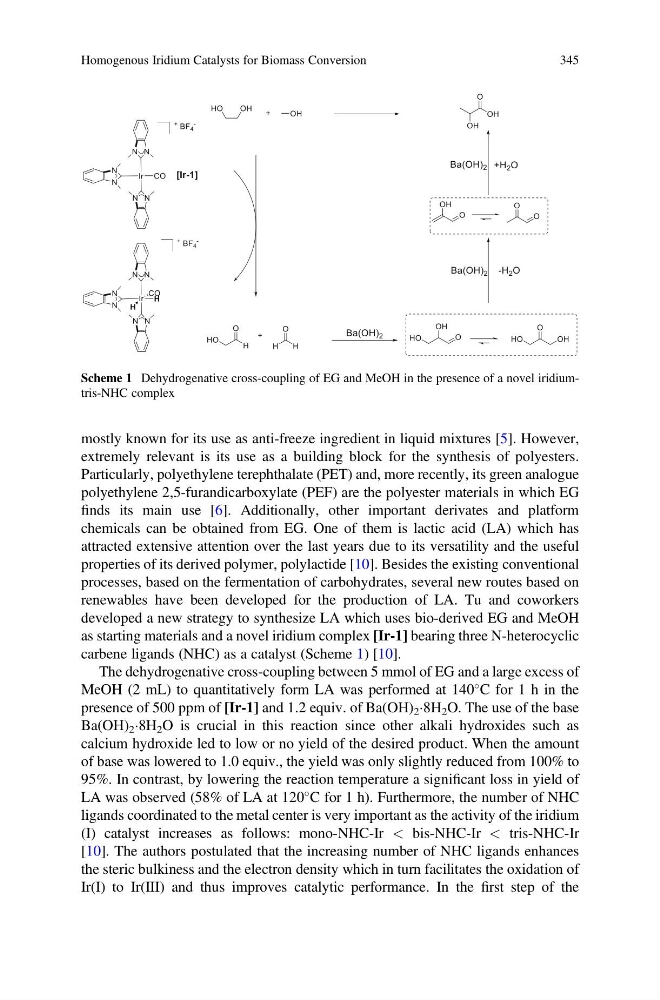
developed a new strategy to synthesize LA which uses bio-derived EG and MeOH
as starting materials and a novel iridium complex [Ir-1] bearing three N-heterocyclic
carbene ligands (NHC) as a catalyst (Scheme 1) [10].
The dehydrogenative cross-coupling between 5 mmol of EG and a large excess of
MeOH (2 mL) to quantitatively form LA was performed at 140
C for 1 h in the
presence of 500 ppm of [Ir-1] and 1.2 equiv. of Ba(OH) 2 Á8H 2 O. The use of the base
Ba(OH) 2 Á8H 2 O is crucial in this reaction since other alkali hydroxides such as
calcium hydroxide led to low or no yield of the desired product. When the amount
of base was lowered to 1.0 equiv., the yield was only slightly reduced from 100% to
95%. In contrast, by lowering the reaction temperature a significant loss in yield of
LA was observed (58% of LA at 120
C for 1 h). Furthermore, the number of NHC
ligands coordinated to the metal center is very important as the activity of the iridium
(I) catalyst increases as follows: mono-NHC-Ir < bis-NHC-Ir < tris-NHC-Ir
[10]. The authors postulated that the increasing number of NHC ligands enhances
the steric bulkiness and the electron density which in turn facilitates the oxidation of
Ir(I) to Ir(III) and thus improves catalytic performance. In the first step of the
Scheme 1 Dehydrogenative cross-coupling of EG and MeOH in the presence of a novel iridiumtris-NHC complex
Homogenous Iridium Catalysts for Biomass Conversion
345
extremely relevant is its use as a building block for the synthesis of polyesters.
Particularly, polyethylene terephthalate (PET) and, more recently, its green analogue
polyethylene 2,5-furandicarboxylate (PEF) are the polyester materials in which EG
finds its main use [6]. Additionally, other important derivates and platform
chemicals can be obtained from EG. One of them is lactic acid (LA) which has
attracted extensive attention over the last years due to its versatility and the useful
properties of its derived polymer, polylactide [10]. Besides the existing conventional
processes, based on the fermentation of carbohydrates, several new routes based on
renewables have been developed for the production of LA. Tu and coworkers
developed a new strategy to synthesize LA which uses bio-derived EG and MeOH
as starting materials and a novel iridium complex [Ir-1] bearing three N-heterocyclic
carbene ligands (NHC) as a catalyst (Scheme 1) [10].
The dehydrogenative cross-coupling between 5 mmol of EG and a large excess of
MeOH (2 mL) to quantitatively form LA was performed at 140
C for 1 h in the
presence of 500 ppm of [Ir-1] and 1.2 equiv. of Ba(OH) 2 Á8H 2 O. The use of the base
Ba(OH) 2 Á8H 2 O is crucial in this reaction since other alkali hydroxides such as
calcium hydroxide led to low or no yield of the desired product. When the amount
of base was lowered to 1.0 equiv., the yield was only slightly reduced from 100% to
95%. In contrast, by lowering the reaction temperature a significant loss in yield of
LA was observed (58% of LA at 120
C for 1 h). Furthermore, the number of NHC
ligands coordinated to the metal center is very important as the activity of the iridium
(I) catalyst increases as follows: mono-NHC-Ir < bis-NHC-Ir < tris-NHC-Ir
[10]. The authors postulated that the increasing number of NHC ligands enhances
the steric bulkiness and the electron density which in turn facilitates the oxidation of
Ir(I) to Ir(III) and thus improves catalytic performance. In the first step of the
Scheme 1 Dehydrogenative cross-coupling of EG and MeOH in the presence of a novel iridiumtris-NHC complex
Homogenous Iridium Catalysts for Biomass Conversion
345