

azole- [41] and pyridyl-pyrazole derivatives [42]. Mechanistic studies have found
that these catalysts promote the activation of CO 2 via an outer-sphere mechanism
[41]. Interestingly, it has been found that using this type of iridium catalysts it is
possible to achieve the pH-controlled reversible hydrogen storage [40, 42, 43].
Further support to the relevant role of oxyanions in these type of catalysts comes
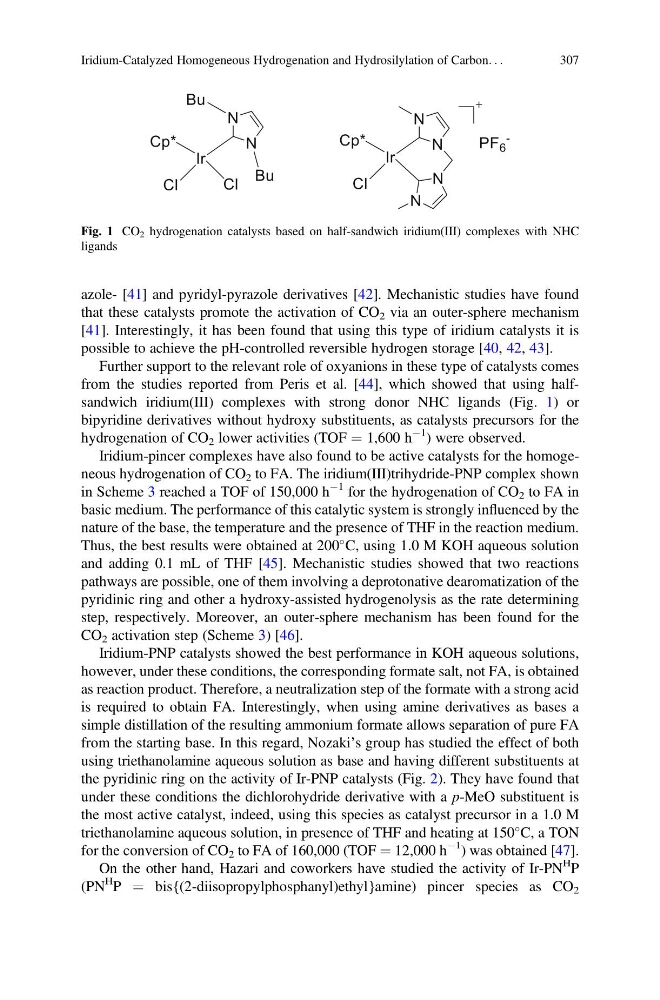
from the studies reported from Peris et al. [44], which showed that using halfsandwich iridium(III) complexes with strong donor NHC ligands (Fig. 1) or
bipyridine derivatives without hydroxy substituents, as catalysts precursors for the
hydrogenation of CO 2 lower activities (TOF ¼ 1,600 h
À1 ) were observed.
Iridium-pincer complexes have also found to be active catalysts for the homogeneous hydrogenation of CO 2 to FA. The iridium(III)trihydride-PNP complex shown
in Scheme 3 reached a TOF of 150,000 h
À1 for the hydrogenation of CO 2 to FA in
basic medium. The performance of this catalytic system is strongly influenced by the
nature of the base, the temperature and the presence of THF in the reaction medium.
Thus, the best results were obtained at 200
C, using 1.0 M KOH aqueous solution
and adding 0.1 mL of THF [45]. Mechanistic studies showed that two reactions
pathways are possible, one of them involving a deprotonative dearomatization of the
pyridinic ring and other a hydroxy-assisted hydrogenolysis as the rate determining
step, respectively. Moreover, an outer-sphere mechanism has been found for the
CO 2 activation step (Scheme 3) [46].
Iridium-PNP catalysts showed the best performance in KOH aqueous solutions,
however, under these conditions, the corresponding formate salt, not FA, is obtained
as reaction product. Therefore, a neutralization step of the formate with a strong acid
is required to obtain FA. Interestingly, when using amine derivatives as bases a
simple distillation of the resulting ammonium formate allows separation of pure FA
from the starting base. In this regard, Nozaki’s group has studied the effect of both
using triethanolamine aqueous solution as base and having different substituents at
the pyridinic ring on the activity of Ir-PNP catalysts (Fig. 2). They have found that
under these conditions the dichlorohydride derivative with a p-MeO substituent is
the most active catalyst, indeed, using this species as catalyst precursor in a 1.0 M
triethanolamine aqueous solution, in presence of THF and heating at 150
C, a TON
for the conversion of CO 2 to FA of 160,000 (TOF ¼ 12,000 h
À1 ) was obtained [47].
On the other hand, Hazari and coworkers have studied the activity of Ir-PN
H P
(PN
H
P ¼ bis{(2-diisopropylphosphanyl)ethyl}amine) pincer species as CO 2
Fig. 1 CO 2 hydrogenation catalysts based on half-sandwich iridium(III) complexes with NHC
ligands
Iridium-Catalyzed Homogeneous Hydrogenation and Hydrosilylation of Carbon. . .
307
that these catalysts promote the activation of CO 2 via an outer-sphere mechanism
[41]. Interestingly, it has been found that using this type of iridium catalysts it is
possible to achieve the pH-controlled reversible hydrogen storage [40, 42, 43].
Further support to the relevant role of oxyanions in these type of catalysts comes
from the studies reported from Peris et al. [44], which showed that using halfsandwich iridium(III) complexes with strong donor NHC ligands (Fig. 1) or
bipyridine derivatives without hydroxy substituents, as catalysts precursors for the
hydrogenation of CO 2 lower activities (TOF ¼ 1,600 h
À1 ) were observed.
Iridium-pincer complexes have also found to be active catalysts for the homogeneous hydrogenation of CO 2 to FA. The iridium(III)trihydride-PNP complex shown
in Scheme 3 reached a TOF of 150,000 h
À1 for the hydrogenation of CO 2 to FA in
basic medium. The performance of this catalytic system is strongly influenced by the
nature of the base, the temperature and the presence of THF in the reaction medium.
Thus, the best results were obtained at 200
C, using 1.0 M KOH aqueous solution
and adding 0.1 mL of THF [45]. Mechanistic studies showed that two reactions
pathways are possible, one of them involving a deprotonative dearomatization of the
pyridinic ring and other a hydroxy-assisted hydrogenolysis as the rate determining
step, respectively. Moreover, an outer-sphere mechanism has been found for the
CO 2 activation step (Scheme 3) [46].
Iridium-PNP catalysts showed the best performance in KOH aqueous solutions,
however, under these conditions, the corresponding formate salt, not FA, is obtained
as reaction product. Therefore, a neutralization step of the formate with a strong acid
is required to obtain FA. Interestingly, when using amine derivatives as bases a
simple distillation of the resulting ammonium formate allows separation of pure FA
from the starting base. In this regard, Nozaki’s group has studied the effect of both
using triethanolamine aqueous solution as base and having different substituents at
the pyridinic ring on the activity of Ir-PNP catalysts (Fig. 2). They have found that
under these conditions the dichlorohydride derivative with a p-MeO substituent is
the most active catalyst, indeed, using this species as catalyst precursor in a 1.0 M
triethanolamine aqueous solution, in presence of THF and heating at 150
C, a TON
for the conversion of CO 2 to FA of 160,000 (TOF ¼ 12,000 h
À1 ) was obtained [47].
On the other hand, Hazari and coworkers have studied the activity of Ir-PN
H P
(PN
H
P ¼ bis{(2-diisopropylphosphanyl)ethyl}amine) pincer species as CO 2
Fig. 1 CO 2 hydrogenation catalysts based on half-sandwich iridium(III) complexes with NHC
ligands
Iridium-Catalyzed Homogeneous Hydrogenation and Hydrosilylation of Carbon. . .
307