

water soluble Ir, Rh, Ru, and Pd phosphane complexes as CO 2 hydrogenation
catalyst is strongly pH dependent [35]. In this regard, Jessop et al. found that
using the complex [RuCl(O 2 CMe)(PMe 3 ) 4 ], which is soluble in supercritical CO 2 ,
as catalysts for the hydrogenation of CO 2 to FA in presence of the appropriate amine
and one alcohol that has an aqueous scale pK a below that of the protonated amine, it
was possible to achieve an initial turnover frequency (TOF) for FA production of
95,000 h
À1 [36]. Since then till the development of the highly active Himeda’s
catalysts [37], based on half-sandwich bipyridine iridium complexes, most of the
homogeneous catalysts effective for the hydrogenation of CO 2 to FA were based on
Ru- and Rh-phosphane complexes.
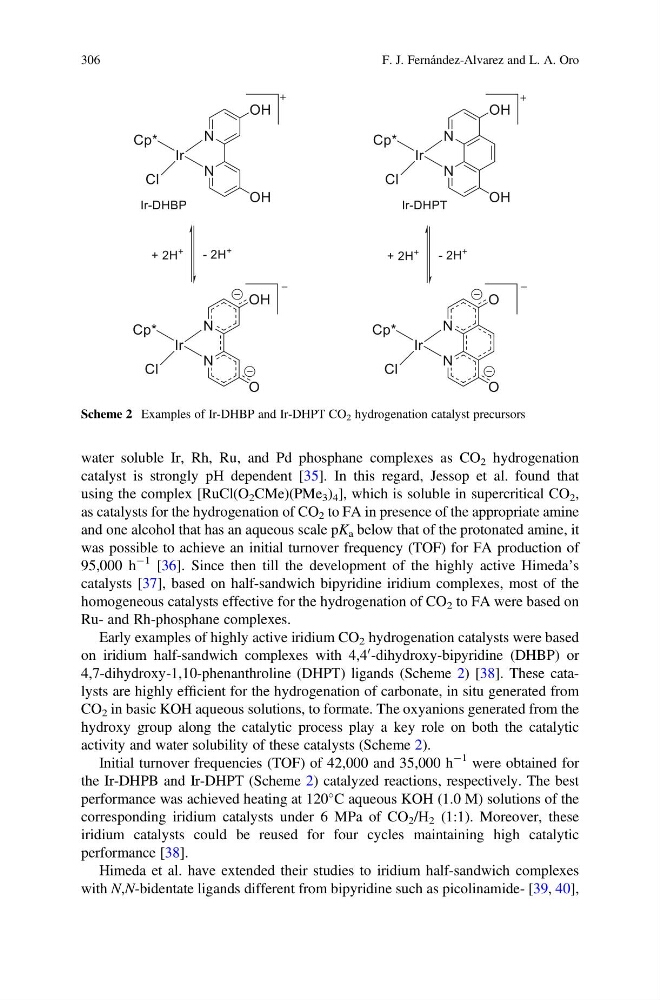
Early examples of highly active iridium CO 2 hydrogenation catalysts were based
on iridium half-sandwich complexes with 4,4
0 -dihydroxy-bipyridine (DHBP) or
4,7-dihydroxy-1,10-phenanthroline (DHPT) ligands (Scheme 2) [38]. These catalysts are highly efficient for the hydrogenation of carbonate, in situ generated from
CO 2 in basic KOH aqueous solutions, to formate. The oxyanions generated from the
hydroxy group along the catalytic process play a key role on both the catalytic
activity and water solubility of these catalysts (Scheme 2).
Initial turnover frequencies (TOF) of 42,000 and 35,000 h
À1 were obtained for
the Ir-DHPB and Ir-DHPT (Scheme 2) catalyzed reactions, respectively. The best
performance was achieved heating at 120
C aqueous KOH (1.0 M) solutions of the
corresponding iridium catalysts under 6 MPa of CO 2 /H 2 (1:1). Moreover, these
iridium catalysts could be reused for four cycles maintaining high catalytic
performance [38].
Himeda et al. have extended their studies to iridium half-sandwich complexes
with N,N-bidentate ligands different from bipyridine such as picolinamide- [39, 40],
Scheme 2 Examples of Ir-DHBP and Ir-DHPT CO 2 hydrogenation catalyst precursors
306
F. J. Fernández-Alvarez and L. A. Oro
catalyst is strongly pH dependent [35]. In this regard, Jessop et al. found that
using the complex [RuCl(O 2 CMe)(PMe 3 ) 4 ], which is soluble in supercritical CO 2 ,
as catalysts for the hydrogenation of CO 2 to FA in presence of the appropriate amine
and one alcohol that has an aqueous scale pK a below that of the protonated amine, it
was possible to achieve an initial turnover frequency (TOF) for FA production of
95,000 h
À1 [36]. Since then till the development of the highly active Himeda’s
catalysts [37], based on half-sandwich bipyridine iridium complexes, most of the
homogeneous catalysts effective for the hydrogenation of CO 2 to FA were based on
Ru- and Rh-phosphane complexes.
Early examples of highly active iridium CO 2 hydrogenation catalysts were based
on iridium half-sandwich complexes with 4,4
0 -dihydroxy-bipyridine (DHBP) or
4,7-dihydroxy-1,10-phenanthroline (DHPT) ligands (Scheme 2) [38]. These catalysts are highly efficient for the hydrogenation of carbonate, in situ generated from
CO 2 in basic KOH aqueous solutions, to formate. The oxyanions generated from the
hydroxy group along the catalytic process play a key role on both the catalytic
activity and water solubility of these catalysts (Scheme 2).
Initial turnover frequencies (TOF) of 42,000 and 35,000 h
À1 were obtained for
the Ir-DHPB and Ir-DHPT (Scheme 2) catalyzed reactions, respectively. The best
performance was achieved heating at 120
C aqueous KOH (1.0 M) solutions of the
corresponding iridium catalysts under 6 MPa of CO 2 /H 2 (1:1). Moreover, these
iridium catalysts could be reused for four cycles maintaining high catalytic
performance [38].
Himeda et al. have extended their studies to iridium half-sandwich complexes
with N,N-bidentate ligands different from bipyridine such as picolinamide- [39, 40],
Scheme 2 Examples of Ir-DHBP and Ir-DHPT CO 2 hydrogenation catalyst precursors
306
F. J. Fernández-Alvarez and L. A. Oro