

industrialists a more diverse palette of methods with which to incorporate hydrogen
isotopes into an increasingly elaborate array of drug candidates.
3.1 Directed sp
3 C–H HIE Methods
Somewhat inspired by the deep understanding of iridium catalysts and compatible
directing groups for ortho-directed HIE protocols, significant contributions have
emerged toward labeling sp
3 centers rather than aromatic sp
2 centers [15, 111, 126,
127].
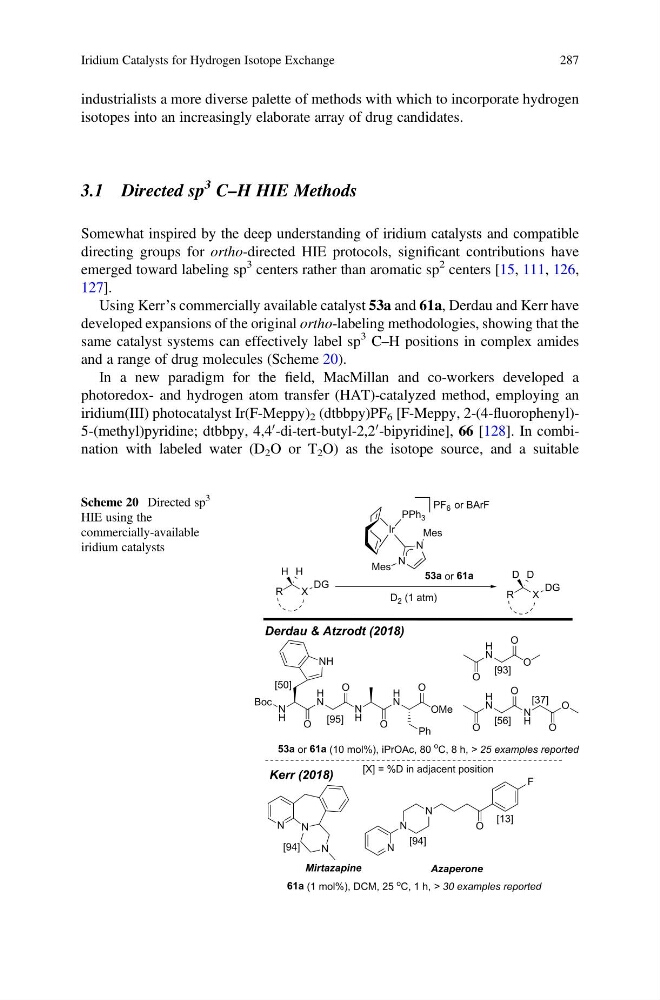
Using Kerr’s commercially available catalyst 53a and 61a, Derdau and Kerr have
developed expansions of the original ortho-labeling methodologies, showing that the
same catalyst systems can effectively label sp
3 C–H positions in complex amides
and a range of drug molecules (Scheme 20).
In a new paradigm for the field, MacMillan and co-workers developed a
photoredox- and hydrogen atom transfer (HAT)-catalyzed method, employing an
iridium(III) photocatalyst Ir(F-Meppy) 2 (dtbbpy)PF 6 [F-Meppy, 2-(4-fluorophenyl)5-(methyl)pyridine; dtbbpy, 4,4
0 -di-tert-butyl-2,2
0 -bipyridine], 66 [128]. In combination with labeled water (D 2 O or T 2 O) as the isotope source, and a suitable
Ir
PF 6
PPh 3
N
N
Mes
Mes
Derdau & Atzrodt (2018)
53a or 61a
R
X
DG
H
H
R
X
DG
D
D
D 2 (1 atm)
or BArF
Kerr (2018)
N
N
N
[94]
N
N
N
O
F
[94]
[13]
61a (1 mol%), DCM, 25
o C, 1 h, > 30 examples reported
53a or 61a (10 mol%), iPrOAc, 80
o
C, 8 h, > 25 examples reported
Boc N
H
H
N
N
H
H
N
OMe
O
O
O
O
Ph
NH
[50]
[95]
O
H
N
O
O
[93]
N
H
H
N
O
O
[56]
O
O
[37]
Mirtazapine
Azaperone
[X] = %D in adjacent position
Scheme 20 Directed sp
3
HIE using the
commercially-available
iridium catalysts
Iridium Catalysts for Hydrogen Isotope Exchange
287
isotopes into an increasingly elaborate array of drug candidates.
3.1 Directed sp
3 C–H HIE Methods
Somewhat inspired by the deep understanding of iridium catalysts and compatible
directing groups for ortho-directed HIE protocols, significant contributions have
emerged toward labeling sp
3 centers rather than aromatic sp
2 centers [15, 111, 126,
127].
Using Kerr’s commercially available catalyst 53a and 61a, Derdau and Kerr have
developed expansions of the original ortho-labeling methodologies, showing that the
same catalyst systems can effectively label sp
3 C–H positions in complex amides
and a range of drug molecules (Scheme 20).
In a new paradigm for the field, MacMillan and co-workers developed a
photoredox- and hydrogen atom transfer (HAT)-catalyzed method, employing an
iridium(III) photocatalyst Ir(F-Meppy) 2 (dtbbpy)PF 6 [F-Meppy, 2-(4-fluorophenyl)5-(methyl)pyridine; dtbbpy, 4,4
0 -di-tert-butyl-2,2
0 -bipyridine], 66 [128]. In combination with labeled water (D 2 O or T 2 O) as the isotope source, and a suitable
Ir
PF 6
PPh 3
N
N
Mes
Mes
Derdau & Atzrodt (2018)
53a or 61a
R
X
DG
H
H
R
X
DG
D
D
D 2 (1 atm)
or BArF
Kerr (2018)
N
N
N
[94]
N
N
N
O
F
[94]
[13]
61a (1 mol%), DCM, 25
o C, 1 h, > 30 examples reported
53a or 61a (10 mol%), iPrOAc, 80
o
C, 8 h, > 25 examples reported
Boc N
H
H
N
N
H
H
N
OMe
O
O
O
O
Ph
NH
[50]
[95]
O
H
N
O
O
[93]
N
H
H
N
O
O
[56]
O
O
[37]
Mirtazapine
Azaperone
[X] = %D in adjacent position
Scheme 20 Directed sp
3
HIE using the
commercially-available
iridium catalysts
Iridium Catalysts for Hydrogen Isotope Exchange
287