

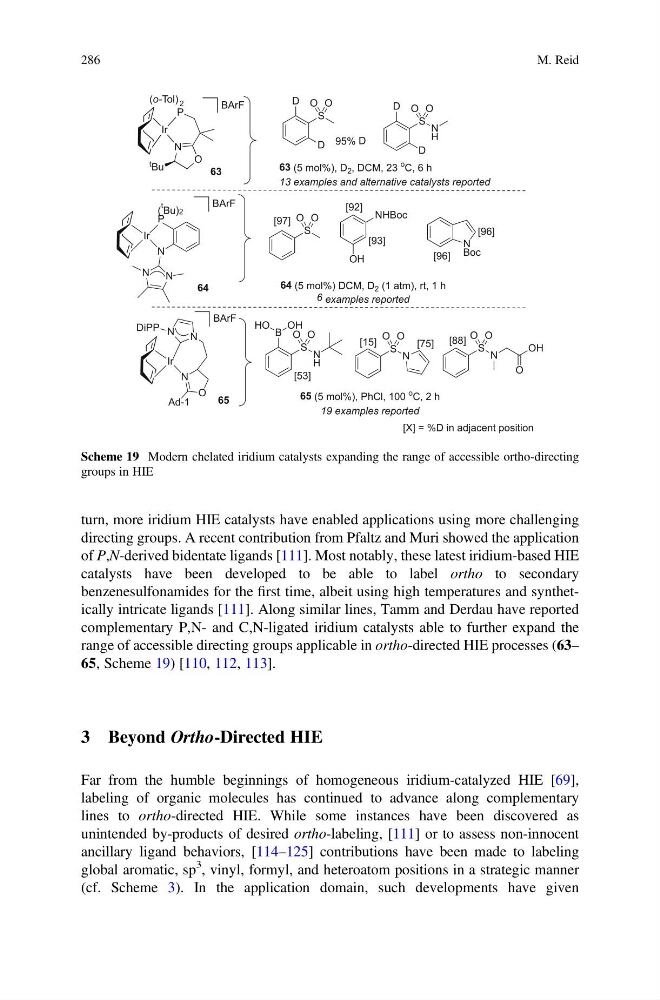
turn, more iridium HIE catalysts have enabled applications using more challenging
directing groups. A recent contribution from Pfaltz and Muri showed the application
of P,N-derived bidentate ligands [111]. Most notably, these latest iridium-based HIE
catalysts have been developed to be able to label ortho to secondary
benzenesulfonamides for the first time, albeit using high temperatures and synthetically intricate ligands [111]. Along similar lines, Tamm and Derdau have reported
complementary P,N- and C,N-ligated iridium catalysts able to further expand the
range of accessible directing groups applicable in ortho-directed HIE processes (63–
65, Scheme 19) [110, 112, 113].
3 Beyond Ortho-Directed HIE
Far from the humble beginnings of homogeneous iridium-catalyzed HIE [69],
labeling of organic molecules has continued to advance along complementary
lines to ortho-directed HIE. While some instances have been discovered as
unintended by-products of desired ortho-labeling, [111] or to assess non-innocent
ancillary ligand behaviors, [114–125] contributions have been made to labeling
global aromatic, sp
3 , vinyl, formyl, and heteroatom positions in a strategic manner
(cf. Scheme 3). In the application domain, such developments have given
64 (5 mol%) DCM, D 2 (1 atm), rt, 1 h
6 examples reported
65 (5 mol%), PhCl, 100
o
C, 2 h
19 examples reported
[97]
(
t Bu)2
P
N
Ir
BArF
N
Ir
N
N
O
Ad-1
N
N
DiPP
BArF
S
O O
OH
NHBoc
N
Boc
[93]
[92]
[96]
[96]
[53]
S N
H
O O
B
HO
OH
S N
O O
S N
O O
O
OH
[15]
[75] [88]
64
65
Ir
N
P
O
t Bu
BArF
63 (5 mol%), D 2 , DCM, 23
o
C, 6 h
13 examples and alternative catalysts reported
S
O O
D
D 95% D
(o-Tol) 2
S N
H
O O
D
D
63
[X] = %D in adjacent position
Scheme 19 Modern chelated iridium catalysts expanding the range of accessible ortho-directing
groups in HIE
286
M. Reid
directing groups. A recent contribution from Pfaltz and Muri showed the application
of P,N-derived bidentate ligands [111]. Most notably, these latest iridium-based HIE
catalysts have been developed to be able to label ortho to secondary
benzenesulfonamides for the first time, albeit using high temperatures and synthetically intricate ligands [111]. Along similar lines, Tamm and Derdau have reported
complementary P,N- and C,N-ligated iridium catalysts able to further expand the
range of accessible directing groups applicable in ortho-directed HIE processes (63–
65, Scheme 19) [110, 112, 113].
3 Beyond Ortho-Directed HIE
Far from the humble beginnings of homogeneous iridium-catalyzed HIE [69],
labeling of organic molecules has continued to advance along complementary
lines to ortho-directed HIE. While some instances have been discovered as
unintended by-products of desired ortho-labeling, [111] or to assess non-innocent
ancillary ligand behaviors, [114–125] contributions have been made to labeling
global aromatic, sp
3 , vinyl, formyl, and heteroatom positions in a strategic manner
(cf. Scheme 3). In the application domain, such developments have given
64 (5 mol%) DCM, D 2 (1 atm), rt, 1 h
6 examples reported
65 (5 mol%), PhCl, 100
o
C, 2 h
19 examples reported
[97]
(
t Bu)2
P
N
Ir
BArF
N
Ir
N
N
O
Ad-1
N
N
DiPP
BArF
S
O O
OH
NHBoc
N
Boc
[93]
[92]
[96]
[96]
[53]
S N
H
O O
B
HO
OH
S N
O O
S N
O O
O
OH
[15]
[75] [88]
64
65
Ir
N
P
O
t Bu
BArF
63 (5 mol%), D 2 , DCM, 23
o
C, 6 h
13 examples and alternative catalysts reported
S
O O
D
D 95% D
(o-Tol) 2
S N
H
O O
D
D
63
[X] = %D in adjacent position
Scheme 19 Modern chelated iridium catalysts expanding the range of accessible ortho-directing
groups in HIE
286
M. Reid