

the functionalization of natural products [185]. The mechanism of this reaction has
been recently studied by DFT calculations [186], suggesting an Ir(III)-Ir(V) catalytic
cycle. The active species, a pentacoordinate [Ir(H) 2 (SiMe 2 Ar)(N,N-ligand)] complex, undergoes dehydrogenation by NBE and concerted Si-H activation to give [Ir
(H)(SiMe 2 Ar) 2 (N,N-ligand)]. Subsequently, intramolecular C(sp
3 )ÀH bond activation affords the corresponding cyclometalated Ir(V) species, which via reductive
elimination affords the organosilane and regenerates de active species.
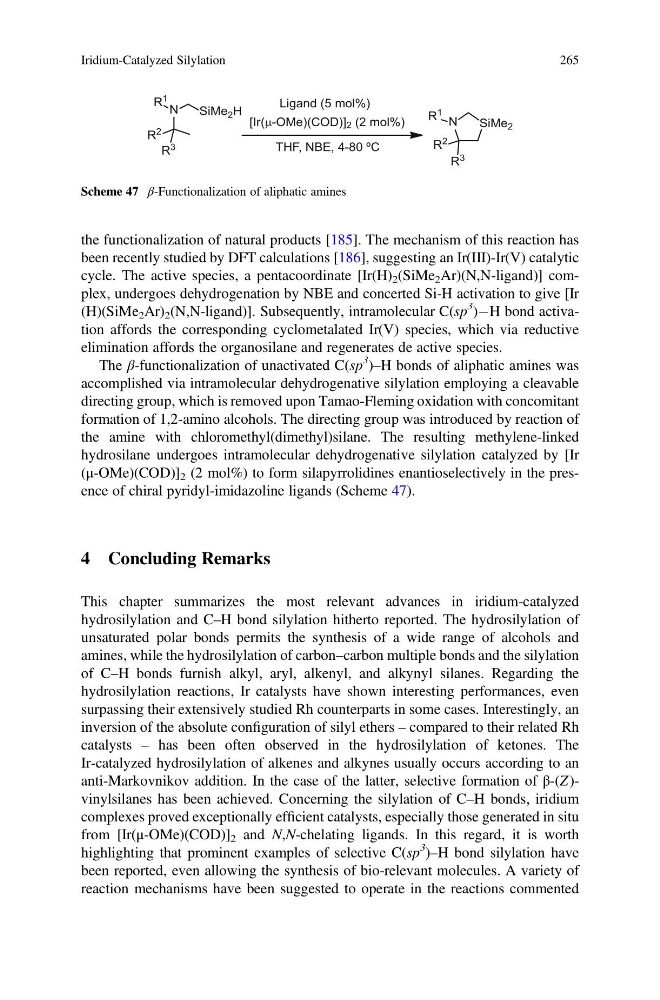
The β-functionalization of unactivated C(sp
3 )–H bonds of aliphatic amines was
accomplished via intramolecular dehydrogenative silylation employing a cleavable
directing group, which is removed upon Tamao-Fleming oxidation with concomitant
formation of 1,2-amino alcohols. The directing group was introduced by reaction of
the amine with chloromethyl(dimethyl)silane. The resulting methylene-linked
hydrosilane undergoes intramolecular dehydrogenative silylation catalyzed by [Ir
(μ-OMe)(COD)] 2 (2 mol%) to form silapyrrolidines enantioselectively in the presence of chiral pyridyl-imidazoline ligands (Scheme 47).
4 Concluding Remarks
This chapter summarizes the most relevant advances in iridium-catalyzed
hydrosilylation and C–H bond silylation hitherto reported. The hydrosilylation of
unsaturated polar bonds permits the synthesis of a wide range of alcohols and
amines, while the hydrosilylation of carbon–carbon multiple bonds and the silylation
of C–H bonds furnish alkyl, aryl, alkenyl, and alkynyl silanes. Regarding the
hydrosilylation reactions, Ir catalysts have shown interesting performances, even
surpassing their extensively studied Rh counterparts in some cases. Interestingly, an
inversion of the absolute configuration of silyl ethers – compared to their related Rh
catalysts – has been often observed in the hydrosilylation of ketones. The
Ir-catalyzed hydrosilylation of alkenes and alkynes usually occurs according to an
anti-Markovnikov addition. In the case of the latter, selective formation of β-(Z )vinylsilanes has been achieved. Concerning the silylation of C–H bonds, iridium
complexes proved exceptionally efficient catalysts, especially those generated in situ
from [Ir(μ-OMe)(COD)] 2 and N,N-chelating ligands. In this regard, it is worth
highlighting that prominent examples of selective C(sp
3
)–H bond silylation have
been reported, even allowing the synthesis of bio-relevant molecules. A variety of
reaction mechanisms have been suggested to operate in the reactions commented
[Ir(µ-OMe)(COD)] 2 (2 mol%)
THF, NBE, 4-80 ºC
Ligand (5 mol%)
R
2
N
SiMe 2 H
R
1
R 3
SiMe 2
N
R
1
R 3
R
2
Scheme 47 β-Functionalization of aliphatic amines
Iridium-Catalyzed Silylation
265
been recently studied by DFT calculations [186], suggesting an Ir(III)-Ir(V) catalytic
cycle. The active species, a pentacoordinate [Ir(H) 2 (SiMe 2 Ar)(N,N-ligand)] complex, undergoes dehydrogenation by NBE and concerted Si-H activation to give [Ir
(H)(SiMe 2 Ar) 2 (N,N-ligand)]. Subsequently, intramolecular C(sp
3 )ÀH bond activation affords the corresponding cyclometalated Ir(V) species, which via reductive
elimination affords the organosilane and regenerates de active species.
The β-functionalization of unactivated C(sp
3 )–H bonds of aliphatic amines was
accomplished via intramolecular dehydrogenative silylation employing a cleavable
directing group, which is removed upon Tamao-Fleming oxidation with concomitant
formation of 1,2-amino alcohols. The directing group was introduced by reaction of
the amine with chloromethyl(dimethyl)silane. The resulting methylene-linked
hydrosilane undergoes intramolecular dehydrogenative silylation catalyzed by [Ir
(μ-OMe)(COD)] 2 (2 mol%) to form silapyrrolidines enantioselectively in the presence of chiral pyridyl-imidazoline ligands (Scheme 47).
4 Concluding Remarks
This chapter summarizes the most relevant advances in iridium-catalyzed
hydrosilylation and C–H bond silylation hitherto reported. The hydrosilylation of
unsaturated polar bonds permits the synthesis of a wide range of alcohols and
amines, while the hydrosilylation of carbon–carbon multiple bonds and the silylation
of C–H bonds furnish alkyl, aryl, alkenyl, and alkynyl silanes. Regarding the
hydrosilylation reactions, Ir catalysts have shown interesting performances, even
surpassing their extensively studied Rh counterparts in some cases. Interestingly, an
inversion of the absolute configuration of silyl ethers – compared to their related Rh
catalysts – has been often observed in the hydrosilylation of ketones. The
Ir-catalyzed hydrosilylation of alkenes and alkynes usually occurs according to an
anti-Markovnikov addition. In the case of the latter, selective formation of β-(Z )vinylsilanes has been achieved. Concerning the silylation of C–H bonds, iridium
complexes proved exceptionally efficient catalysts, especially those generated in situ
from [Ir(μ-OMe)(COD)] 2 and N,N-chelating ligands. In this regard, it is worth
highlighting that prominent examples of selective C(sp
3
)–H bond silylation have
been reported, even allowing the synthesis of bio-relevant molecules. A variety of
reaction mechanisms have been suggested to operate in the reactions commented
[Ir(µ-OMe)(COD)] 2 (2 mol%)
THF, NBE, 4-80 ºC
Ligand (5 mol%)
R
2
N
SiMe 2 H
R
1
R 3
SiMe 2
N
R
1
R 3
R
2
Scheme 47 β-Functionalization of aliphatic amines
Iridium-Catalyzed Silylation
265