

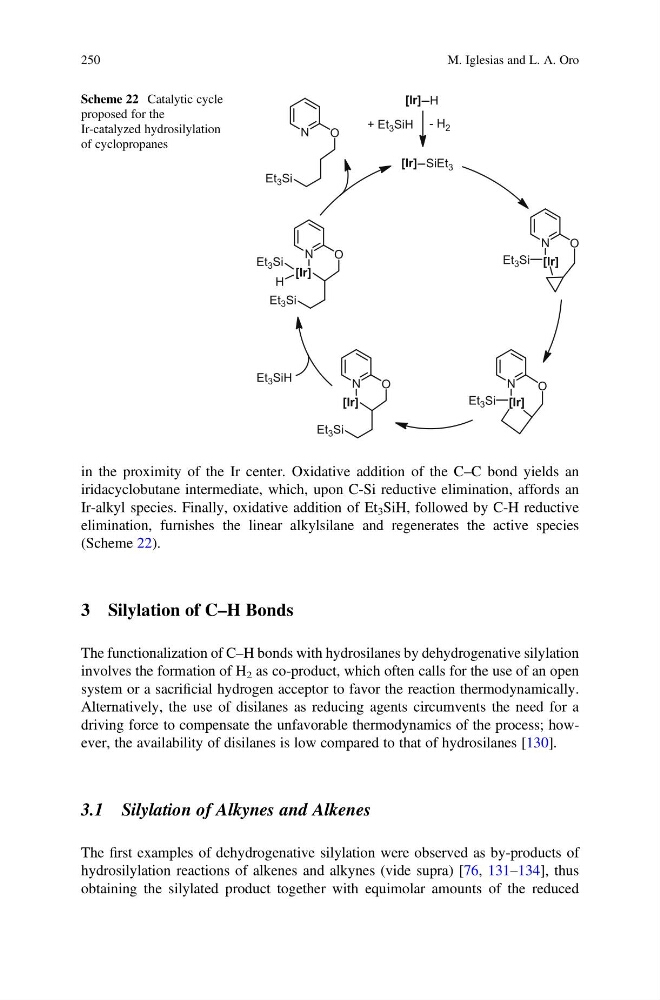
in the proximity of the Ir center. Oxidative addition of the C–C bond yields an
iridacyclobutane intermediate, which, upon C-Si reductive elimination, affords an
Ir-alkyl species. Finally, oxidative addition of Et 3 SiH, followed by C-H reductive
elimination, furnishes the linear alkylsilane and regenerates the active species
(Scheme 22).
3 Silylation of C–H Bonds
The functionalization of C–H bonds with hydrosilanes by dehydrogenative silylation
involves the formation of H 2 as co-product, which often calls for the use of an open
system or a sacrificial hydrogen acceptor to favor the reaction thermodynamically.
Alternatively, the use of disilanes as reducing agents circumvents the need for a
driving force to compensate the unfavorable thermodynamics of the process; however, the availability of disilanes is low compared to that of hydrosilanes [130].
3.1 Silylation of Alkynes and Alkenes
The first examples of dehydrogenative silylation were observed as by-products of
hydrosilylation reactions of alkenes and alkynes (vide supra) [76, 131–134], thus
obtaining the silylated product together with equimolar amounts of the reduced
+ Et 3 SiH - H 2
N
[Ir] H
[Ir] SiEt 3
[Ir]
Et 3 Si
O
N
[Ir]
Et 3 Si
O
N
[Ir]
O
Et 3 Si
N
[Ir]
O
Et 3 Si
H
Et 3 Si
Et 3 SiH
N
O
Et 3 Si
Scheme 22 Catalytic cycle
proposed for the
Ir-catalyzed hydrosilylation
of cyclopropanes
250
M. Iglesias and L. A. Oro
iridacyclobutane intermediate, which, upon C-Si reductive elimination, affords an
Ir-alkyl species. Finally, oxidative addition of Et 3 SiH, followed by C-H reductive
elimination, furnishes the linear alkylsilane and regenerates the active species
(Scheme 22).
3 Silylation of C–H Bonds
The functionalization of C–H bonds with hydrosilanes by dehydrogenative silylation
involves the formation of H 2 as co-product, which often calls for the use of an open
system or a sacrificial hydrogen acceptor to favor the reaction thermodynamically.
Alternatively, the use of disilanes as reducing agents circumvents the need for a
driving force to compensate the unfavorable thermodynamics of the process; however, the availability of disilanes is low compared to that of hydrosilanes [130].
3.1 Silylation of Alkynes and Alkenes
The first examples of dehydrogenative silylation were observed as by-products of
hydrosilylation reactions of alkenes and alkynes (vide supra) [76, 131–134], thus
obtaining the silylated product together with equimolar amounts of the reduced
+ Et 3 SiH - H 2
N
[Ir] H
[Ir] SiEt 3
[Ir]
Et 3 Si
O
N
[Ir]
Et 3 Si
O
N
[Ir]
O
Et 3 Si
N
[Ir]
O
Et 3 Si
H
Et 3 Si
Et 3 SiH
N
O
Et 3 Si
Scheme 22 Catalytic cycle
proposed for the
Ir-catalyzed hydrosilylation
of cyclopropanes
250
M. Iglesias and L. A. Oro