

the alkynes, β-(Z ) to β-(E) isomerization was observed. Besides, in some cases,
important amounts of dehydrogenative silylation products were obtained. The formation of these products was explained by means of a reaction mechanism substantiated by DFT calculations. The intermediate that determines whether a
hydrosilylation or dehydrogenative silylation reaction occurs is a
metallacyclopropene species, which may evolve upon coordination of a silane
molecule to give an alkenyl complex and eventually the corresponding vinylsilane.
Alternatively, the metallacyclopropene may undergo β-hydride elimination to afford
the silylalkyne [127].
The selective Markovnikov hydrosilylation of terminal alkynes catalyzed by
iridium complexes has been recently reported [128]. This methodology involves
the use of (TMSO) 3 SiH (TMS ¼ tris(trimethylsilyl)silane) as silicon source, which
allows α/β selectivities over 20/1 using [Ir(μ-Cl)(cod)] 2 as catalyst. The use of this
silane inverts the regioselectivity of the process when compared to other silanes, e.g.,
Et 3 SiH, which renders α/β selectivities over 1/20. It is noteworthy that the use of
other Ir precatalysts, namely, [Ir(μ-OMe)(cod)] 2 , [Ir(μ-Cl)(coe) 2 ] 2 , and [Cp*IrCl 2 ] 2 ,
led to yields lower than 5%. This methodology can be applied to a broad range of
terminal alkynes, is compatible with a variety of functional groups, and is applicable
to late-stage functionalization of a number of bio-relevant organic compounds.
2.5 Hydrosilylation of Cyclopropanes
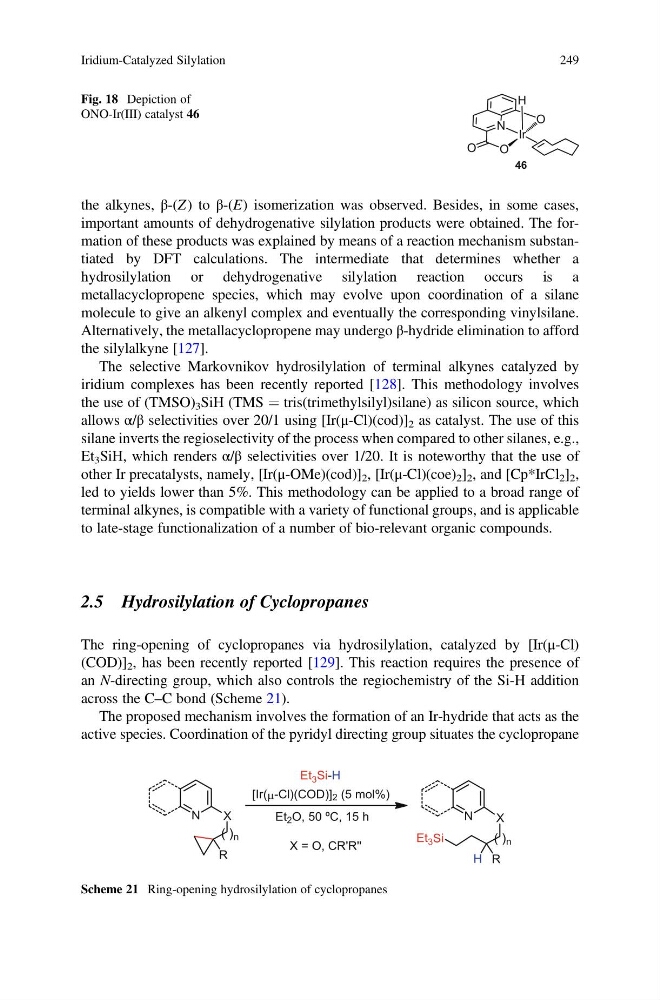
The ring-opening of cyclopropanes via hydrosilylation, catalyzed by [Ir(μ-Cl)
(COD)] 2 , has been recently reported [129]. This reaction requires the presence of
an N-directing group, which also controls the regiochemistry of the Si-H addition
across the C–C bond (Scheme 21).
The proposed mechanism involves the formation of an Ir-hydride that acts as the
active species. Coordination of the pyridyl directing group situates the cyclopropane
N
O
O
Ir
O
H
46
Fig. 18 Depiction of
ONO-Ir(III) catalyst 46
[Ir(µ-Cl)(COD)] 2 (5 mol%)
Et 2 O, 50 ºC, 15 h
Et 3 Si-H
N
X
R
( ) n
N
X
R
( ) n
Et 3 Si
H
X = O, CR'R''
Scheme 21 Ring-opening hydrosilylation of cyclopropanes
Iridium-Catalyzed Silylation
249
important amounts of dehydrogenative silylation products were obtained. The formation of these products was explained by means of a reaction mechanism substantiated by DFT calculations. The intermediate that determines whether a
hydrosilylation or dehydrogenative silylation reaction occurs is a
metallacyclopropene species, which may evolve upon coordination of a silane
molecule to give an alkenyl complex and eventually the corresponding vinylsilane.
Alternatively, the metallacyclopropene may undergo β-hydride elimination to afford
the silylalkyne [127].
The selective Markovnikov hydrosilylation of terminal alkynes catalyzed by
iridium complexes has been recently reported [128]. This methodology involves
the use of (TMSO) 3 SiH (TMS ¼ tris(trimethylsilyl)silane) as silicon source, which
allows α/β selectivities over 20/1 using [Ir(μ-Cl)(cod)] 2 as catalyst. The use of this
silane inverts the regioselectivity of the process when compared to other silanes, e.g.,
Et 3 SiH, which renders α/β selectivities over 1/20. It is noteworthy that the use of
other Ir precatalysts, namely, [Ir(μ-OMe)(cod)] 2 , [Ir(μ-Cl)(coe) 2 ] 2 , and [Cp*IrCl 2 ] 2 ,
led to yields lower than 5%. This methodology can be applied to a broad range of
terminal alkynes, is compatible with a variety of functional groups, and is applicable
to late-stage functionalization of a number of bio-relevant organic compounds.
2.5 Hydrosilylation of Cyclopropanes
The ring-opening of cyclopropanes via hydrosilylation, catalyzed by [Ir(μ-Cl)
(COD)] 2 , has been recently reported [129]. This reaction requires the presence of
an N-directing group, which also controls the regiochemistry of the Si-H addition
across the C–C bond (Scheme 21).
The proposed mechanism involves the formation of an Ir-hydride that acts as the
active species. Coordination of the pyridyl directing group situates the cyclopropane
N
O
O
Ir
O
H
46
Fig. 18 Depiction of
ONO-Ir(III) catalyst 46
[Ir(µ-Cl)(COD)] 2 (5 mol%)
Et 2 O, 50 ºC, 15 h
Et 3 Si-H
N
X
R
( ) n
N
X
R
( ) n
Et 3 Si
H
X = O, CR'R''
Scheme 21 Ring-opening hydrosilylation of cyclopropanes
Iridium-Catalyzed Silylation
249