

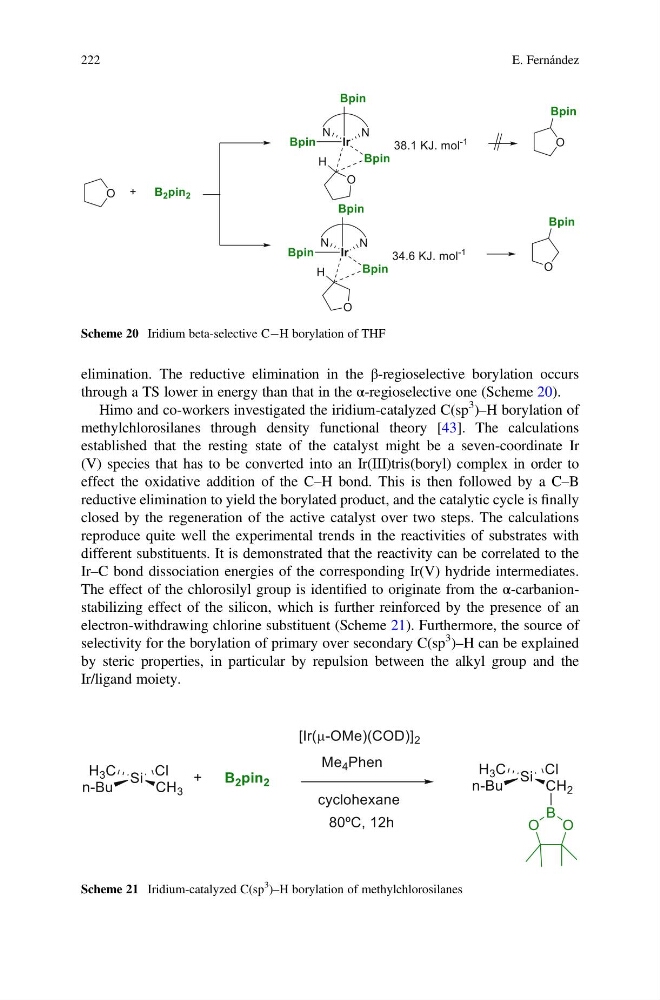
elimination. The reductive elimination in the β-regioselective borylation occurs
through a TS lower in energy than that in the α-regioselective one (Scheme 20).
Himo and co-workers investigated the iridium-catalyzed C(sp
3 )–H borylation of
methylchlorosilanes through density functional theory [43]. The calculations
established that the resting state of the catalyst might be a seven-coordinate Ir
(V) species that has to be converted into an Ir(III)tris(boryl) complex in order to
effect the oxidative addition of the C–H bond. This is then followed by a C–B
reductive elimination to yield the borylated product, and the catalytic cycle is finally
closed by the regeneration of the active catalyst over two steps. The calculations
reproduce quite well the experimental trends in the reactivities of substrates with
different substituents. It is demonstrated that the reactivity can be correlated to the
Ir–C bond dissociation energies of the corresponding Ir(V) hydride intermediates.
The effect of the chlorosilyl group is identified to originate from the α-carbanionstabilizing effect of the silicon, which is further reinforced by the presence of an
electron-withdrawing chlorine substituent (Scheme 21). Furthermore, the source of
selectivity for the borylation of primary over secondary C(sp
3 )–H can be explained
by steric properties, in particular by repulsion between the alkyl group and the
Ir/ligand moiety.
Scheme 20 Iridium beta-selective CÀH borylation of THF
Scheme 21 Iridium-catalyzed C(sp
3
)–H borylation of methylchlorosilanes
222
E. Fernández
through a TS lower in energy than that in the α-regioselective one (Scheme 20).
Himo and co-workers investigated the iridium-catalyzed C(sp
3 )–H borylation of
methylchlorosilanes through density functional theory [43]. The calculations
established that the resting state of the catalyst might be a seven-coordinate Ir
(V) species that has to be converted into an Ir(III)tris(boryl) complex in order to
effect the oxidative addition of the C–H bond. This is then followed by a C–B
reductive elimination to yield the borylated product, and the catalytic cycle is finally
closed by the regeneration of the active catalyst over two steps. The calculations
reproduce quite well the experimental trends in the reactivities of substrates with
different substituents. It is demonstrated that the reactivity can be correlated to the
Ir–C bond dissociation energies of the corresponding Ir(V) hydride intermediates.
The effect of the chlorosilyl group is identified to originate from the α-carbanionstabilizing effect of the silicon, which is further reinforced by the presence of an
electron-withdrawing chlorine substituent (Scheme 21). Furthermore, the source of
selectivity for the borylation of primary over secondary C(sp
3 )–H can be explained
by steric properties, in particular by repulsion between the alkyl group and the
Ir/ligand moiety.
Scheme 20 Iridium beta-selective CÀH borylation of THF
Scheme 21 Iridium-catalyzed C(sp
3
)–H borylation of methylchlorosilanes
222
E. Fernández