

1 Introduction
The present chapter collects the most recent advances on undirected homogeneous
C–H borylation catalyzed by iridium complexes since 2014, due to the tremendous
development of the field within the last 5 years. Previous works are not described
here to minimize unnecessary overlap with other reviews [1–5]. The criterion to
classify the present chapter is based on the type of substrates such as heteroarenes,
arenes, and alkanes. Precursors of catalysts are based on [Ir(μ-Cl)(COD)] 2
(COD ¼ cyclooctadiene), [Ir(μ-OMe)(COD)] 2 , and [Ir(η
6 -mes)(Bpin) 3 ] although
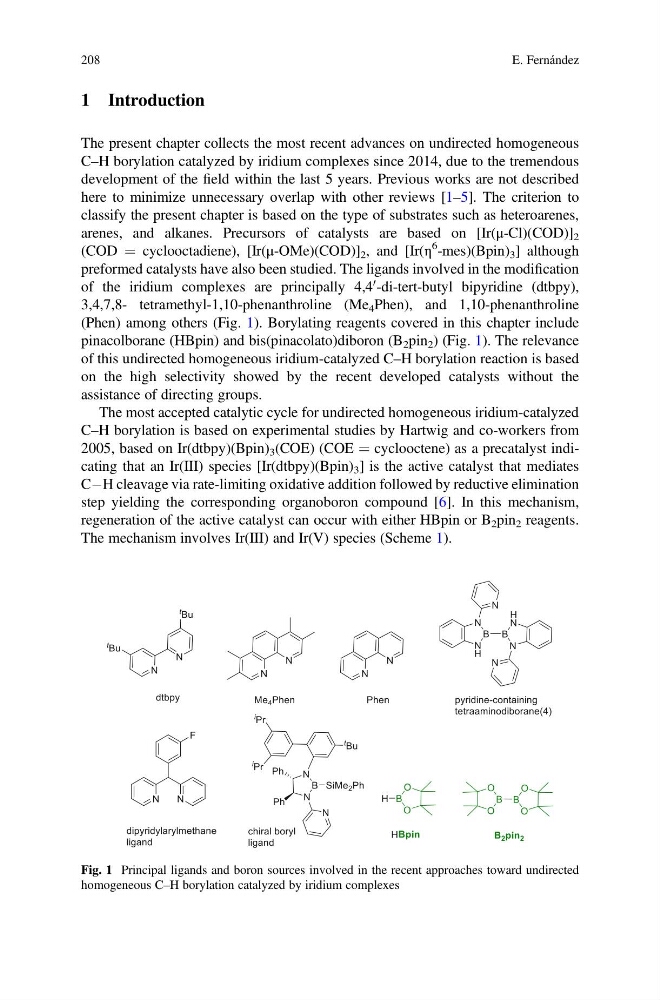
preformed catalysts have also been studied. The ligands involved in the modification
of the iridium complexes are principally 4,4
0 -di-tert-butyl bipyridine (dtbpy),
3,4,7,8- tetramethyl-1,10-phenanthroline (Me 4 Phen), and 1,10-phenanthroline
(Phen) among others (Fig. 1). Borylating reagents covered in this chapter include
pinacolborane (HBpin) and bis(pinacolato)diboron (B 2 pin 2 ) (Fig. 1). The relevance
of this undirected homogeneous iridium-catalyzed C–H borylation reaction is based
on the high selectivity showed by the recent developed catalysts without the
assistance of directing groups.
The most accepted catalytic cycle for undirected homogeneous iridium-catalyzed
C–H borylation is based on experimental studies by Hartwig and co-workers from
2005, based on Ir(dtbpy)(Bpin) 3 (COE) (COE ¼ cyclooctene) as a precatalyst indicating that an Ir(III) species [Ir(dtbpy)(Bpin) 3 ] is the active catalyst that mediates
CÀH cleavage via rate-limiting oxidative addition followed by reductive elimination
step yielding the corresponding organoboron compound [6]. In this mechanism,
regeneration of the active catalyst can occur with either HBpin or B 2 pin 2 reagents.
The mechanism involves Ir(III) and Ir(V) species (Scheme 1).
Fig. 1 Principal ligands and boron sources involved in the recent approaches toward undirected
homogeneous C–H borylation catalyzed by iridium complexes
208
E. Fernández
The present chapter collects the most recent advances on undirected homogeneous
C–H borylation catalyzed by iridium complexes since 2014, due to the tremendous
development of the field within the last 5 years. Previous works are not described
here to minimize unnecessary overlap with other reviews [1–5]. The criterion to
classify the present chapter is based on the type of substrates such as heteroarenes,
arenes, and alkanes. Precursors of catalysts are based on [Ir(μ-Cl)(COD)] 2
(COD ¼ cyclooctadiene), [Ir(μ-OMe)(COD)] 2 , and [Ir(η
6 -mes)(Bpin) 3 ] although
preformed catalysts have also been studied. The ligands involved in the modification
of the iridium complexes are principally 4,4
0 -di-tert-butyl bipyridine (dtbpy),
3,4,7,8- tetramethyl-1,10-phenanthroline (Me 4 Phen), and 1,10-phenanthroline
(Phen) among others (Fig. 1). Borylating reagents covered in this chapter include
pinacolborane (HBpin) and bis(pinacolato)diboron (B 2 pin 2 ) (Fig. 1). The relevance
of this undirected homogeneous iridium-catalyzed C–H borylation reaction is based
on the high selectivity showed by the recent developed catalysts without the
assistance of directing groups.
The most accepted catalytic cycle for undirected homogeneous iridium-catalyzed
C–H borylation is based on experimental studies by Hartwig and co-workers from
2005, based on Ir(dtbpy)(Bpin) 3 (COE) (COE ¼ cyclooctene) as a precatalyst indicating that an Ir(III) species [Ir(dtbpy)(Bpin) 3 ] is the active catalyst that mediates
CÀH cleavage via rate-limiting oxidative addition followed by reductive elimination
step yielding the corresponding organoboron compound [6]. In this mechanism,
regeneration of the active catalyst can occur with either HBpin or B 2 pin 2 reagents.
The mechanism involves Ir(III) and Ir(V) species (Scheme 1).
Fig. 1 Principal ligands and boron sources involved in the recent approaches toward undirected
homogeneous C–H borylation catalyzed by iridium complexes
208
E. Fernández