

derivatives, the best catalytic performance is therefore reached with the
phosphinite-based ligand with Ph phosphinite substituent, while for the less rigid
cyclic substrate, the phosphinite ligand with a bulkier o-tolyl group is needed.
Finally, the even less rigid acyclic substrates require the ligand with the bulkiest
cyclohexyl phosphinite group. Even more interestingly, maintaining the same
skeleton of the ligand by simply changing the phosphinite functionality by the
right phosphite group (ligands L37a-c, Fig. 19), we could also efficiently reduce
many unfunctionalized tri- and disubstituted olefins (ees up to 98%, Fig. 19). In
summary, from a common simple skeleton, the correct choice of either phosphite
or phosphinite groups gives for the first time ligands that are suitable for di-, tri-,
and tetrasubstituted unfunctionalized substrates and also for cyclic β-enamides
(62 examples, with ees up to 99%).
A notable last contribution is the identification of an Ir-catalyst that is able to
successfully hydrogenate a very broad range of diverse acyclic unfunctionalized
tetrasubstituted olefins (around 30 examples) [160]. A first parallel screening of a set
of 34 different Ir-catalysts found previous Ir-catalyst 3 (Fig. 17, R
1
¼ o-Tol;
R
2
¼
i Pr) to be the best candidate. A subsequent optimization of its structure
(phosphine and oxazoline substituent) identified 3 with R
1
¼ Cy and R
2
bist Bu-Ph as the optimal catalyst.
3 Ir-Catalyzed Asymmetric Hydrogenation of Olefins
Containing Coordinating Groups
As already mentioned, the hydrogenation of olefins with strongly coordinating
groups has been predominantly performed using Rh- or Ru-catalysts bearing
chiral diphosphine ligands. They still constitute the optimal choice for the synthesis of optically active α-amino acids and many pharmaceutically relevant compounds. Nowadays, excellent enantioselectivities can be achieved for N-acyl
α-dehydroamino acid derivatives, enamides and acrylates or itaconates, among
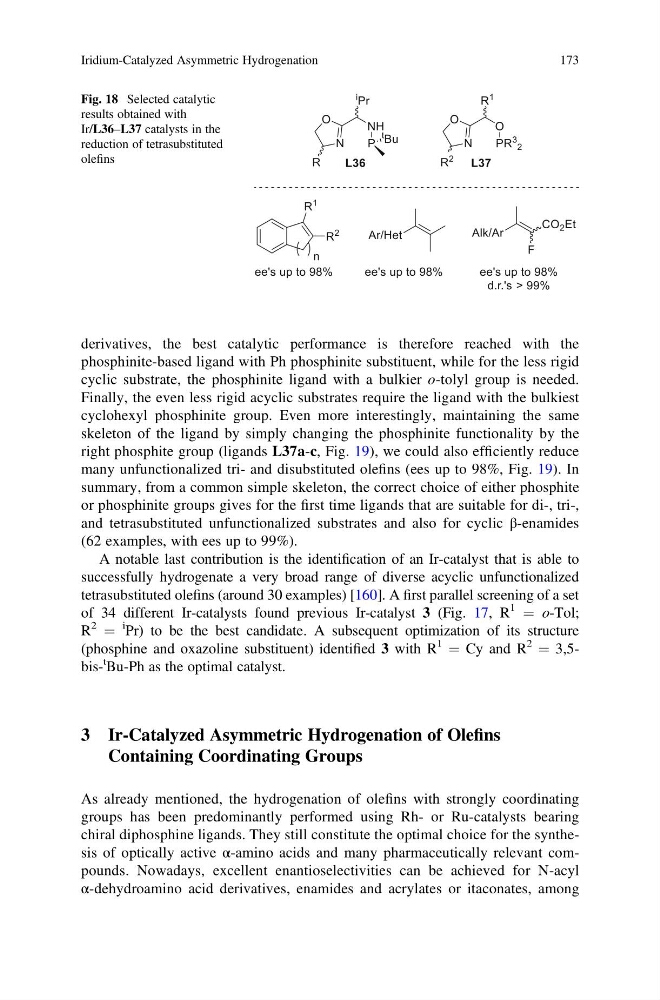
Fig. 18 Selected catalytic
results obtained with
Ir/L36–L37 catalysts in the
reduction of tetrasubstituted
olefins
Iridium-Catalyzed Asymmetric Hydrogenation
173
phosphinite-based ligand with Ph phosphinite substituent, while for the less rigid
cyclic substrate, the phosphinite ligand with a bulkier o-tolyl group is needed.
Finally, the even less rigid acyclic substrates require the ligand with the bulkiest
cyclohexyl phosphinite group. Even more interestingly, maintaining the same
skeleton of the ligand by simply changing the phosphinite functionality by the
right phosphite group (ligands L37a-c, Fig. 19), we could also efficiently reduce
many unfunctionalized tri- and disubstituted olefins (ees up to 98%, Fig. 19). In
summary, from a common simple skeleton, the correct choice of either phosphite
or phosphinite groups gives for the first time ligands that are suitable for di-, tri-,
and tetrasubstituted unfunctionalized substrates and also for cyclic β-enamides
(62 examples, with ees up to 99%).
A notable last contribution is the identification of an Ir-catalyst that is able to
successfully hydrogenate a very broad range of diverse acyclic unfunctionalized
tetrasubstituted olefins (around 30 examples) [160]. A first parallel screening of a set
of 34 different Ir-catalysts found previous Ir-catalyst 3 (Fig. 17, R
1
¼ o-Tol;
R
2
¼
i Pr) to be the best candidate. A subsequent optimization of its structure
(phosphine and oxazoline substituent) identified 3 with R
1
¼ Cy and R
2
bist Bu-Ph as the optimal catalyst.
3 Ir-Catalyzed Asymmetric Hydrogenation of Olefins
Containing Coordinating Groups
As already mentioned, the hydrogenation of olefins with strongly coordinating
groups has been predominantly performed using Rh- or Ru-catalysts bearing
chiral diphosphine ligands. They still constitute the optimal choice for the synthesis of optically active α-amino acids and many pharmaceutically relevant compounds. Nowadays, excellent enantioselectivities can be achieved for N-acyl
α-dehydroamino acid derivatives, enamides and acrylates or itaconates, among
Fig. 18 Selected catalytic
results obtained with
Ir/L36–L37 catalysts in the
reduction of tetrasubstituted
olefins
Iridium-Catalyzed Asymmetric Hydrogenation
173