

hydrogen source. This system did not require any base [230]. 2-Naphthaldehyde was
reduced in 1,4-dioxane/water 1/1 (v/v) mixtures, at 85
C, at 5.0 mol% of catalyst
loading using glycerol (1 equiv., 24 h, 87% yield) or glucose (1 equiv., 24 h, 95%
yield) as a hydrogen source. Monosaccharides galactose and xylose; disaccharides
lactose, sucrose and maltose; and the trisaccharide raffinose can also be employed as
a hydrogen source. Under the same conditions, yields from 79 to 92% were obtained
[230] with these biogenetic H-donors.
Aryl aldehydes bearing different substituents (A7, A23, A31, A32, A35), heterocyclic aldehydes such as 4-pyridine carboxaldehyde and 2-thiophene
carboxaldehyde, alkyl aldehyde A56 (Scheme 3) and diphenylketone were
converted to the corresponding alcohols in yields ranging from 61 to 83%, using
1 equiv. of glucose as a hydrogen source [230].
Various aldehydes and ketones were efficiently converted to the corresponding
alcohols with 2 equiv. of glucose as a H-donor, in the presence of 0.1–1 mol% of the
bipyridonate iridium complex 79 (Scheme 51). Reactions were carried out at 100
C,
using water or N,N-dimethylacetamide as a solvent and Na 2 CO 3 as a base. Aryl
aldehydes (A1, A10, A21, A23, A24, A28, A30, A31, A35, A37, A50, A51), alkyl
aryl (B1, B3, B5, B8, B11, B18, B21-B24, B26, B27, B47, B58), methyl alkyl
(B107) and cyclic (B118, B120) ketones were reduced to the corresponding alcohols. Isolated yields from 54 to 91% were obtained [231].
To determine which of the glucose OH groups functioned as a hydrogen donor,
the reaction of acetophenone was conducted using α-glucopyranoside, in which only
the hydroxyl group at the C1 position was methylated, or, alternatively, using
2,3,4,6-tetra-O-methyl α-glucopyranose, in which all the hydroxyl groups except
that at C1 are methylated. The TH reaction did not proceed with the former but gave
97% yield in the alcohol with the latter. These results suggested that TH of the CO
group of the carbonyl substrates implied the hydroxyl group at the C1 position
glucose [231].
O
O
I
I
N
N
K +
N
N
K +
Ir
I
N
N
Cp*
N
N
51
SO 3
-
SO 3
-
86
50
O
O
I
I
N
N
SO 3
- K +
N
N
SO 3
- K +
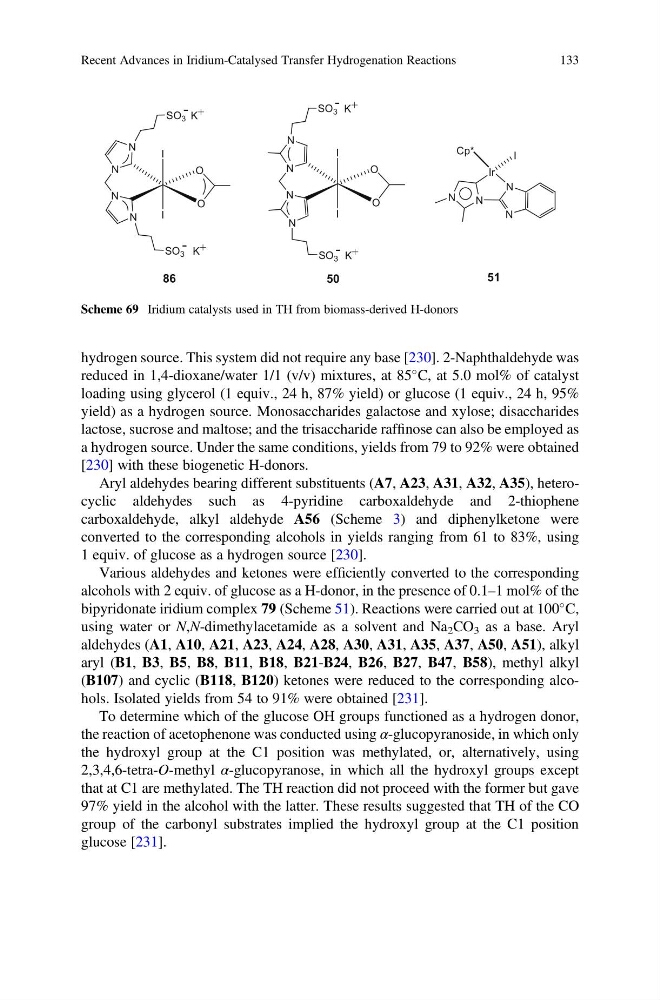
Scheme 69 Iridium catalysts used in TH from biomass-derived H-donors
Recent Advances in Iridium-Catalysed Transfer Hydrogenation Reactions
133
reduced in 1,4-dioxane/water 1/1 (v/v) mixtures, at 85
C, at 5.0 mol% of catalyst
loading using glycerol (1 equiv., 24 h, 87% yield) or glucose (1 equiv., 24 h, 95%
yield) as a hydrogen source. Monosaccharides galactose and xylose; disaccharides
lactose, sucrose and maltose; and the trisaccharide raffinose can also be employed as
a hydrogen source. Under the same conditions, yields from 79 to 92% were obtained
[230] with these biogenetic H-donors.
Aryl aldehydes bearing different substituents (A7, A23, A31, A32, A35), heterocyclic aldehydes such as 4-pyridine carboxaldehyde and 2-thiophene
carboxaldehyde, alkyl aldehyde A56 (Scheme 3) and diphenylketone were
converted to the corresponding alcohols in yields ranging from 61 to 83%, using
1 equiv. of glucose as a hydrogen source [230].
Various aldehydes and ketones were efficiently converted to the corresponding
alcohols with 2 equiv. of glucose as a H-donor, in the presence of 0.1–1 mol% of the
bipyridonate iridium complex 79 (Scheme 51). Reactions were carried out at 100
C,
using water or N,N-dimethylacetamide as a solvent and Na 2 CO 3 as a base. Aryl
aldehydes (A1, A10, A21, A23, A24, A28, A30, A31, A35, A37, A50, A51), alkyl
aryl (B1, B3, B5, B8, B11, B18, B21-B24, B26, B27, B47, B58), methyl alkyl
(B107) and cyclic (B118, B120) ketones were reduced to the corresponding alcohols. Isolated yields from 54 to 91% were obtained [231].
To determine which of the glucose OH groups functioned as a hydrogen donor,
the reaction of acetophenone was conducted using α-glucopyranoside, in which only
the hydroxyl group at the C1 position was methylated, or, alternatively, using
2,3,4,6-tetra-O-methyl α-glucopyranose, in which all the hydroxyl groups except
that at C1 are methylated. The TH reaction did not proceed with the former but gave
97% yield in the alcohol with the latter. These results suggested that TH of the CO
group of the carbonyl substrates implied the hydroxyl group at the C1 position
glucose [231].
O
O
I
I
N
N
K +
N
N
K +
Ir
I
N
N
Cp*
N
N
51
SO 3
-
SO 3
-
86
50
O
O
I
I
N
N
SO 3
- K +
N
N
SO 3
- K +
Scheme 69 Iridium catalysts used in TH from biomass-derived H-donors
Recent Advances in Iridium-Catalysed Transfer Hydrogenation Reactions
133