

byproduct from biodiesel processing. Its physical and solvation properties [225]
make glycerol a promising candidate to be employed as an environmentally friendly
reaction medium for synthetic chemistry [226]. Furthermore, glycerol has advantages, for example, over ethanol, another H-donor also produced from biomass.
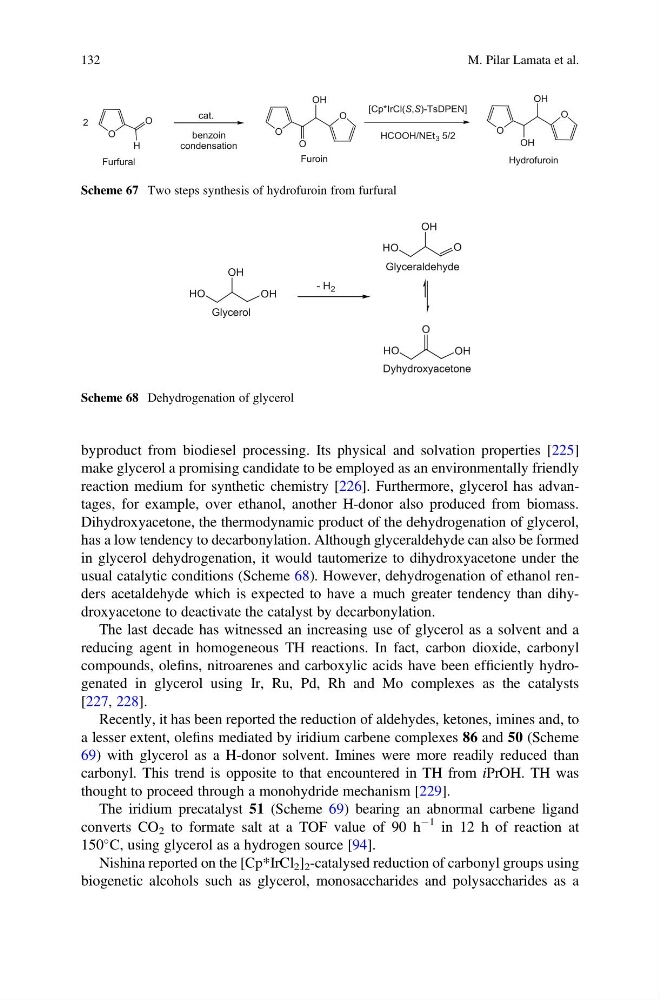
Dihydroxyacetone, the thermodynamic product of the dehydrogenation of glycerol,
has a low tendency to decarbonylation. Although glyceraldehyde can also be formed
in glycerol dehydrogenation, it would tautomerize to dihydroxyacetone under the
usual catalytic conditions (Scheme 68). However, dehydrogenation of ethanol renders acetaldehyde which is expected to have a much greater tendency than dihydroxyacetone to deactivate the catalyst by decarbonylation.
The last decade has witnessed an increasing use of glycerol as a solvent and a
reducing agent in homogeneous TH reactions. In fact, carbon dioxide, carbonyl
compounds, olefins, nitroarenes and carboxylic acids have been efficiently hydrogenated in glycerol using Ir, Ru, Pd, Rh and Mo complexes as the catalysts
[227, 228].
Recently, it has been reported the reduction of aldehydes, ketones, imines and, to
a lesser extent, olefins mediated by iridium carbene complexes 86 and 50 (Scheme
69) with glycerol as a H-donor solvent. Imines were more readily reduced than
carbonyl. This trend is opposite to that encountered in TH from iPrOH. TH was
thought to proceed through a monohydride mechanism [229].
The iridium precatalyst 51 (Scheme 69) bearing an abnormal carbene ligand
converts CO 2 to formate salt at a TOF value of 90 h
À1 in 12 h of reaction at
150
C, using glycerol as a hydrogen source [94].
Nishina reported on the [Cp*IrCl 2 ] 2 -catalysed reduction of carbonyl groups using
biogenetic alcohols such as glycerol, monosaccharides and polysaccharides as a
O
HCOOH/NEt 3 5/2
O
H
O
O
O
OH
benzoin
condensation
[Cp*IrCl(S,S)-TsDPEN]
cat.
O
OH
O
OH
Hydrofuroin
2
Furfural
Furoin
Scheme 67 Two steps synthesis of hydrofuroin from furfural
HO
OH
OH
- H 2
HO
O
OH
HO
OH
O
Glycerol
Glyceraldehyde
Dyhydroxyacetone
Scheme 68 Dehydrogenation of glycerol
132
M. Pilar Lamata et al.
make glycerol a promising candidate to be employed as an environmentally friendly
reaction medium for synthetic chemistry [226]. Furthermore, glycerol has advantages, for example, over ethanol, another H-donor also produced from biomass.
Dihydroxyacetone, the thermodynamic product of the dehydrogenation of glycerol,
has a low tendency to decarbonylation. Although glyceraldehyde can also be formed
in glycerol dehydrogenation, it would tautomerize to dihydroxyacetone under the
usual catalytic conditions (Scheme 68). However, dehydrogenation of ethanol renders acetaldehyde which is expected to have a much greater tendency than dihydroxyacetone to deactivate the catalyst by decarbonylation.
The last decade has witnessed an increasing use of glycerol as a solvent and a
reducing agent in homogeneous TH reactions. In fact, carbon dioxide, carbonyl
compounds, olefins, nitroarenes and carboxylic acids have been efficiently hydrogenated in glycerol using Ir, Ru, Pd, Rh and Mo complexes as the catalysts
[227, 228].
Recently, it has been reported the reduction of aldehydes, ketones, imines and, to
a lesser extent, olefins mediated by iridium carbene complexes 86 and 50 (Scheme
69) with glycerol as a H-donor solvent. Imines were more readily reduced than
carbonyl. This trend is opposite to that encountered in TH from iPrOH. TH was
thought to proceed through a monohydride mechanism [229].
The iridium precatalyst 51 (Scheme 69) bearing an abnormal carbene ligand
converts CO 2 to formate salt at a TOF value of 90 h
À1 in 12 h of reaction at
150
C, using glycerol as a hydrogen source [94].
Nishina reported on the [Cp*IrCl 2 ] 2 -catalysed reduction of carbonyl groups using
biogenetic alcohols such as glycerol, monosaccharides and polysaccharides as a
O
HCOOH/NEt 3 5/2
O
H
O
O
O
OH
benzoin
condensation
[Cp*IrCl(S,S)-TsDPEN]
cat.
O
OH
O
OH
Hydrofuroin
2
Furfural
Furoin
Scheme 67 Two steps synthesis of hydrofuroin from furfural
HO
OH
OH
- H 2
HO
O
OH
HO
OH
O
Glycerol
Glyceraldehyde
Dyhydroxyacetone
Scheme 68 Dehydrogenation of glycerol
132
M. Pilar Lamata et al.