

corresponding indoline and tetrahydroquinolines, respectively. Isoquinoline
exhibited low reactivity (27% isolated yield) [181].
Asymmetric TH of isoquinolines H46 and H47; dehydroquinolines H58, H61
and H62 (Scheme 60); quinoline H2 (Scheme 57); and sulfonyl imine H94 (Scheme
62) was accomplished by using a combination of [Cp*IrCl 2 ] 2 and chiral cyclic
diamine ligands as the catalyst precursor [214]. The best results were obtained
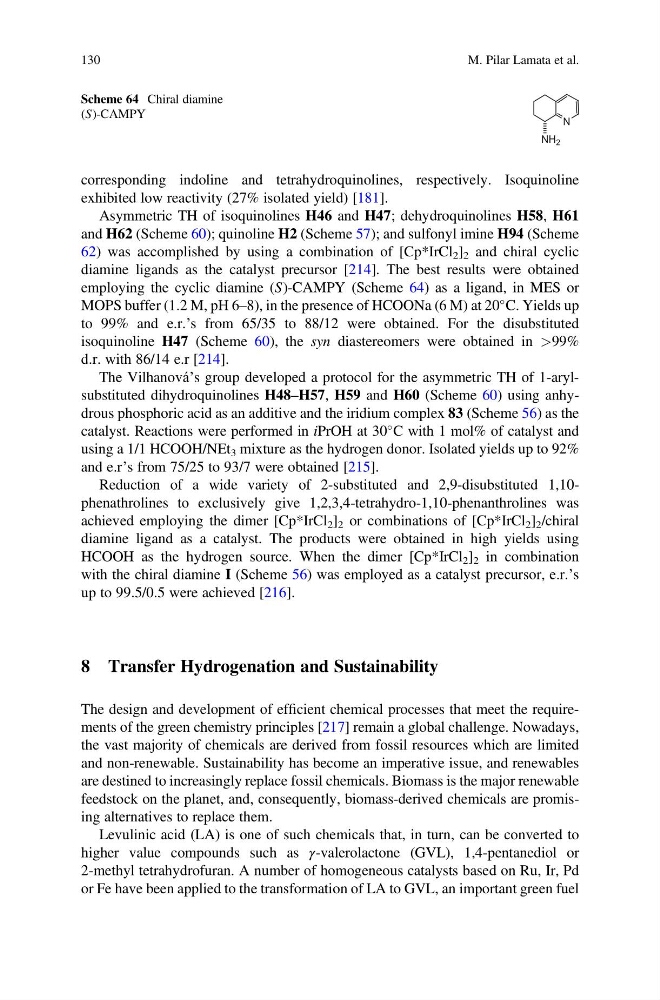
employing the cyclic diamine (S)-CAMPY (Scheme 64) as a ligand, in MES or
MOPS buffer (1.2 M, pH 6–8), in the presence of HCOONa (6 M) at 20
C. Yields up
to 99% and e.r.’s from 65/35 to 88/12 were obtained. For the disubstituted
isoquinoline H47 (Scheme 60), the syn diastereomers were obtained in >99%
d.r. with 86/14 e.r [214].
The Vilhanová’s group developed a protocol for the asymmetric TH of 1-arylsubstituted dihydroquinolines H48–H57, H59 and H60 (Scheme 60) using anhydrous phosphoric acid as an additive and the iridium complex 83 (Scheme 56) as the
catalyst. Reactions were performed in iPrOH at 30
C with 1 mol% of catalyst and
using a 1/1 HCOOH/NEt 3 mixture as the hydrogen donor. Isolated yields up to 92%
and e.r’s from 75/25 to 93/7 were obtained [215].
Reduction of a wide variety of 2-substituted and 2,9-disubstituted 1,10phenathrolines to exclusively give 1,2,3,4-tetrahydro-1,10-phenanthrolines was
achieved employing the dimer [Cp*IrCl 2 ] 2 or combinations of [Cp*IrCl 2 ] 2 /chiral
diamine ligand as a catalyst. The products were obtained in high yields using
HCOOH as the hydrogen source. When the dimer [Cp*IrCl 2 ] 2 in combination
with the chiral diamine I (Scheme 56) was employed as a catalyst precursor, e.r.’s
up to 99.5/0.5 were achieved [216].
8 Transfer Hydrogenation and Sustainability
The design and development of efficient chemical processes that meet the requirements of the green chemistry principles [217] remain a global challenge. Nowadays,
the vast majority of chemicals are derived from fossil resources which are limited
and non-renewable. Sustainability has become an imperative issue, and renewables
are destined to increasingly replace fossil chemicals. Biomass is the major renewable
feedstock on the planet, and, consequently, biomass-derived chemicals are promising alternatives to replace them.
Levulinic acid (LA) is one of such chemicals that, in turn, can be converted to
higher value compounds such as γ-valerolactone (GVL), 1,4-pentanediol or
2-methyl tetrahydrofuran. A number of homogeneous catalysts based on Ru, Ir, Pd
or Fe have been applied to the transformation of LA to GVL, an important green fuel
N
NH 2
Scheme 64 Chiral diamine
(S)-CAMPY
130
M. Pilar Lamata et al.
exhibited low reactivity (27% isolated yield) [181].
Asymmetric TH of isoquinolines H46 and H47; dehydroquinolines H58, H61
and H62 (Scheme 60); quinoline H2 (Scheme 57); and sulfonyl imine H94 (Scheme
62) was accomplished by using a combination of [Cp*IrCl 2 ] 2 and chiral cyclic
diamine ligands as the catalyst precursor [214]. The best results were obtained
employing the cyclic diamine (S)-CAMPY (Scheme 64) as a ligand, in MES or
MOPS buffer (1.2 M, pH 6–8), in the presence of HCOONa (6 M) at 20
C. Yields up
to 99% and e.r.’s from 65/35 to 88/12 were obtained. For the disubstituted
isoquinoline H47 (Scheme 60), the syn diastereomers were obtained in >99%
d.r. with 86/14 e.r [214].
The Vilhanová’s group developed a protocol for the asymmetric TH of 1-arylsubstituted dihydroquinolines H48–H57, H59 and H60 (Scheme 60) using anhydrous phosphoric acid as an additive and the iridium complex 83 (Scheme 56) as the
catalyst. Reactions were performed in iPrOH at 30
C with 1 mol% of catalyst and
using a 1/1 HCOOH/NEt 3 mixture as the hydrogen donor. Isolated yields up to 92%
and e.r’s from 75/25 to 93/7 were obtained [215].
Reduction of a wide variety of 2-substituted and 2,9-disubstituted 1,10phenathrolines to exclusively give 1,2,3,4-tetrahydro-1,10-phenanthrolines was
achieved employing the dimer [Cp*IrCl 2 ] 2 or combinations of [Cp*IrCl 2 ] 2 /chiral
diamine ligand as a catalyst. The products were obtained in high yields using
HCOOH as the hydrogen source. When the dimer [Cp*IrCl 2 ] 2 in combination
with the chiral diamine I (Scheme 56) was employed as a catalyst precursor, e.r.’s
up to 99.5/0.5 were achieved [216].
8 Transfer Hydrogenation and Sustainability
The design and development of efficient chemical processes that meet the requirements of the green chemistry principles [217] remain a global challenge. Nowadays,
the vast majority of chemicals are derived from fossil resources which are limited
and non-renewable. Sustainability has become an imperative issue, and renewables
are destined to increasingly replace fossil chemicals. Biomass is the major renewable
feedstock on the planet, and, consequently, biomass-derived chemicals are promising alternatives to replace them.
Levulinic acid (LA) is one of such chemicals that, in turn, can be converted to
higher value compounds such as γ-valerolactone (GVL), 1,4-pentanediol or
2-methyl tetrahydrofuran. A number of homogeneous catalysts based on Ru, Ir, Pd
or Fe have been applied to the transformation of LA to GVL, an important green fuel
N
NH 2
Scheme 64 Chiral diamine
(S)-CAMPY
130
M. Pilar Lamata et al.