

the iridium complex 82 (Scheme 56) and aqueous HCOOH/HCOONa as a solvent
and a hydrogen source. The same result was obtained using [Cp*IrCl 2 ] 2 with the
ligand 8-aminoquinoline as the catalyst precursor. Application of the same conditions to unsubstituted quinoline led to the hydrogenation of the pyridinic ring along
with the introduction of a formyl group on the nitrogen atom in 33% yield [213].
The N,C,P pincer iridium complex 72 (Scheme 55), at 0.25 mol% catalyst
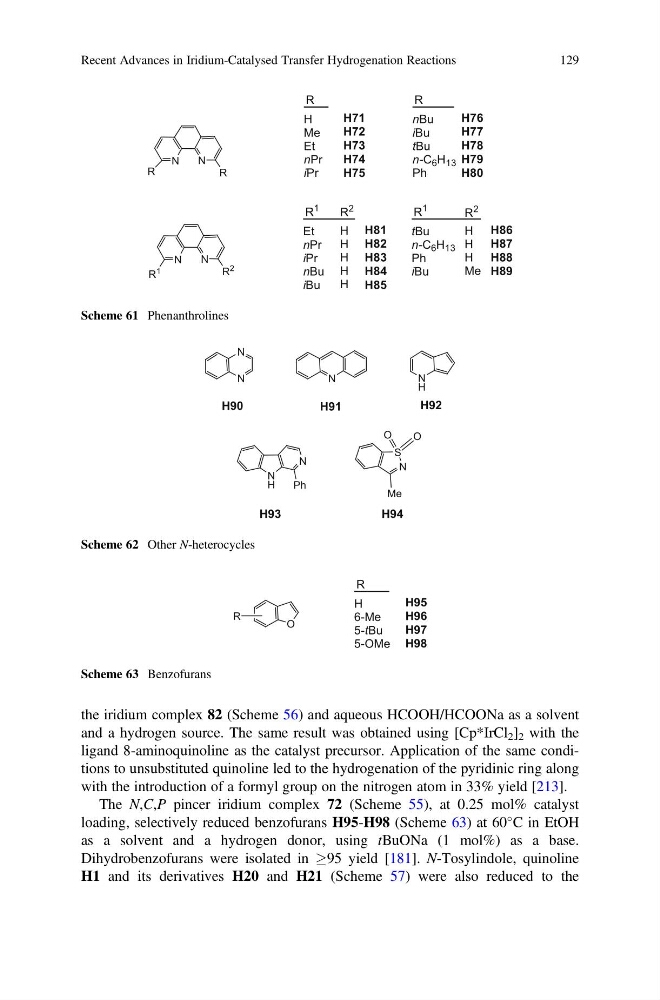
loading, selectively reduced benzofurans H95-H98 (Scheme 63) at 60
C in EtOH
as a solvent and a hydrogen donor, using tBuONa (1 mol%) as a base.
Dihydrobenzofurans were isolated in !95 yield [181]. N-Tosylindole, quinoline
H1 and its derivatives H20 and H21 (Scheme 57) were also reduced to the
N
N
H
Me
Et
nPr
iPr
H71
H72
H73
H74
H75
R
nBu
iBu
tBu
n-C 6 H 13
Ph
H76
H77
H78
H79
H80
R
R
R
N
N
R
1
R
2
Et
nPr
iPr
nBu
iBu
H81
H82
H83
H84
H85
R
1
H
H
H
H
H
R
2
tBu
n-C 6 H 13
Ph
iBu
H86
H87
H88
H89
R
1
H
H
H
Me
R
2
Scheme 61 Phenanthrolines
N
N
N
N
H
H90
H91
H92
H93
N
H
N
Ph
H94
N
S
Me
O
O
Scheme 62 Other N-heterocycles
O
H
6-Me
5-tBu
5-OMe
H95
H96
H97
H98
R
R
Scheme 63 Benzofurans
Recent Advances in Iridium-Catalysed Transfer Hydrogenation Reactions
129
and a hydrogen source. The same result was obtained using [Cp*IrCl 2 ] 2 with the
ligand 8-aminoquinoline as the catalyst precursor. Application of the same conditions to unsubstituted quinoline led to the hydrogenation of the pyridinic ring along
with the introduction of a formyl group on the nitrogen atom in 33% yield [213].
The N,C,P pincer iridium complex 72 (Scheme 55), at 0.25 mol% catalyst
loading, selectively reduced benzofurans H95-H98 (Scheme 63) at 60
C in EtOH
as a solvent and a hydrogen donor, using tBuONa (1 mol%) as a base.
Dihydrobenzofurans were isolated in !95 yield [181]. N-Tosylindole, quinoline
H1 and its derivatives H20 and H21 (Scheme 57) were also reduced to the
N
N
H
Me
Et
nPr
iPr
H71
H72
H73
H74
H75
R
nBu
iBu
tBu
n-C 6 H 13
Ph
H76
H77
H78
H79
H80
R
R
R
N
N
R
1
R
2
Et
nPr
iPr
nBu
iBu
H81
H82
H83
H84
H85
R
1
H
H
H
H
H
R
2
tBu
n-C 6 H 13
Ph
iBu
H86
H87
H88
H89
R
1
H
H
H
Me
R
2
Scheme 61 Phenanthrolines
N
N
N
N
H
H90
H91
H92
H93
N
H
N
Ph
H94
N
S
Me
O
O
Scheme 62 Other N-heterocycles
O
H
6-Me
5-tBu
5-OMe
H95
H96
H97
H98
R
R
Scheme 63 Benzofurans
Recent Advances in Iridium-Catalysed Transfer Hydrogenation Reactions
129