

ovary as well as a cytotoxic effect on the uterus or embryo. The female ruminants
appear to be relatively insensitive to the antifertility effect of gossypol; nevertheless,
in vitro data indicate embryonic development inhibition and ovarian steroidogenesis.
The same report also mentioned the negative impacts of gossypol on male reproductive health, such as sperm immotility, reduced sperm counts, and infertility
(Coutinho 2002; Cope 2018). Other symptoms of gossypol toxicity include breathing problems and anorexia. Recent study demonstrated that gossypol promotes the
degeneration of chicken ovarian follicles in vitro. In laying hens fed with cottonseed,
gossypol was found to reduce egg production and weight and also associated with
discoloration of the egg yolk and/or albumen (Gadelha et al. 2016). Increased
proportion of atretic follicles at all stages of development in cultivated chicken
ovaries was observed in the presence of gossypol. Hence, authors concluded that
gossypol may affect ovarian follicular viability and maturation, which might interfere with female fertility. Similar results were also obtained by Câmara et al. (2015)
while studying the effect of gossypol present in cottonseeds on ovarian follicles in
sheep to increase atresia. Significant efforts have been directed to reduce gossypol
content in cottonseeds by selecting glandless cotton varieties and genetic engineering of gossypol-free seeds of cotton plants to reduce such adverse health effects.
3.8 Food Applications
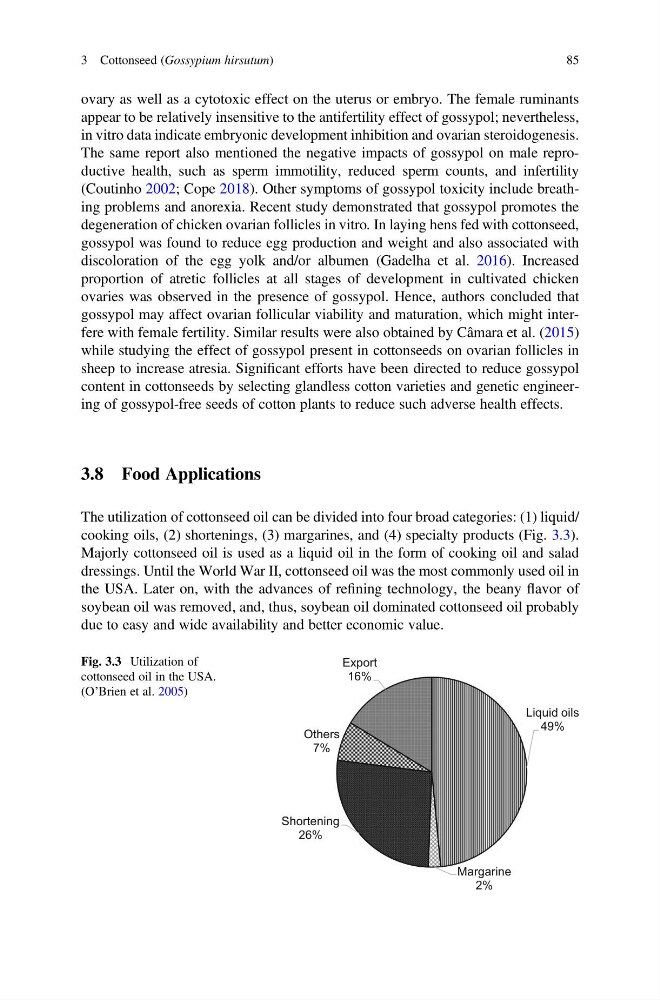
The utilization of cottonseed oil can be divided into four broad categories: (1) liquid/
cooking oils, (2) shortenings, (3) margarines, and (4) specialty products (Fig. 3.3).
Majorly cottonseed oil is used as a liquid oil in the form of cooking oil and salad
dressings. Until the World War II, cottonseed oil was the most commonly used oil in
the USA. Later on, with the advances of refining technology, the beany flavor of
soybean oil was removed, and, thus, soybean oil dominated cottonseed oil probably
due to easy and wide availability and better economic value.
Liquid oils
49%
Margarine
2%
Shortening
26%
Others
7%
Export
16%
Fig. 3.3 Utilization of
cottonseed oil in the USA.
(O’Brien et al. 2005)
3 Cottonseed (Gossypium hirsutum)
8 5
appear to be relatively insensitive to the antifertility effect of gossypol; nevertheless,
in vitro data indicate embryonic development inhibition and ovarian steroidogenesis.
The same report also mentioned the negative impacts of gossypol on male reproductive health, such as sperm immotility, reduced sperm counts, and infertility
(Coutinho 2002; Cope 2018). Other symptoms of gossypol toxicity include breathing problems and anorexia. Recent study demonstrated that gossypol promotes the
degeneration of chicken ovarian follicles in vitro. In laying hens fed with cottonseed,
gossypol was found to reduce egg production and weight and also associated with
discoloration of the egg yolk and/or albumen (Gadelha et al. 2016). Increased
proportion of atretic follicles at all stages of development in cultivated chicken
ovaries was observed in the presence of gossypol. Hence, authors concluded that
gossypol may affect ovarian follicular viability and maturation, which might interfere with female fertility. Similar results were also obtained by Câmara et al. (2015)
while studying the effect of gossypol present in cottonseeds on ovarian follicles in
sheep to increase atresia. Significant efforts have been directed to reduce gossypol
content in cottonseeds by selecting glandless cotton varieties and genetic engineering of gossypol-free seeds of cotton plants to reduce such adverse health effects.
3.8 Food Applications
The utilization of cottonseed oil can be divided into four broad categories: (1) liquid/
cooking oils, (2) shortenings, (3) margarines, and (4) specialty products (Fig. 3.3).
Majorly cottonseed oil is used as a liquid oil in the form of cooking oil and salad
dressings. Until the World War II, cottonseed oil was the most commonly used oil in
the USA. Later on, with the advances of refining technology, the beany flavor of
soybean oil was removed, and, thus, soybean oil dominated cottonseed oil probably
due to easy and wide availability and better economic value.
Liquid oils
49%
Margarine
2%
Shortening
26%
Others
7%
Export
16%
Fig. 3.3 Utilization of
cottonseed oil in the USA.
(O’Brien et al. 2005)
3 Cottonseed (Gossypium hirsutum)
8 5